
 By admin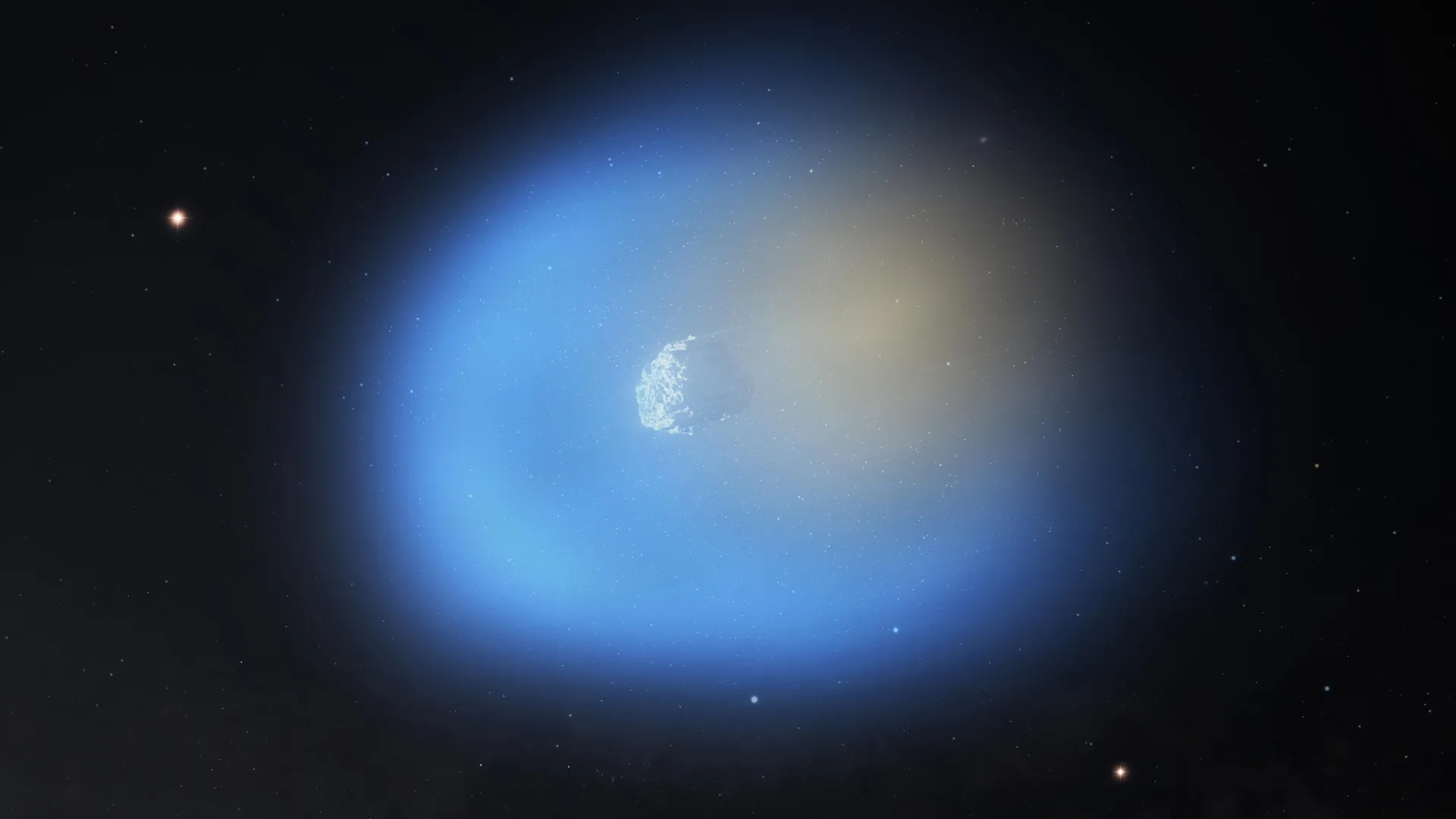
The discovery underscores the profound potential of studying interstellar objects – cosmic travelers that originate beyond the gravitational confines of our Sun – to unlock the chemical diversity of planetary systems across the galaxy. Unlike comets from our solar system, which formed from the same primordial cloud of gas and dust that birthed the Sun and planets, 3I/ATLAS carries a chemical signature from an entirely different stellar neighborhood.
"Observing 3I/ATLAS is like taking a fingerprint from another solar system," shares Nathan Roth, lead author on this groundbreaking research and a professor with American University. His words resonate with the scientific community’s excitement, emphasizing the unique opportunity presented by such an object. "The details reveal what it’s made of, and it’s bursting with methanol in a way we just don’t usually see in comets in our own solar system." This "fingerprint" is not just a list of molecules; it’s a window into the physical and chemical conditions prevalent during the formation of a foreign planetary system, offering a direct comparison to our own cosmic origins.
A Chemical Fingerprint From Another Solar System
The research team meticulously utilized ALMA’s Atacama Compact Array, a subset of the full ALMA observatory specifically designed for wide-field observations, located high in the Atacama Desert of Chile. Their observations of 3I/ATLAS spanned several crucial dates in late 2025 as the comet continued its trajectory closer to the Sun. As the interstellar wanderer drew nearer to our star, the increasing solar radiation began to heat its icy surface. This process, known as sublimation, caused volatile gases and dust particles to escape from the comet’s nucleus, forming a vast, luminous envelope known as a coma around its solid core.
By meticulously analyzing the faint spectral signatures emitted by molecules within this coma, astronomers were able to identify and quantify the chemical makeup of the material carried by the comet. This method is akin to reading a cosmic barcode, where each molecule emits or absorbs light at specific wavelengths, allowing scientists to identify its presence and abundance. Because 3I/ATLAS definitively originated outside our solar system – an interstellar interloper confirmed by its hyperbolic trajectory – these measurements provide an extraordinarily rare opportunity. They allow scientists to investigate the fundamental processes and chemical conditions under which small, icy bodies, the building blocks of planets, may form in another planetary system, all without the daunting challenge of traveling beyond our own cosmic backyard.
The scientists concentrated their efforts on detecting the faint submillimeter signatures of two specific molecules: methanol (CH3OH), a simple type of alcohol, and hydrogen cyanide (HCN), a nitrogen-bearing organic molecule that is a common constituent of comets within our solar system. Both molecules are significant in astrobiology, with methanol being a precursor to more complex organic chemistry, and HCN playing a role in the formation of amino acids. Their presence and relative abundances offer crucial clues about the thermal and chemical history of their parent body.
ALMA’s unparalleled sensitivity and resolution revealed a striking and highly significant finding: 3I/ATLAS contains an unusually high amount of methanol relative to hydrogen cyanide. On two distinct observation dates, researchers measured methanol-to-HCN ratios of approximately 70 and 120. To put this into perspective, typical solar system comets usually exhibit methanol-to-HCN ratios in the single digits or low tens, rarely exceeding 30-40, even in some of the most methanol-rich examples like Comet Hale-Bopp. These elevated values emphatically place 3I/ATLAS among the most methanol-rich comets ever studied, irrespective of their origin. This extreme enrichment immediately signals that its formation environment, or its subsequent evolutionary path, must have differed significantly from that of most comets in our home system.
Unusual Chemistry Points to Different Origins
The compelling measurements strongly suggest that the pristine ice locked within 3I/ATLAS either formed under, or was subsequently exposed to, conditions markedly different from those experienced by the vast majority of comets in our solar system. In our solar system, comets are believed to have formed in the cold, outer reaches of the protoplanetary disk, largely beyond the "snow line," where water and other volatile compounds could condense into ice. The chemical composition of these comets is thought to reflect the conditions of that primordial disk, offering a snapshot of the early solar system.
The unusually high methanol content of 3I/ATLAS hints at a formation environment that might have been colder, denser, or perhaps subjected to different types of radiation (like cosmic rays or stellar flares) that could catalyze the formation of complex organic molecules like methanol more efficiently. Methanol itself is a relatively complex organic molecule, and its abundance in interstellar clouds is well-documented, forming on the surfaces of dust grains in extremely cold conditions. Its preservation in such high quantities within 3I/ATLAS could imply that the comet formed in a region of its home stellar system where it experienced minimal thermal processing, or perhaps in a molecular cloud environment that was particularly rich in the precursors for methanol synthesis.
Adding another layer to its enigmatic profile, earlier observations of 3I/ATLAS conducted with the powerful James Webb Space Telescope (JWST) had already indicated that its coma was dominated by carbon dioxide (CO2) while the comet was still at a considerable distance from the Sun. The new ALMA measurements now significantly bolster this growing list of unusual features in the comet’s overall chemical makeup, adding abundant methanol to the previously observed CO2 dominance. The combination of high CO2 and high methanol suggests a highly volatile and organic-rich composition, painting a picture of a comet that is chemically distinct from its solar system counterparts.
Beyond simply identifying molecules, ALMA’s exceptional high resolution for imaging also provided astronomers with the capability to meticulously track how different molecules are released and travel away from the comet’s nucleus. This level of detail allowed the researchers to observe the spatial distribution and evolution of the outgassing process, revealing critical insights into the physical structure and internal composition of the comet. The observations unveiled a striking and unexpected contrast between the behavior of methanol and hydrogen cyanide.
Hydrogen cyanide, consistent with observations of many solar system comets, appeared to originate predominantly from the comet’s central body, or nucleus. This behavior is considered typical, as the nucleus is the primary reservoir of ice and volatile compounds. As the sun warms the nucleus, the ice sublimates directly from its surface. Methanol, however, presented a more complex and intriguing pattern: it appeared to come from both the nucleus and from numerous tiny ice particles suspended and floating within the extensive coma itself. This bifurcated origin for methanol suggests a more intricate structure within 3I/ATLAS than initially assumed.
Tiny Ice Grains Act Like Mini-Comets
This fascinating observation indicates that these small, icy grains within the coma effectively behave like miniature comets. As 3I/ATLAS approaches the Sun and temperatures inevitably rise, the ice trapped within these ubiquitous grains also begins to turn into gas, or sublimate. This process releases additional methanol directly into the surrounding coma, significantly contributing to the overall methanol abundance observed. This phenomenon of "distributed sources" or "distributed outgassing" is a crucial insight into cometary physics and chemistry. It implies that a significant fraction of the comet’s volatile material, particularly methanol, is not just concentrated in the main nucleus but is also locked within a myriad of smaller icy fragments that are shed or ejected from the nucleus as it becomes active.
Astronomers have, on rare occasions, observed similar distributed outgassing behavior in some comets originating from our own solar system. However, this particular instance marks a monumental first: it is the initial time researchers have been able to trace and characterize the detailed physics of this type of outgassing in an object definitively known to have originated in interstellar space. This distinction is vital because it allows scientists to compare the physical processes occurring in interstellar comets with those in solar system comets, potentially revealing universal mechanisms or, conversely, unique characteristics indicative of their disparate origins.
Comet 3I/ATLAS holds a special place in astronomical discovery, as it is only the third confirmed object ever observed entering our solar system from the vast expanse of interstellar space. Its predecessors were the enigmatic 1I/’Oumuamua, discovered in 2017, and the more comet-like 2I/Borisov, identified in 2019. Each of these interstellar visitors has, in its own way, continued to surprise and challenge astronomers’ preconceptions about extrasolar objects, consistently unveiling unusual characteristics that deviate from the norms established by solar system bodies. ‘Oumuamua, for instance, baffled scientists with its elongated shape and mysterious non-gravitational acceleration, while Borisov displayed a composition that, while generally cometary, also had some distinct differences.
As astronomers continue their vigilant search and examination of more interstellar objects – a field of study that is still very much in its infancy – each new discovery offers yet another invaluable opportunity to directly compare the chemical and physical characteristics of our solar system with those of planetary systems elsewhere in the galaxy. These objects are not merely transient visitors; they are cosmic emissaries, carrying vital clues about the formation and evolution of other stars and their accompanying planets. The highly unusual chemistry of 3I/ATLAS, with its exceptional methanol enrichment and distributed outgassing, is thus adding another profoundly intriguing and complex piece to the ever-expanding broader picture of how planets, comets, and other small bodies form and evolve around distant stars, challenging and refining our existing models of cosmochemistry and astrobiology.
The combination of ALMA’s submillimeter precision and JWST’s infrared capabilities has proven to be a powerful synergistic approach. While JWST provided early insights into the more common volatile components like CO2, ALMA delved into the more subtle, complex organic molecules like methanol and their spatial distribution. This multi-wavelength strategy is crucial for obtaining a comprehensive "chemical fingerprint" of these interstellar visitors. Future observations with even more advanced telescopes and techniques will undoubtedly push the boundaries further, potentially revealing even more complex organic molecules that could be precursors to life, or detailing isotopic ratios that can pinpoint the exact stellar nursery where 3I/ATLAS was born. The continuous discovery and characterization of interstellar objects promise to transform our understanding of cosmic diversity and the prevalence of life’s building blocks across the Milky Way.
