
 By admin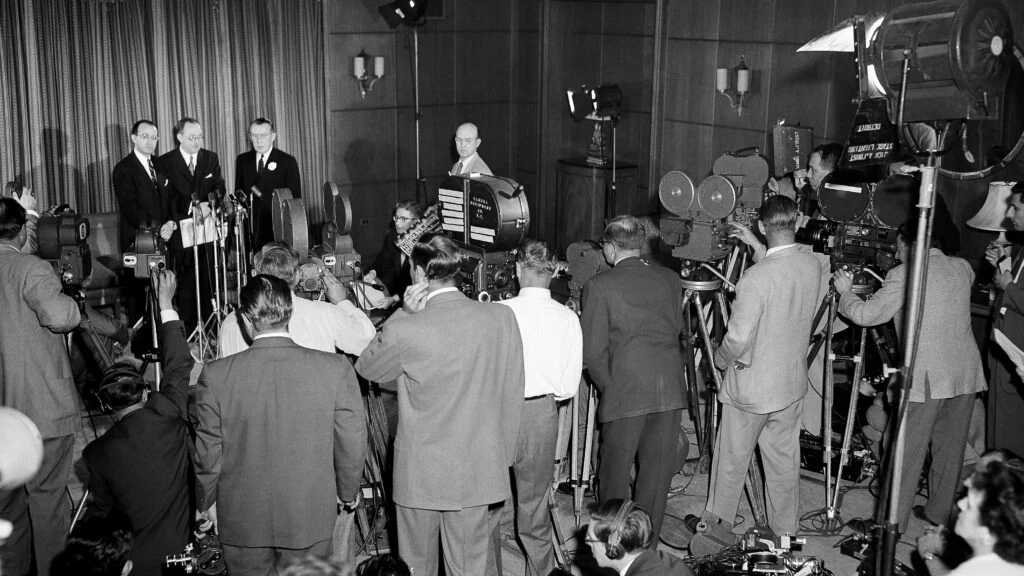
On April 12, 1955, the United States didn’t just witness a medical breakthrough; it threw a nationwide vaccine party. That morning, at the University of Michigan’s Rackham Auditorium, Dr. Thomas Francis Jr.—the man tasked with evaluating the massive field trials of the polio vaccine developed by Jonas Salk—stepped before a microphone to deliver a verdict the entire world had been waiting for. It was not merely a press conference; it was a global event of seismic proportions. Reporters from every major outlet packed the hall, and in an era before digital streaming, the logistics of the announcement were a marvel of mid-century engineering. Tens of thousands of physicians gathered in movie theaters across the country to watch a closed-circuit broadcast of the results, while millions of American families sat motionless around their radios, their breath held in collective anticipation.
The verdict was definitive: the vaccine was safe, effective, and potent. A disease that had paralyzed and killed thousands of children every year, turning summers into seasons of fear and forcing the closure of swimming pools and theaters, had finally met its match. The reaction was visceral and immediate. As historical documentaries later described the scene, factory whistles blew in celebration, school children cheered in their classrooms, and parents wept with the relief of a generation freed from a shadow of terror. Newspapers across the land ran massive, bold-type headlines that simply read “POLIO IS CONQUERED.” Store owners scrawled “Thank you, Dr. Salk” on their windows in white shoe polish. When Dr. Salk eventually took the stage, he was met with a standing ovation so prolonged and thunderous that it cemented his status as a living legend and a secular saint of science.
Fast forward seventy-one years to the late summer of 2026. The landscape of American public health has shifted from one of communal triumph to one of clinical caution and defensive posturing. On September 2, 2026, a coalition of major medical societies released an independent, comprehensive research evaluation covering the latest iterations of flu, COVID-19, and RSV vaccines. Another press conference was held, and once again, the news was objectively excellent: the vaccines remain remarkably safe and continue to provide a robust shield against hospitalization, long-term disability, and death. But this time, there were no factory whistles. There were no cheers in the streets.
Instead of a celebration, the 2026 announcement was a somber exercise in professional restraint. Experts spoke in the measured, sterilized language of "informed decision-making," "shared commitment," and "restoring institutional trust." The American Medical Association (AMA) launched a new digital initiative, but rather than stories of lives saved or communities protected, the website was a repository of technical JAMA articles and downloadable PDF charts. The tone was dour, the mood was clinical, and the energy was nonexistent. The "party" of 1955 had been replaced by a faculty meeting.
As a communications consultant who has spent years in the trenches supporting vaccine advocates, I find the current atmosphere excruciating. Every conversation in the public health sphere feels heavy with defeatism. We are currently witnessing a resurgence of diseases we once thought were relics of the past; measles, once declared eliminated in the U.S. in 2000, has come roaring back due to declining vaccination rates in specific pockets of the country. The Centers for Disease Control and Prevention (CDC), once the gold standard of global health, is struggling with a fractured reputation and internal morale crises. Perhaps most significantly, the political landscape has shifted such that Robert F. Kennedy Jr., a man who has built a career on vaccine skepticism and led organizations that actively undermine immunization efforts, now sits at the helm of the Department of Health and Human Services (HHS).
For those of us on the pro-vaccine side, the daily grind has become a reactive loop of debunking and fact-checking. We spend our hours debating whether to engage with wellness influencers who peddle misinformation or whether such engagement only serves to amplify their reach. We obsessively search for the perfect analogy or the most precise metaphor that might finally break through to a hesitant parent. We take vaccines with the utmost seriousness because, fundamentally, it is a matter of life and death. But in our quest for scientific accuracy and professional gravity, we have forgotten how to celebrate. We have lost the optimism, the excitement, and the sense of belonging that once turned medical progress into a social movement. We have become so wound up in the defense of data that we have sucked the joy out of the miracle.
To understand what we are missing, we must look at how the opposition builds its community. Consider Children’s Health Defense, the organization previously led by Kennedy. While their messaging is often scientifically untethered and dangerous, their understanding of movement-building is masterful. They do not just offer "information"; they offer an identity. They frame their cause as a fight for "health freedom." Their volunteers are not mere "advocates" but "defenders" in an "army of truth." They host book clubs, organize movie screenings, and sell merchandise that allows supporters to wear their beliefs. They encourage people to "grab a couple of friends" and engage in street-level activism. They have created a culture of togetherness, however misguided its foundation may be.
Currently, the pro-vaccine side has no equivalent energy. This is a profound historical irony because communal energy is exactly what allowed the polio vaccine to succeed in the first place. The 1955 announcement was not a top-down decree; it was the culmination of a massive, grassroots effort. More than 1.8 million children participated in the Salk trials. They weren’t just test subjects; they were "Polio Pioneers." They were given keepsake cards and buttons that they wore with pride, many keeping them as cherished mementos for decades. Their parents didn’t just wait for the vaccine; they actively raised the money to fund the research through the March of Dimes, contributing small change that added up to a national victory. It was a shared mission.
The results of that mission were staggering. Within less than a decade of the 1955 "vaccine party," cases of polio in the United States plummeted by 97%. We saw a brief flicker of this same spirit during the early days of the COVID-19 pandemic. In the spring of 2021, vaccination sites were often places of high emotion. I remember receiving my first dose in the parking lot of a Six Flags amusement park, where a symphony of car horns erupted every time a group of people finished their observation period. People posted "vax selfies" on social media and wore "I Got Vaccinated" stickers like badges of honor. States experimented with creative incentives, from million-dollar lotteries to college scholarships and free tickets to Major League Baseball games.
These efforts worked. According to data from the Commonwealth Fund, the COVID-19 vaccination campaign in the U.S. prevented more than 3 million deaths and over 18 million hospitalizations. Yet, as the pandemic became politicized, the enthusiasm curdled. The subsequent backlash seems to have frightened the public health establishment into a crouch. The prevailing wisdom now is to be cautious, clinical, and restrained—to avoid "triggering" the opposition. But this is the wrong lesson. By retreating into a purely academic and defensive posture, we have ceded the emotional high ground.
To reverse the decline in vaccination rates, we must match our seriousness of purpose with a renewed spirit of possibility. We need to give the public—especially those who are unsure—a team they actually feel good about joining. This transformation must begin with the way we talk. In the world of public health messaging guides, you will almost never find an exclamation point. Why? Vaccines are a marvel of human ingenuity! They are incredible! They allow us to hug our grandparents, send our children to school safely, and travel the world without fear. It is time we started acting like we believe in the magic of the science we defend.
Beyond messaging, we need to rethink the "user experience" of vaccination. We should be exploring expanded incentive programs, as pandemic-era data showed that while results were mixed, the potential for increasing uptake through tangible rewards and "gamification" is significant. But the greatest opportunity lies in civic engagement. We should treat vaccination clinics not as sterile medical appointments, but as community milestones.
Imagine a system where health departments recruit "vaccine ambassadors" in the same way election officials recruit poll workers. Cities could match volunteers with elderly neighbors who need rides to clinics. Civic groups, local businesses, and schools could "adopt" a clinic, providing food, music, and a sense of celebration. Students could earn service-learning hours by helping staff information tables. We need to make the act of getting vaccinated feel like a contribution to a larger, joyful cause.
The pro-vaccine side will always have the data and the facts on its side. But facts alone do not move mountains; people do. The greatest successes in the history of immunization were marked by the sound of factory whistles, the honking of car horns, and the cheers of a public that felt it was winning a war against a common enemy. It has gotten far too quiet in our camp. It is time to stop whispering in the face of noise and start making some joyful noise of our own. The health of the nation depends not just on the needle, but on the spirit with which we embrace it.
