
 By Rifan Muazin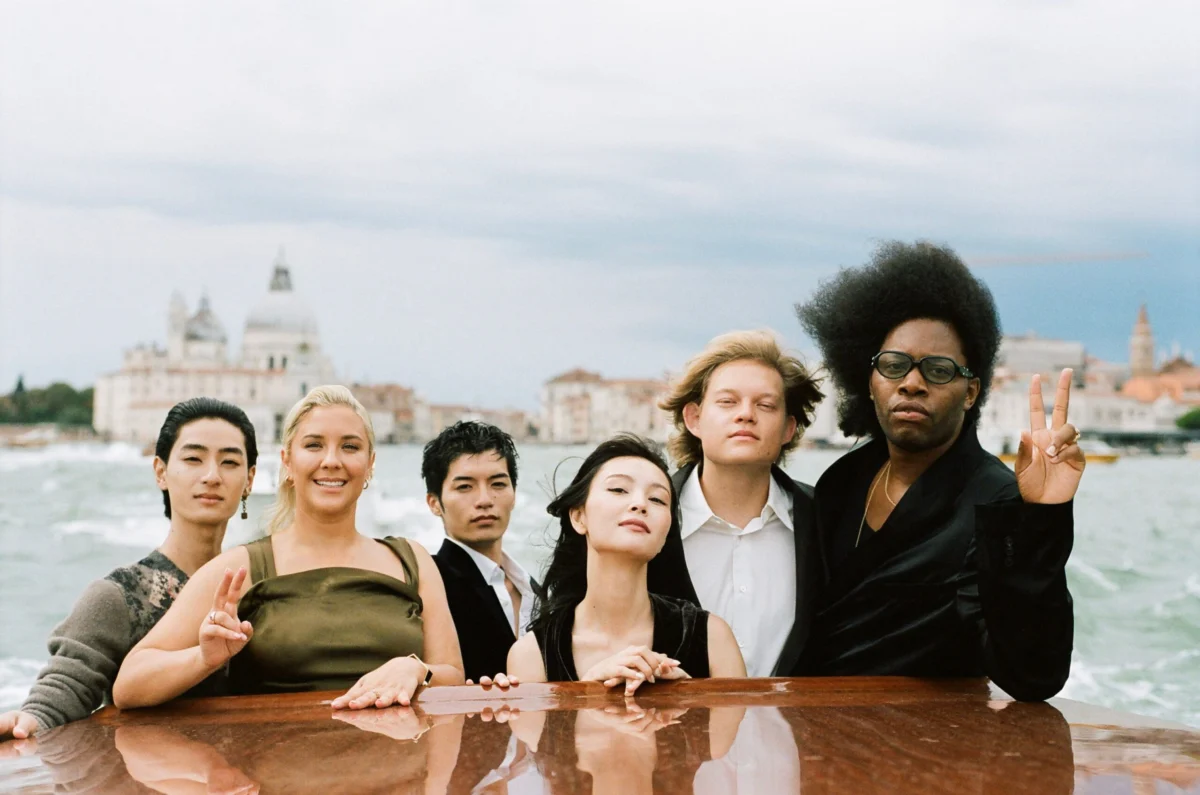
The pair are in town for the prestigious Venice Film Festival premiere of Tera’s feature debut, The Colour of the Sun, a project that has rapidly become one of the most talked-about entries in the festival’s peripheral selections. Produced by Harris alongside Jane Chartier, Stella Savino, and Shogen, the film represents the culmination of a creative journey that began four years ago in the neon-lit sprawl of Tokyo. In 2022, Tera was commissioned to photograph Harris for a GQ Japan feature—a routine editorial assignment that quickly spiraled into a deep intellectual and creative kinship. At the time, Harris was in Japan to oversee the release of his provocative play Daddy, a work that examines the intersections of race, desire, and power.

“Jeremy was in Japan to release his play Daddy,” Tera recalls, reflecting on those early days of their friendship. “So we did that photo shoot and then just hung out for a month. We went to Fuji Rock, the Coachella of Japan, and just traveled around, and that sparked our friendship.” This period of immersion in Japanese culture and the shared experience of the country’s premier music festival laid the groundwork for a partnership built on mutual aesthetic respect. It was during this month of wandering that Tera shared a nascent idea for a film, inspired by a book of portraits he had shot of Okinawan youth for a Marc Jacobs campaign.
The transition from a book of portraits to a feature-length screenplay was not an overnight process. Harris, recognizing the raw potential in Tera’s vision, stepped in as a mentor and collaborator. “He showed me the beginnings of the script and I was like, ‘If there’s any way I can help, let me know,’” Harris says. “So part of our friendship in the years since that initial shoot were these epistolary romance writing sessions. Xavier would send me different drafts and we’d talk about it until we got to the one that we’re at now. It was amazing.” This "epistolary" approach—trading drafts across time zones—allowed the script to marinate, absorbing the distinct voices of both the visual-first photographer and the dialogue-heavy playwright.

The resulting film, The Colour of the Sun, is a lush and sensual coming-of-age story that transcends the tropes of the genre. Filmed entirely on 35mm, the movie possesses a grain and warmth that evokes the humid, sun-drenched atmosphere of Okinawa. However, beneath its beautiful surface lies a rigorous examination of the cross-cultural tensions intrinsic to the island. Okinawa’s history is one of layers and erasures; once the independent Ryukyu Kingdom, it was annexed by Japan in the late 19th century, a move that began a long process of cultural assimilation. Following World War II and the devastating Battle of Okinawa, the island became home to one of America’s largest military installations on foreign soil. Today, while making up only 0.6% of Japan’s landmass, Okinawa hosts approximately 70% of the U.S. military presence in the country.
The Colour of the Sun follows two teenagers—one from the Ryukyu culture and an American living on the military base—as they navigate a relationship fraught with the ghosts of the past. “The backdrop is a little darker,” Tera explains, “because obviously the military brings a lot of issues in Okinawa. So that creates a shadow over this friendship, where we see this generational trauma that comes and changes the perception of these two kids toward each other.” By focusing on the youth of the island, Tera and Harris highlight how geopolitical history is not just found in textbooks, but in the very ways young people interact, love, and view their own futures.

The production’s commitment to authenticity extended to its casting. The film stars Naoto Shimajiri and Yuma Taira, young Okinawans who brought a lived-in reality to their roles. For many of the cast members, the trip to the Venice Film Festival was a series of overwhelming "firsts." Harris recounts a poignant moment at the Venice airport: “Our star, Naoto, was standing at the airport in front of a guy who had a sign with his name on it, and he had no idea that it was for him. He thought we would be there to pick him up.” This innocence and "greenness" provided a sharp contrast to the sophisticated world of international cinema, yet Harris and Tera observed a remarkable transformation once the promotional machine began to whir.
A pivotal moment in this transformation occurred during a fitting for Maison Margiela. The legendary fashion house, led by creative director John Galliano, provided the looks for the cast and crew to wear throughout the festival. “Once they put on the clothes, it was so cool to see how quickly they were able to ease into being movie stars,” Harris says. “There was no hesitation. It was like all of a sudden I saw Yuma just putting her hands like this and standing on the carpet already in her head.” The choice of Margiela was intentional and deeply connected to the film’s visual language. Tera, who first met the Margiela team through his work with GQ Japan, felt the brand’s focus on deconstruction and texture mirrored the film’s 35mm aesthetic. “Margiela has always been so great at pushing for different textures, and the film is very much about that visually,” he notes.

The synergy between the film’s themes and its red-carpet presentation was palpable. Harris views the premiere as a collective performance, a moment where the disparate elements of production—the acting, the cinematography, the fashion—unite. “A movie premiere is a moment when everyone gets to be in a band together,” Harris adds. “You want the band to all show up looking right and playing their parts properly, so you need a designer that is dynamic enough to really show off all of the different colors of the players in your band.” When the crew finally hit the red carpet on Wednesday night, styled with hair and make-up by the renowned Giovanni Errol, they presented a "rock-and-roll" aesthetic characterized by a rich tapestry of velvets, tweeds, and silks.
The industry’s response to The Colour of the Sun has been nothing short of rapturous. Shortly after its premiere, the film was awarded the prestigious FIPRESCI International Critics Prize. The FIPRESCI award, given by the International Federation of Film Critics, is often a harbinger of long-term cinematic relevance, signaling that a film possesses both artistic merit and a unique perspective. For Tera, a first-time filmmaker, this recognition validates his transition from the static world of photography to the narrative complexity of cinema. For Harris, it further cements his reputation as a "kingmaker" and a producer with an unerring eye for global talent.

However, the celebration didn’t end with the awards ceremony. In true Jeremy O. Harris fashion, the premiere was followed by an afterparty designed to disrupt the often-stuffy atmosphere of the Venice Film Festival. Held at the Palazzo de Fiori, the bash was a sensory explosion featuring sake-based cocktails and custom merchandise that paid homage to Okinawan culture. The music was curated by the film’s composers, electronic music heavyweights Nosaj Thing and Jacques Greene, who traded their cinematic scores for high-energy DJ sets.
“We’re throwing the craziest rager ever,” Harris said prior to the event, his excitement infectious. “The one negative I have about the Venice Film Festival? Love it, but no one rages here. Because Venice is a very old city, and I feel like people like to go to bed early. But this is going to be a big house party rager that lasts until the wee hours.” This "house party" ethos is central to Harris’s approach to art—the belief that the most profound creative breakthroughs happen when the boundaries between high art, fashion, and communal celebration are blurred.

As the sun sets over the Venetian lagoons and the echoes of the Palazzo de Fiori party fade, the impact of The Colour of the Sun remains. It is a film that successfully bridges the gap between the indigenous history of the Ryukyu people and the global language of cinema. It also serves as a reminder that in the modern creative economy, a single photo shoot for a magazine like GQ can be the spark that ignites a multi-year, award-winning collaboration. For Xavier Tera and Jeremy O. Harris, the journey from the streets of Tokyo to the red carpets of Venice is just the beginning of a partnership that promises to continue pushing the boundaries of how stories are told and who gets to tell them. Through the lens of 35mm film and the fabric of Maison Margiela, they have captured the vibrant, complicated, and beautiful "colour of the sun."
