
 By admin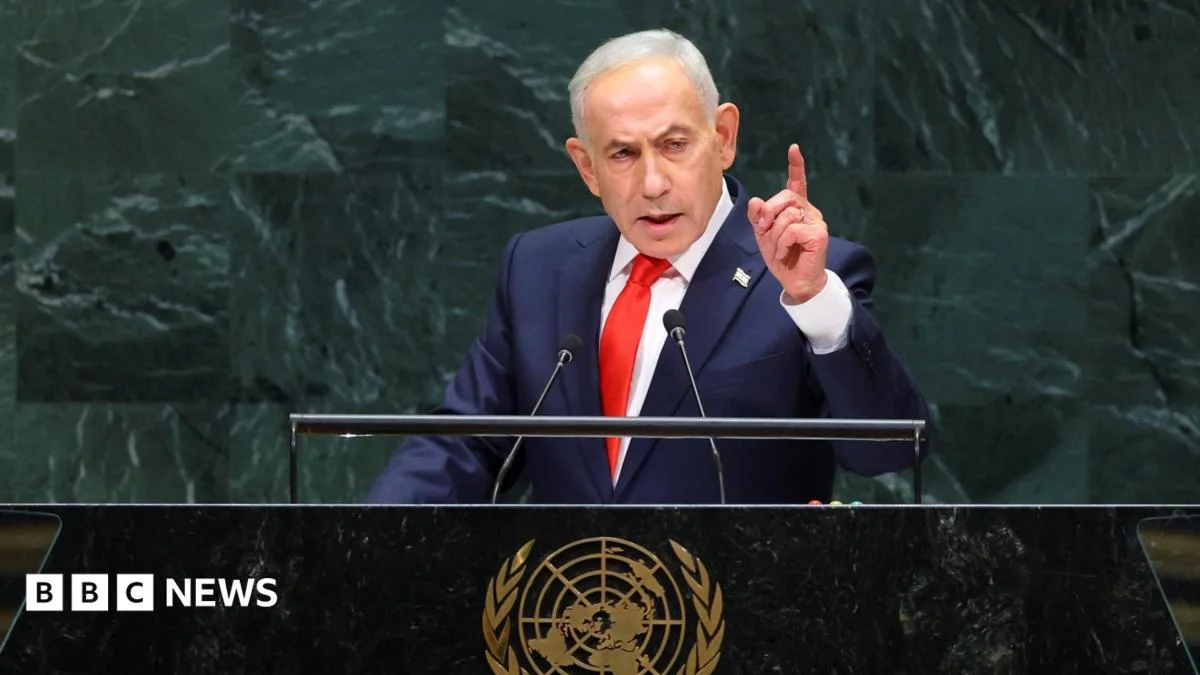
In a fiery address to the United Nations General Assembly, Israeli Prime Minister Benjamin Netanyahu launched a staunch defense of his nation’s military operations across the Middle East, specifically targeting campaigns in Iran, Gaza, and other regional hotspots. The speech, delivered amidst a significant walkout by dozens of delegates who protested his presence on stage, was punctuated by Netanyahu’s defiant vow to continue the fight, declaring, "We’re going to win. We have no other choice." The palpable tension in the hall was further amplified when Netanyahu, in response to the mass departure, provocatively challenged remaining delegates: "If there are any other moral cowards who haven’t left the hall, please do so now."
The Israeli leader’s address came as his government faces intensifying international scrutiny and accusations of war crimes and genocide. Netanyahu vehemently rejected the characterization of Israel’s actions in Gaza as genocide, a claim echoed by Palestinian President Mahmoud Abbas in a prerecorded message delivered hours earlier to the UN. Abbas, addressing the annual gathering via video link after being denied a U.S. entry visa, painted a grim picture of the situation for Palestinians, attributing their plight to Israeli policies, particularly the "illegal expansion of Jewish settlements in the occupied West Bank." He asserted that these policies threatened "the very life and existence of the Palestinian people on their homeland" and jeopardized the viability of the internationally backed two-state solution, a framework designed to achieve lasting peace between Israelis and Palestinians. Abbas further detailed the suffering of Palestinians, citing "killing, destruction, starvation and attempts at displacement, as well as a genocidal war" being waged by the Israeli military in Gaza.
Netanyahu’s speech was not solely a defense of military actions but also a scathing critique of international figures and nations that have voiced criticism of Israel. He specifically targeted those who have labeled Israel as a colonial power, sarcastically remarking, "They accuse Israel, tiny Israel, of colonialism – some colonialism. And who’s accusing us? Among them are people in Britain and in France. For God’s sake, they invented the term." This jab alluded to the historical colonial empires established by European powers, suggesting a hypocrisy in their condemnation of Israel.
Further escalating his rhetoric, Netanyahu singled out Turkish President Recep Tayyip Erdogan, labeling him a "tyrant" and accusing him of actively supporting Hamas, the Palestinian armed group that governs Gaza. This accusation directly challenged Erdogan’s own recent statements at the UN, where he had described the injustices faced by Palestinians in Gaza and the West Bank as deeply offending "the conscience of humanity." The exchange underscored the deep geopolitical rifts and ideological antagonisms surrounding the Israeli-Palestinian conflict.
The Israeli Prime Minister also turned his attention to New York City’s left-wing mayor, Zohran Mamdani. Mamdani had previously expressed an intention to arrest Netanyahu, though he later acknowledged a lack of legal authority to do so. Netanyahu directly addressed this, stating, "Since you were elected mayor of this city, many Jews no longer feel safe in New York." This statement aimed to link Mamdani’s political stance to a perceived rise in antisemitism, a charge that was swiftly rebutted by Mamdani’s office. A spokesperson for the mayor issued a statement asserting that Netanyahu "used his speech to repeat baseless lies meant to sanitize his genocide of Palestinians," reframing Netanyahu’s criticism as an attempt to deflect from alleged Israeli atrocities.
In a notable acknowledgment, Netanyahu expressed gratitude to former U.S. President Donald Trump for his "bold leadership," specifically referencing the joint U.S.-Israel air strikes against Tehran in February. Netanyahu framed this military action as a collaborative effort to "protect ourselves, but to save civilisation," implying a broader existential threat that necessitated such intervention. This statement highlighted the strategic alliance between Israel and the United States under the Trump administration, particularly concerning Iran’s regional influence and nuclear program.
The protests against Netanyahu’s presence in New York City extended beyond diplomatic halls. Several individuals, including acclaimed figures like Oscar-winning actress Susan Sarandon and Emmy-winning actress Hannah Einbinder, were detained by authorities for protesting Netanyahu’s visit. Their detention underscored the deep divisions and strong emotions evoked by Netanyahu’s policies and the ongoing conflict in the Middle East, drawing parallels between global political discourse and local activism.
The context of Netanyahu’s address at the UN General Assembly is crucial for understanding the weight of his words and the reactions they elicited. The UN, established in the aftermath of World War II to prevent future conflicts and promote international cooperation, serves as a global stage for leaders to voice their concerns, negotiate solutions, and engage in diplomatic discourse. However, it also serves as a forum where deeply entrenched conflicts and ideological divides are laid bare. The walkout by delegates, while a symbolic act of protest, reflects a significant portion of the international community’s discontent with Israel’s policies and its military actions in the region.
The accusations of genocide leveled against Israel, particularly concerning Gaza, are rooted in the devastating humanitarian crisis unfolding in the territory. Since the escalation of hostilities, Gaza has faced widespread destruction, a severe shortage of essential resources, and a staggering civilian death toll, primarily among women and children. International bodies, including the International Criminal Court (ICC), have been investigating alleged war crimes committed by both Israeli forces and Palestinian militant groups. Netanyahu’s status as potentially subject to an ICC arrest warrant adds another layer of gravity to his presence and pronouncements at the UN. The ICC’s mandate is to prosecute individuals for the most serious international crimes, including genocide, war crimes, and crimes against humanity, when national courts are unwilling or unable to do so.
The expansion of Israeli settlements in the occupied West Bank, a key point raised by President Abbas, is a long-standing point of contention and a major obstacle to peace. International law, as codified in numerous UN resolutions, considers these settlements illegal and a violation of the Fourth Geneva Convention. Critics argue that the continuous settlement expansion effectively annexes Palestinian territory, fragments Palestinian communities, and undermines the territorial contiguity necessary for a viable Palestinian state under the two-state solution framework. The United States, historically a staunch ally of Israel, has at times expressed reservations about settlement expansion, though its policy has varied across administrations.
The broader geopolitical backdrop of Netanyahu’s speech includes ongoing tensions with Iran, which Israel views as a primary threat due to its nuclear program and its support for regional proxy groups. The joint U.S.-Israel air strikes mentioned by Netanyahu likely refer to operations aimed at disrupting Iranian military infrastructure or influence in Syria or other parts of the region. These actions are part of a complex web of proxy conflicts and direct confrontations that characterize the Middle East’s volatile security landscape.
The criticism directed at figures like President Erdogan highlights the regional rivalries and competing interests that further complicate efforts to achieve peace and stability. Turkey, under Erdogan, has increasingly positioned itself as a champion of the Palestinian cause, often adopting a more confrontational stance towards Israel than some other Muslim-majority nations. This has led to diplomatic friction and public exchanges between the two leaders.
The specific criticism leveled against Mayor Mamdani, while seemingly localized to New York City, speaks to a broader debate about the intersection of domestic politics, international relations, and the perception of safety for Jewish communities. Netanyahu’s assertion that Jews feel less safe in New York under Mamdani’s leadership is a politically charged statement designed to resonate with a particular segment of the electorate and to draw attention to what he perceives as rising antisemitism. However, Mamdani’s response, framing Netanyahu’s speech as an attempt to "sanitize his genocide of Palestinians," indicates a counter-narrative that centers on accountability for Israeli actions.
The detention of protesters, including prominent cultural figures like Susan Sarandon and Hannah Einbinder, further illustrates the polarized environment surrounding the Israeli-Palestinian conflict and the strong emotions it evokes in global centers like New York. These detentions, while potentially stemming from violations of public order, can also be interpreted as an attempt to silence dissent and to control the narrative surrounding Netanyahu’s visit.
In conclusion, Prime Minister Netanyahu’s address at the UN General Assembly was a high-stakes diplomatic event marked by defiance, sharp rhetoric, and a clear defense of Israel’s military posture in the Middle East. The speech not only highlighted the ongoing challenges in resolving the Israeli-Palestinian conflict but also exposed the deep divisions within the international community regarding the conflict’s causes, consequences, and potential solutions. The accusations of genocide, the defense of military actions, and the sharp critiques of international leaders underscore the enduring complexities and the profound human cost of this protracted conflict. The events of the day, from the walkout to the detentions of protesters, served as stark reminders of the potent emotions and entrenched positions that continue to shape the discourse and hinder progress towards a lasting peace.
