
 By admin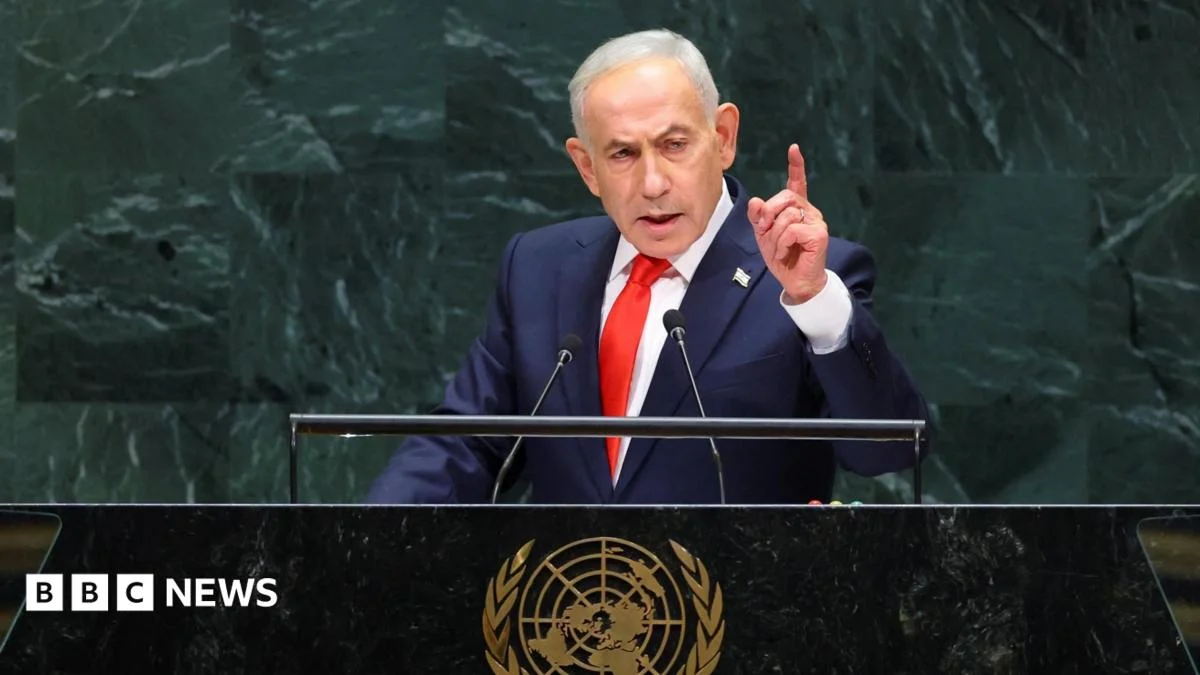
United Nations Headquarters, New York – In a fiery address to the United Nations General Assembly, Israeli Prime Minister Benjamin Netanyahu mounted a robust defense of his nation’s military operations across the Middle East, including in Iran and Gaza, while simultaneously launching sharp critiques against international detractors. The speech, delivered amidst a significant walkout by dozens of delegates, underscored the deep divisions and mounting pressures facing Israel on the global stage.
As Netanyahu took to the podium, a palpable tension filled the hall. The immediate departure of numerous representatives signaled a clear rejection of his presence and, by extension, his government’s policies. Undeterred, the Israeli premier declared his unwavering commitment to ongoing military efforts, asserting, "We’re going to win. We have no other choice." His defiant stance was further amplified by a pointed remark directed at those who had exited: "If there are any other moral cowards who haven’t left the hall, please do so now." This provocative statement, seemingly pre-scripted, was a clear attempt to frame his critics as lacking courage and moral fortitude.
Netanyahu vehemently refuted accusations of genocide in Gaza, a claim that has gained traction among many international observers and human rights organizations. This denial comes as the humanitarian crisis in the besieged Palestinian territory intensifies, with reports of widespread destruction, civilian casualties, and a severe lack of essential resources.
Earlier in the day, Palestinian President Mahmoud Abbas delivered a pre-recorded message to the UN, painting a starkly different picture of the situation. Abbas condemned what he termed Israeli "policies," with a particular focus on the "illegal expansion of Jewish settlements in the occupied West Bank." He argued that these actions posed a direct threat to "the very life and existence of the Palestinian people on their homeland." Furthermore, Abbas asserted that continued settlement activity jeopardized the viability of the two-state solution, a peace framework internationally endorsed as the most feasible path to resolving the Israeli-Palestinian conflict. His address highlighted the dire circumstances faced by Palestinians, citing "killing, destruction, starvation and attempts at displacement, as well as a genocidal war" in Gaza perpetrated by the Israeli military. President Abbas’s inability to address the assembly in person, reportedly due to being denied a U.S. entry visa, further underscored the diplomatic challenges faced by the Palestinian leadership.
The context of Netanyahu’s speech is critical. He faces an International Criminal Court (ICC) arrest warrant for alleged war crimes, a fact that loomed large over his pronouncements. His address was characterized by scathing attacks on nations and leaders who have voiced criticism of Israel. He specifically targeted European powers like Britain and France, questioning their moral authority to accuse Israel of colonialism, ironically reminding them that they were the originators of the term. This rhetorical jab aimed to deflect criticism by highlighting the historical colonial legacies of some of his accusers.
On the contentious issue of settler violence in the West Bank, Netanyahu downplayed its severity, suggesting that "maybe two or three" individuals are killed annually in such incidents. This assertion directly contradicts figures compiled by the United Nations, which indicate that 23 Palestinians have been killed in the context of settler attacks this year alone, and a staggering 72 since the beginning of 2023. These UN figures paint a far more alarming picture of escalating violence and underscore the disparity between Netanyahu’s narrative and documented realities on the ground.
Further escalating international tensions, Netanyahu labeled Turkish President Recep Tayyip Erdogan a "tyrant" and accused him of supporting Hamas. This accusation came in the wake of Erdogan’s own address to the UN, where he decried the "injustices faced by those in Gaza and the West Bank" as deeply offensive to the "conscience of humanity." The Turkish presidency responded swiftly, with communications director Burhanettin Duran stating that Netanyahu’s "baseless accusations" were incompatible with the UN’s "ideals of peace, law and dialogue."
The Israeli Prime Minister also turned his attention to New York City’s left-wing mayor, Zohran Mamdani. Netanyahu accused Mamdani, who had previously expressed an intention to arrest him but later acknowledged lacking the authority, of making Jews feel unsafe in their own city since his election. Mamdani’s office, in turn, issued a statement accusing Netanyahu of using his speech to disseminate "baseless lies meant to sanitize his genocide of Palestinians." This exchange highlights the increasing politicization of the conflict, even at the municipal level in major global cities.
Adding another layer to the complex geopolitical dynamics, Netanyahu expressed gratitude to former U.S. President Donald Trump for his "bold leadership," specifically referencing joint U.S.-Israeli air strikes against Iran in February. Netanyahu framed these actions as a joint effort "not only to protect ourselves, but to save civilization," a statement that positions Israel and its allies as defenders of global order against perceived existential threats.
The strategic intent behind Netanyahu’s UN address was multifaceted, primarily targeting two crucial audiences: the Israeli electorate, ahead of a critical election next month, and the American public and political establishment, as Israel grapples with growing international isolation and waning support. Domestically, Netanyahu’s long-standing image as "Mr. Security" has faced unprecedented challenges in the wake of the October 7th attacks. His political opponents have capitalized on Israeli media reports, which he denies, suggesting he disregarded intelligence warnings about a potential Hamas assault. His characteristic defiance at the UN is likely to be a central theme in his campaign, aiming to reassert his image as the indispensable leader capable of confronting Israel’s global critics. The pre-scripted nature of his remarks regarding "moral cowards" suggests a calculated effort to generate memorable soundbites for his domestic political base.
For his American audience, Netanyahu’s speech contained clearly delineated messages, including the emphasis on joint military actions with the U.S. and his praise for Trump. Having spent his formative years in Pennsylvania, Netanyahu has consistently sought to portray himself as uniquely positioned to articulate Israel’s case to an American audience. However, despite continued U.S. military aid, public opinion in America is increasingly divided. Polls indicate a significant decline in support for Israel among Democrats, and even within the Republican party, historically a staunch ally, fractures are appearing, particularly among the Trump-aligned MAGA base. This suggests that Netanyahu’s traditional appeals may be losing traction in a shifting American political landscape.
The backdrop to Netanyahu’s UN address is a region in flux, with ongoing conflicts and shifting alliances. The military campaigns he defended are deeply controversial, raising serious questions about proportionality, civilian casualties, and adherence to international law. While Netanyahu presented a defiant front, his speech illuminated the significant diplomatic and political challenges Israel faces. The walkout, the accusations of genocide, the condemnation from leaders like Erdogan, and the shifting sands of international public opinion all point to a period of intense scrutiny and potential isolation for Israel. The coming months will likely see continued efforts by Netanyahu to rally domestic and international support, while his critics will undoubtedly intensify their calls for accountability and a re-evaluation of Israeli policies in the occupied territories and beyond. The UN General Assembly, often a stage for diplomatic pronouncements and protests, served as a potent microcosm of these global tensions, highlighting the profound disagreements over the path to peace in the Middle East.
