
 By Titik Puspa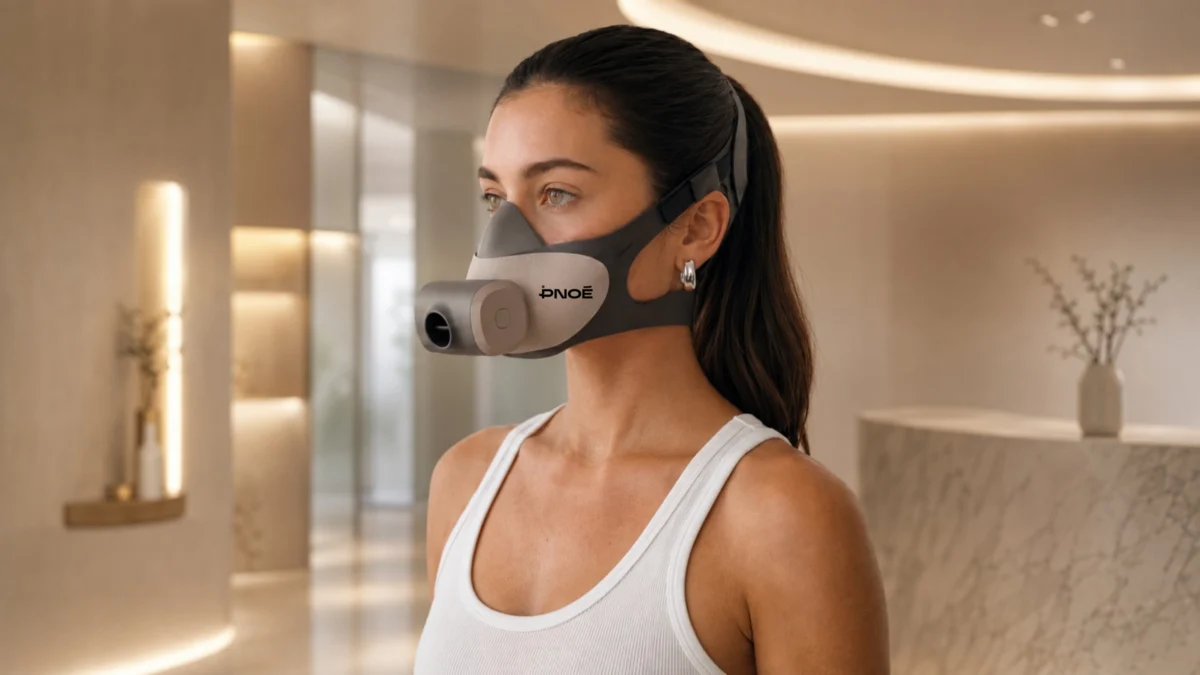
At first glance, the newest device from PNOë might evoke images from a superhero saga, its sleek, mask-like design reminiscent of the formidable Bane, Batman’s iconic adversary. However, this striking appearance belies a profoundly benign and groundbreaking purpose: to decipher the intricate language of human breath. The mask, designed to cover the nose and mouth and secure comfortably around the back of the head, meticulously measures an individual’s oxygen consumption and carbon dioxide exhalation. This vital data is then transformed into personalized recommendations, offering insights into optimal nutrition, exercise regimens, and, the company’s ultimate aspiration, a pathway to a longer, healthier life.
PNOë, a dynamic company with its headquarters in Malden, Massachusetts, and significant operations in Athens, Greece, is on the cusp of launching its highly anticipated PNOë 2.0 on October 1st. The most transformative advancement in this new iteration is its self-administered testing capability. According to Apostolos Atsalakis, co-founder and CEO, the process is remarkably simple: "Someone can walk into a gym, just wear the mask, push the button, sit down, and breathe for eight minutes. That’s it. It’s that easy," he explained during a recent Zoom conversation from the company’s Athenian hub. This ease of use is a critical differentiator, addressing a key limitation of their current device, which requires a trained professional to operate. This self-serve model promises to democratize access to metabolic insights, extending its reach beyond specialized sports labs and hospitals to fitness centers lacking dedicated staff, and potentially even to pharmacies, thereby broadening its impact on public health and wellness.
The scientific underpinnings of PNOë’s technology are not novel; in fact, metabolic testing, the analysis of breath gases to understand the body’s energy production mechanisms, has been a cornerstone of physiological research for over a century. For decades, it has been recognized as the gold standard for determining VO2 max, a crucial metric representing the maximum oxygen uptake during exercise, and a widely accepted indicator of cardiorespiratory fitness. Historically, however, these tests have been constrained by bulky, expensive equipment, confining them largely to elite athletes and exclusive executive wellness programs. PNOë’s innovation lies in its ability to distill this complex science into a portable, user-friendly package, complemented by sophisticated software that translates raw data into actionable advice. "We made it accessible to everyone," Atsalakis emphasized, highlighting the company’s mission to democratize advanced health diagnostics.
The PNOë test goes beyond simply measuring VO2 max, capturing an impressive 23 biomarkers. These include vital indicators such as resting metabolic rate, which quantifies the number of calories the body burns at rest, and metabolic flexibility, a measure of how efficiently the body switches between utilizing fat and carbohydrates for energy. Atsalakis argues that these metrics offer a more comprehensive understanding of an individual’s metabolic health than traditional blood tests, answering critical questions about calorie needs and optimal training strategies.
The timing of PNOë’s innovation aligns perfectly with the burgeoning interest in longevity. VO2 max has emerged as a significant buzzword within the longevity community, fueled by compelling research linking higher cardiorespiratory fitness to reduced mortality rates. Atsalakis firmly believes that VO2 max is the most potent predictor of human lifespan, positioning PNOë’s data as a valuable scorecard for the rapidly expanding wellness industry.
The PNOë 2.0 is a testament to thoughtful design and engineering. It is notably smaller and more compact than its predecessor, featuring a streamlined design with fewer components, which Atsalakis states enhances its reliability. The development process involved extensive collaboration with Milan-based Design Group Italia, undertaking numerous iterations to perfect a self-administered metabolic testing device, a concept that had not been previously realized. Furthermore, the PNOë 2.0 addresses a pertinent concern in the post-pandemic era: hygiene and shared use. The device is ingeniously designed so that its electronics detach from the silicone mask and straps. This allows for the cost-effective sharing of the hardware among multiple users, with each individual retaining their own personal, easily cleanable mask, ensuring both safety and accessibility.
Despite its advanced clinical capabilities and the profound health insights it offers, PNOë maintains a careful stance on its claims. The device has not yet received clearance from the U.S. Food and Drug Administration (FDA), and Atsalakis is explicit: "We do not provide medical recommendations." PNOë positions itself firmly within the wellness sector, drawing parallels to body composition devices or scales. "It’s like a body composition device, like a scale," he explained. "A doctor cannot prescribe medication based on our results." This distinction is crucial, emphasizing that PNOë is a tool for personal insight and optimization rather than a diagnostic medical device.
However, the potential for future clinical applications is significant. Researchers have long investigated the possibility of identifying disease markers, such as early indicators of cancer, within human breath. Atsalakis envisions that PNOë’s ever-growing repository of breath data could eventually contribute to flagging potential health issues. He acknowledges, however, that the realization of such diagnostic capabilities is "definitely a couple of years away," with regulatory hurdles likely extending this timeline considerably. "We’re not there yet," he stated candidly.
The genesis of PNOë can be traced back to Atsalakis’s doctoral research in sensing technologies at the University of Cambridge. During a period when wearable technology was gaining traction, he became captivated by the potential of breath analysis to reveal intimate details about the human body. He subsequently co-founded the company with Panos Papadiamantis, a childhood friend who now serves as the company’s Chief Product Officer.
The startup gained early traction by participating in Y Combinator’s Winter 2019 cohort, a time when the concept of "longevity" was not yet the burgeoning industry it is today. Since then, PNOë has secured approximately $22 million in funding, including a recently closed $11 million round. Notable investors include 50 Years and Lars Rasmussen, co-founder of Google Maps, who is now based in Athens, underscoring the growing interest in PNOë’s vision.
PNOë’s business model focuses exclusively on B2B sales, with businesses then offering the PNOë test to their clientele. Their current roster of clients reads like a who’s who of the wellness and sports world, including Equinox, where the device is available in nearly all of its clubs, Four Seasons hotels, Red Bull, the NBA, the Mount Sinai Health System, and the popular med spa chain Restore Hyper Wellness. This diverse client base highlights the broad applicability of PNOë’s technology across various consumer-facing industries.
Geographically, approximately 85% of PNOë’s business originates from the United States, a market Atsalakis describes as "by far the most advanced market globally" for longevity-focused solutions. The company is actively pursuing international expansion, extending its reach into Europe and, through strategic partnerships, into Latin America and Asia.
For its business clients, PNOë offers a comprehensive subscription package, ranging from $400 to over $1,000 per month. This "business in a box" solution encompasses the hardware, software, essential training for staff, and marketing materials, enabling businesses to seamlessly integrate PNOë’s offering. A key feature of PNOë’s platform is its ability to link test results to the specific services a business provides. This allows gyms, spas, and wellness centers to offer personalized recommendations for their offerings based on a customer’s unique metabolic profile. Many clients utilize the PNOë test during the initial onboarding process for new customers, positioning it as a sophisticated assessment that bridges the gap between the estimations provided by smartwatches and a comprehensive clinical examination.
The market for personal health and performance tracking is becoming increasingly competitive. Major players like Apple, Garmin, and Whoop are leveraging heart-rate data to estimate VO2 max, while consumer devices such as Lumen utilize breath analysis to assess fat and carbohydrate utilization. At the higher end of the spectrum, traditional metabolic cart systems continue to be the benchmark in laboratory and hospital settings. PNOë differentiates itself by offering a blend of scientific accuracy, portability, and user-friendliness, all within a more accessible price point than traditional clinical equipment.
With a dedicated team of 110 employees, PNOë reports recent profitability and sustained growth exceeding 100% annually. Atsalakis indicates that the company is planning to seek Series B funding within the next six to twelve months. This strategic capital infusion will be crucial for scaling operations and, despite the initial comparisons to comic book villains, placing their innovative mask in front of a significantly larger global audience, further democratizing access to personalized longevity insights.
