
 By Lina Irawan
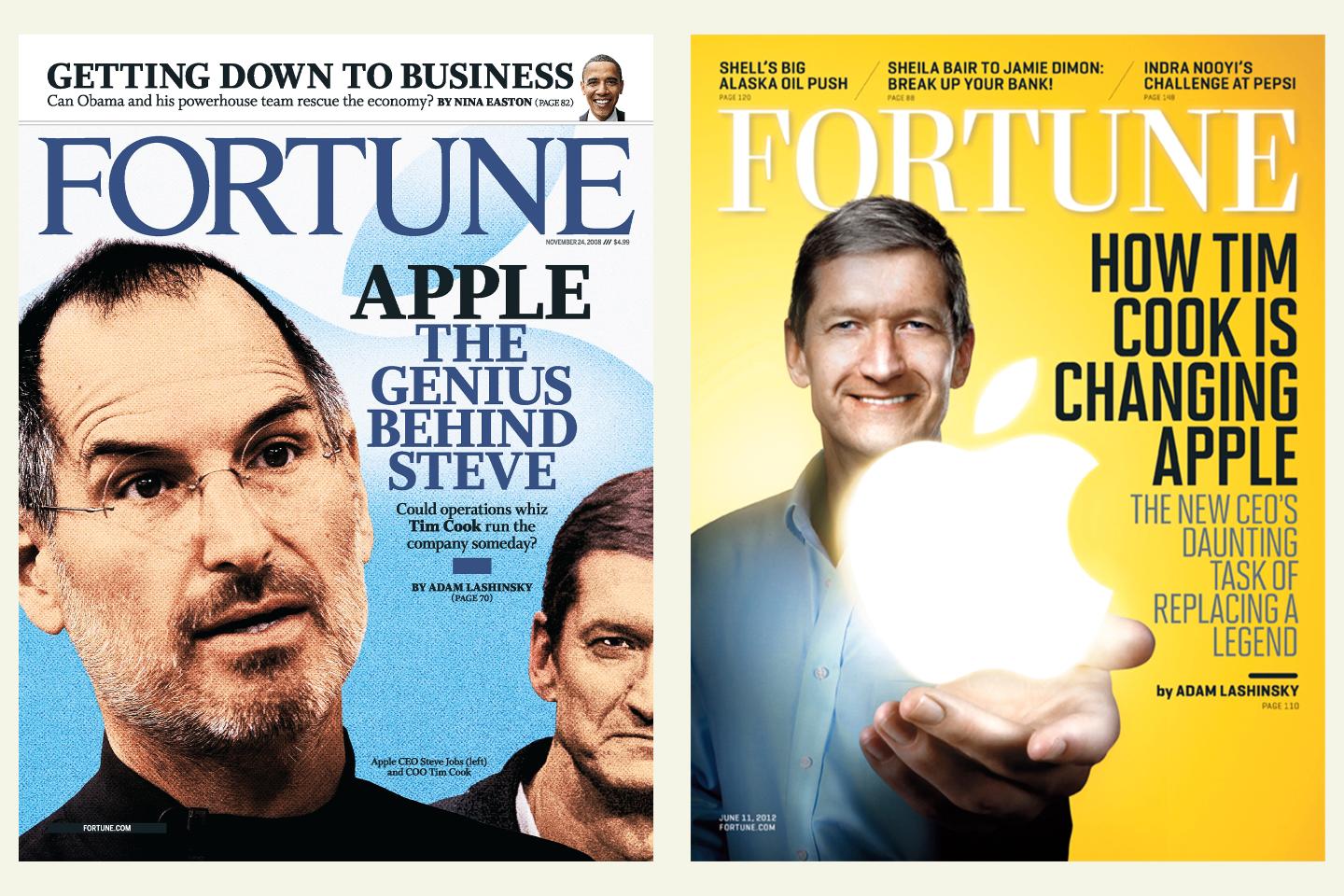
When Fortune first put Tim Cook on its cover in 2008, senior writer Adam Lashinsky introduced him as the “under-the-radar guy” who might someday succeed Steve Jobs as Apple CEO—a “genius” and an “operations whiz,” but also a “blank slate” to outsiders. This initial portrayal, now viewed through the lens of history from 2026, appears remarkably prescient, yet it barely scratches the surface of the profound transformation Apple’s current leader would undergo and orchestrate. Cook himself, famously modest and deeply loyal to his mentor, resisted the notion then: “Come on, replace Steve? No. He’s irreplaceable.” Yet, the ensuing years would demonstrate not only his capacity to lead one of the world’s most iconic companies, but to redefine its trajectory, making it richer, bigger, and more expansive than even its legendary co-founder might have imagined.
To truly appreciate Tim Cook’s ascent, one must rewind to Apple’s precarious position in the late 1990s and its miraculous resurgence under Steve Jobs. When Cook joined Apple in 1998 from Compaq, the company was just beginning its incredible turnaround. Jobs, newly returned, tasked Cook with overhauling Apple’s notoriously inefficient supply chain. Cook, with his meticulous attention to detail and relentless pursuit of optimization, famously shut down Apple’s numerous factories and warehouses, establishing a lean, just-in-time manufacturing process that became the envy of the industry. He drastically cut inventory from months to mere days, saving the company billions and making it possible to deliver products like the iMac and later the iPod and iPhone with unprecedented speed and scale. This operational mastery was the bedrock upon which Jobs’s creative visions could be built. He was the silent engine, the strategic backbone, enabling Apple to innovate at an accelerated pace while maintaining healthy margins. By the mid-2000s, as the iPod dominated music and the iPhone began its revolution, Cook’s role as Chief Operating Officer became indispensable, making him the obvious choice to step in whenever Jobs’s health issues necessitated a leave of absence. The 2008 Fortune article, therefore, wasn’t just speculation; it was a recognition of a quiet power consolidating behind the scenes.
The period between 2008 and 2011 was a crucible for Apple and for Cook. Jobs’s public health struggles grew more pronounced, and Cook increasingly took the reins of daily operations, demonstrating his capability to keep the behemoth moving forward. When Jobs finally stepped down as CEO in August 2011, naming Cook as his successor, the tech world held its breath. The announcement was met with a mix of respect for Cook’s operational genius and profound skepticism about whether anyone could fill Jobs’s shoes as the company’s visionary product architect. Analysts wondered if Apple’s innovative spark would dim without its charismatic leader. The tragic passing of Steve Jobs just weeks later, in October 2011, amplified these concerns, casting an immense shadow over Cook’s nascent tenure. The pressure was unimaginable.
Lashinsky returned to Cupertino in 2012, just six months into Cook’s tenure, and found a CEO “in complete control.” This wasn’t merely a statement of corporate authority; it signified Cook’s rapid and confident assertion of leadership. While he consistently paid homage to Jobs’s legacy, understanding the profound reverence the company and its customers held for the founder, Cook also made it clear that he wouldn’t apologize for charting a new course. This "new course" was subtly but significantly different from the Jobs era. Where Jobs was often seen as the singular genius, driving product development through intuition and often confrontational demands, Cook adopted a more collaborative, systems-oriented approach. He empowered his executive team, trusting their expertise in their respective domains, from software to design to marketing.
One of Cook’s immediate impacts was a deepened focus on operational excellence, an area he had already mastered. He fine-tuned Apple’s supply chain further, ensuring global scale and efficiency that would be crucial for future product launches. He also began to subtly shift Apple’s strategic priorities. While product innovation remained paramount, Cook increasingly emphasized values that he felt were critical for a global technology leader. Privacy, environmental sustainability, and human rights in the supply chain became central tenets of Apple’s public identity under his leadership, a clear departure from Jobs’s almost exclusive focus on product and user experience. This ethical stance, articulated clearly and consistently by Cook, began to resonate with a growing segment of consumers and investors, differentiating Apple in an increasingly competitive and scrutinized tech landscape.
By 2015, when Lashinsky visited again, the transformation was undeniable. Under Cook, Apple had become "richer, bigger, and more expansive in its ambitions." Financially, the numbers spoke for themselves. Apple’s market capitalization, already significant under Jobs, soared under Cook, eventually reaching unprecedented milestones, becoming the first company to hit $1 trillion, then $2 trillion, and even briefly $3 trillion. This wasn’t just organic growth; it was the result of strategic diversification and meticulous financial management. Cook significantly expanded Apple’s share buyback programs and initiated a dividend, returning billions to shareholders and demonstrating a mature, responsible approach to corporate finance that Jobs, focused on growth at all costs, had largely eschewed.
Product-wise, Cook didn’t shy away from new categories. The Apple Watch, launched in 2015, marked Apple’s first major new product line since the iPad. Despite initial skepticism, the Watch evolved into a dominant player in the wearables market, becoming a critical platform for health and fitness monitoring. This was followed by the wildly successful AirPods, which transformed the wireless earbud market. Beyond new hardware, Cook spearheaded a massive pivot towards services. Recognizing the growing saturation of the smartphone market, he began to emphasize recurring revenue streams from the App Store, Apple Music (launched 2015), iCloud, and later Apple TV+, Apple Arcade, and Apple Fitness+. This services strategy proved incredibly successful, with services revenue growing exponentially, providing a stable, high-margin counterpoint to hardware sales and fundamentally changing Apple’s business model. From just over $20 billion in 2015, Apple’s services revenue had more than quadrupled by the early 2020s, solidifying its status as a software and content giant, not just a hardware innovator.
The observation from an Apple executive in 2015, "He never tried to be Steve. He tried to always be himself," encapsulates the essence of Cook’s success. He understood that imitation would be a disservice to both Jobs’s legacy and his own leadership potential. Jobs was a whirlwind of creative energy, often described as an "ideas man" with a penchant for dramatic reveals and a perfectionist’s eye for design. Cook, by contrast, emerged as the "calm pragmatist"—a leader whose strength lay in strategic execution, methodical planning, and an unwavering focus on efficiency and scalability. His public persona was understated, analytical, and thoughtful, a stark contrast to Jobs’s often combative and charismatic style. This allowed Apple to mature from a founder-driven startup into a global corporate powerhouse, capable of navigating complex geopolitical challenges, antitrust scrutinies, and global supply chain disruptions with remarkable resilience.
Looking back from 2026, Tim Cook’s tenure has not just sustained Apple; it has propelled it into new dimensions of influence and profitability. He navigated the company through the iPhone’s mature phase, expanded its ecosystem exponentially with wearables and services, and laid the groundwork for future categories like augmented and virtual reality, culminating in the groundbreaking Apple Vision Pro. His commitment to privacy, environmental responsibility, and ethical manufacturing has not only enhanced Apple’s brand but has also set new benchmarks for corporate responsibility in the tech industry.
Tim Cook’s journey from the "under-the-radar guy" to a visionary leader in his own right is a testament to the power of authentic leadership and strategic evolution. He took the reins of a company built on revolutionary products and a singular vision, and through calm pragmatism, operational mastery, and a deep-seated commitment to values, he expanded its empire and solidified its future. The October/November 2026 issue of Fortune fittingly titles its retrospective "Becoming Tim Cook," a recognition that his ascent was not merely a succession, but a profound transformation of both the leader and the company he now defines.
