
 By Titik Puspa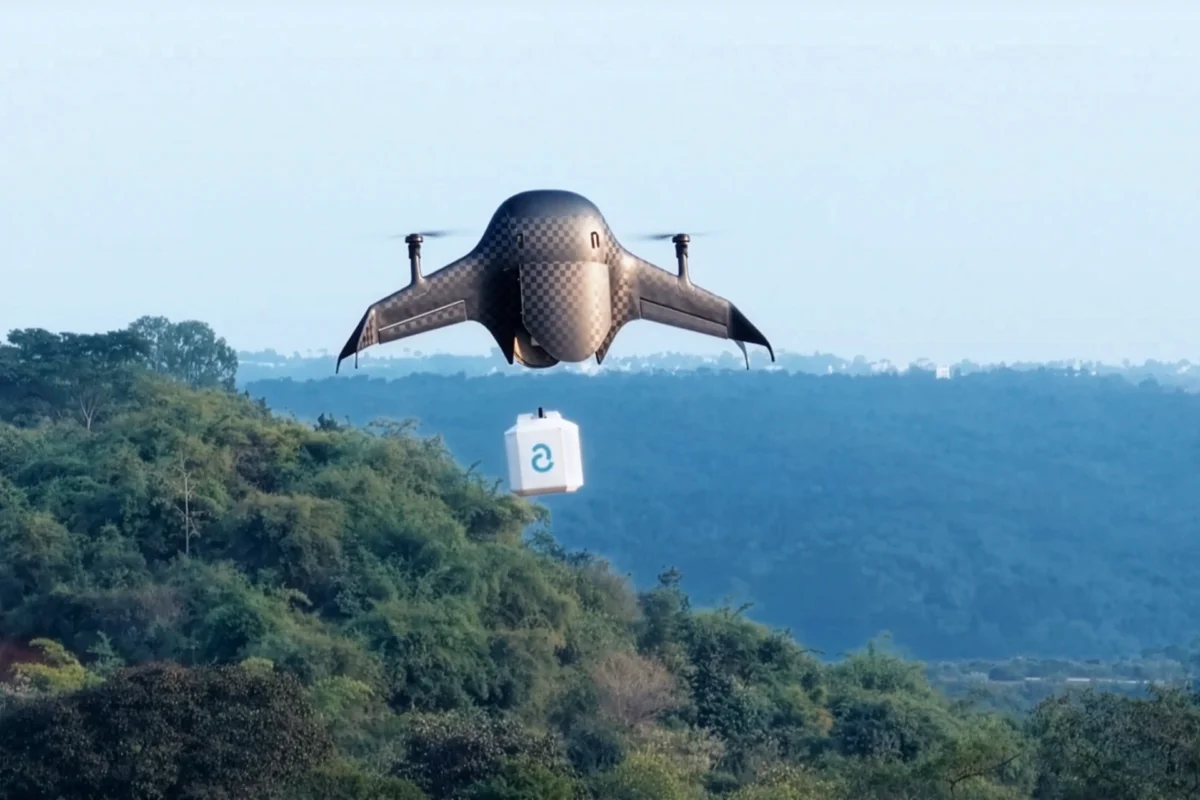
Indian startup Airbound, at the forefront of developing autonomous drone technology, has successfully raised a substantial $37 million in a Series A funding round. This significant capital infusion is earmarked to propel the company’s ambitious mission of making aerial goods transportation as economically viable as traditional trucking. The funding round was spearheaded by Greenoaks, with crucial participation from industry heavyweights including DoorDash, Lachy Groom, Lightspeed, and Humba Ventures. This latest financial achievement follows closely on the heels of Airbound’s $8.65 million seed round, secured less than a year ago, bringing the three-year-old startup’s total funding to nearly $50 million.
The burgeoning field of drone delivery, though promising, has historically grappled with the challenge of matching the scale, versatility, and cost-effectiveness of established road-based logistics. Startups like Airbound, however, contend that drones possess the inherent capability to transport specific types of goods faster and more affordably than conventional vehicles. Airbound is proactively addressing the existing limitations by fundamentally redesigning its aircraft, with the explicit goal of making aerial transport a competitive alternative to ground transportation.
A primary hurdle in conventional aerial logistics is the significant energy expenditure dedicated to an aircraft’s own weight, rather than its payload. This inherent inefficiency translates into higher operational costs, particularly for the transportation of smaller loads. Airbound’s innovative solution, as articulated by its founder and CEO Naman Pushp, lies in the development of vertical-flight drones engineered to be lighter than the cargo they are designed to carry. This radical approach prioritizes payload efficiency, a critical factor in achieving cost parity with trucking.
Pushp elaborated on the specifics of Airbound’s drone technology, highlighting the capabilities of its current model, the TRT. This drone weighs approximately 3.3 pounds and is capable of carrying a payload of around 2.2 pounds. The company is not resting on its laurels, however, as an enhanced next-generation version is currently under development. This upcoming iteration is projected to weigh about 6.6 pounds but will boast an impressive carrying capacity of up to 11 pounds, indicating a significant leap in payload efficiency and overall performance.
The design philosophy behind Airbound’s drones is rooted in a unique "tail-sitter" configuration, reminiscent of rocket technology. This design allows the drones to take off and land vertically in an upright stance, transitioning seamlessly to horizontal flight once airborne. Crucially, Pushp emphasized that Airbound intends to maintain its vertical takeoff and landing (VTOL) capabilities even as it scales up its aircraft to larger sizes. This commitment to VTOL technology eliminates the reliance on traditional runways, vastly expanding the operational flexibility and accessibility of its drone network, especially in diverse geographical settings.
"We want to build towards a world where everything has cost parity with trucking," Pushp stated, underscoring the ambitious economic target that drives Airbound’s innovation. This vision is not merely theoretical; the company has already accumulated significant operational experience. Since its inception in 2023, Airbound has successfully completed over 13,000 autonomous flights across the southern Indian cities of Bengaluru and Guntur. A particularly impactful deployment involves more than 1,000 flights in partnership with Narayana Health, a prominent Indian hospital network. In this critical application, Airbound’s drones are employed to transport diagnostic samples between various healthcare facilities, a service that has demonstrated tangible benefits in terms of speed and efficiency.
The Narayana Health collaboration serves as a compelling case study for the practical advantages of Airbound’s drone delivery system. On a specific Narayana route, a single active drone facilitates the transport of diagnostic samples over a distance of approximately 2.5 miles in roughly seven minutes. This stands in stark contrast to the logistical complexities and time delays associated with traditional road transport. Pushp highlighted that the same samples, when moved by truck, can take anywhere from three to five hours to reach their destination, largely due to the time required to accumulate sufficient samples for a consolidated road shipment and the inherent traffic delays.
This successful partnership is poised for expansion, with plans to integrate Airbound’s drone services with Narayana Health’s new Banashankari hospital in Bengaluru. This facility has been strategically designed without an on-site diagnostic lab or blood bank, a forward-thinking approach that will rely heavily on Airbound’s drone network to ensure seamless connectivity with centralized medical facilities for critical sample and supply transfers.
Beyond its healthcare applications, Airbound is charting a course for a far more expansive vision: the establishment of a comprehensive drone delivery network connecting three cities within the state of Andhra Pradesh. The company has already formalized this ambition through an agreement with the state government, setting an ambitious long-term target of facilitating 10,000 flights per day. This extensive network is intended to serve a wide array of sectors, including retail, e-commerce, and healthcare deliveries. Achieving this daily flight volume is projected to require a fleet of between 250 and 1,000 aircraft, with Pushp anticipating the need to be closer to the lower end of that spectrum, contingent on the optimization of route lengths and delivery densities.
It is important to note that the agreement with the Andhra Pradesh government does not involve any direct government contracts or subsidies. Instead, the state government is actively collaborating with Airbound to develop the necessary regulatory framework that will underpin the operation of such an extensive drone network. Airbound anticipates generating revenue through businesses that leverage its delivery infrastructure, positioning itself as a vital enabler of future logistics solutions.
The competitive landscape in India’s aerial logistics sector is increasingly dynamic. Several other Indian startups, including Skye Air Mobility and TSAW Drones, are actively building their own aerial logistics businesses. Furthermore, established Indian drone manufacturers like Garuda Aerospace have also explored and invested in delivery use cases. However, Pushp distinguishes Airbound’s strategic focus by emphasizing its ambition to develop the fundamental aircraft technology that other logistics networks can eventually utilize, rather than solely aiming to become the largest delivery operator. He drew an insightful analogy, stating, "That’s the Boeing role – the aircraft airlines everywhere rely on, not the airline itself." This positioning suggests a long-term strategy focused on becoming a foundational technology provider in the drone delivery ecosystem.
Airbound designs and manufactures its cutting-edge aircraft in-house at a sprawling 43,000-square-foot facility located in Bengaluru. This integrated approach allows the company to maintain meticulous control over the airframe and other core systems. While Pushp chose not to disclose specific figures regarding production capacity or the total number of aircraft manufactured to date, he expressed confidence that manufacturing scalability will not pose a bottleneck as Airbound expands its operations.
Conversely, Pushp identified regulatory hurdles as the more significant challenge to Airbound’s growth trajectory. The primary obstacle lies in securing approvals for Beyond Visual Line of Sight (BVLOS) operations. BVLOS certification is paramount for the large-scale operation of delivery networks, as it permits drones to fly beyond the direct visual observation of an operator, enabling longer-range and more efficient missions. These regulatory constraints have, in turn, impacted Airbound’s ability to translate its extensive flight operations into significant commercial revenue. Consequently, despite employing a dedicated team of over 150 professionals, the startup remains broadly pre-revenue.
Addressing the company’s current financial status and future outlook, Pushp stated, "The goal is to be a giant in a few decades, not to make revenue as soon as we can." This long-term perspective highlights Airbound’s strategic commitment to foundational development and market establishment, prioritizing sustainable growth and technological leadership over immediate profitability. The substantial Series A funding provides the runway and resources necessary to pursue this ambitious vision, positioning Airbound as a key player in the transformative future of aerial logistics.
