
 By admin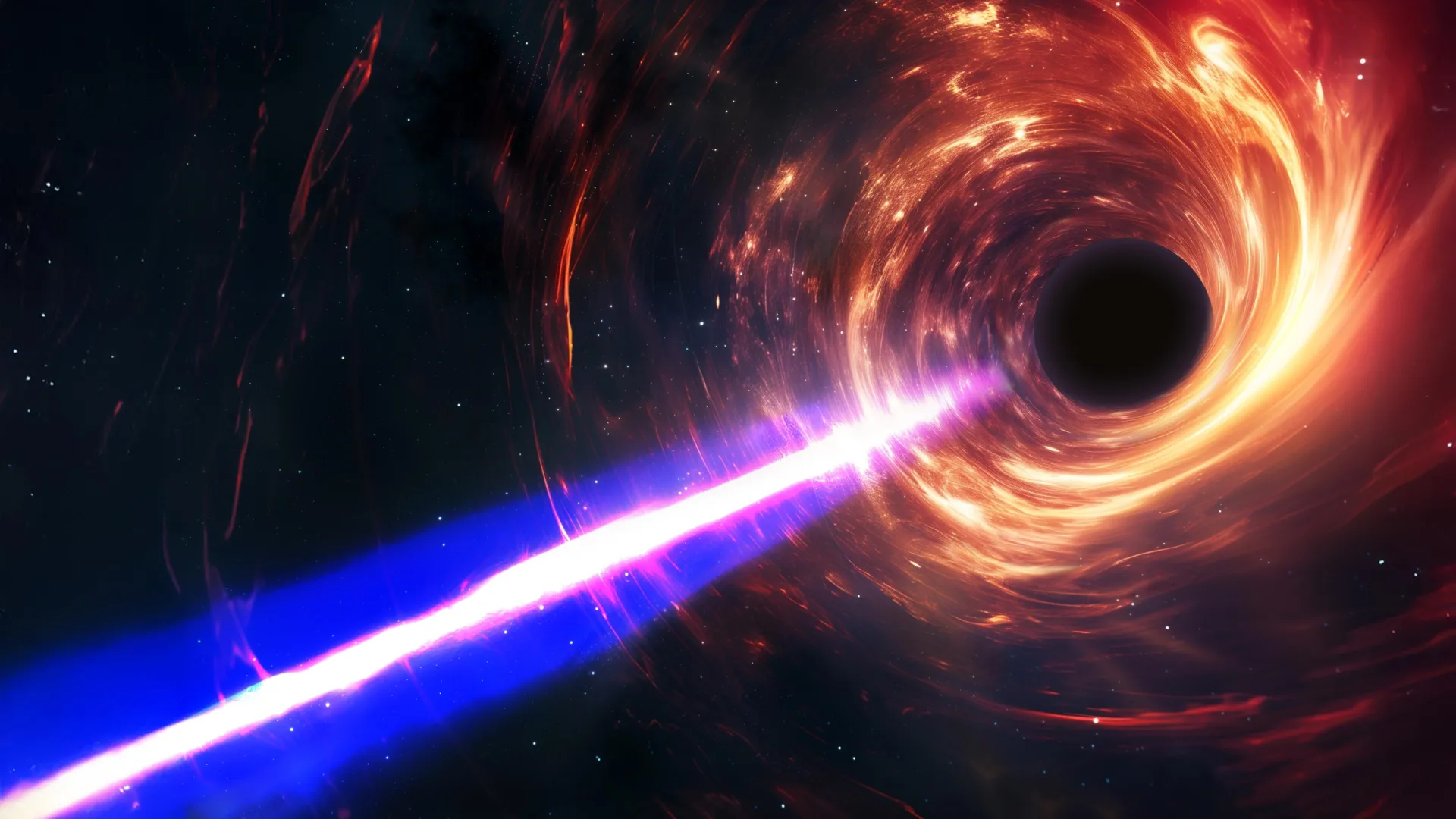
The researchers uncovered that black holes, irrespective of their size, appear to launch these formidable jets at precisely the same critical stage of their feeding cycle. This universality is a profound insight, bridging the observational and theoretical gap between "stellar-mass" black holes, typically formed from the collapse of massive stars and about ten times the mass of our sun, and the "supermassive" black holes residing at the hearts of most galaxies, which can be millions to billions of times heavier. The consistency implies a singular underlying physical mechanism, regardless of the scale of the black hole engine.
This pivotal work was spearheaded by Andrew Mummery, a Martin A. and Helen Chooljian Member (2025-30) in the School of Natural Sciences at the Institute for Advanced Study (IAS), and Adelle Goodwin, a Forrest Research Foundation Fellow at Curtin University’s International Centre for Radio Astronomy Research (ICRAR) in Western Australia. Their collaborative effort, spanning continents and leveraging extensive observational data, culminated in a study that promises to redefine how astronomers approach black hole accretion and jet formation.
The Enigma of Black Hole Jets and Their Cosmic Significance
Black hole jets are among the most energetic phenomena in the universe. These collimated beams of plasma, accelerated to near the speed of light, can extend for hundreds of thousands of light-years, carving vast cavities in the surrounding intergalactic medium and profoundly influencing the evolution of their host galaxies. They are crucial components of what is known as "feedback" mechanisms, where energy and matter expelled from the central black hole regulate star formation within the galaxy, preventing runaway starbursts and shaping galactic structures. For decades, scientists have strived to understand the conditions under which these jets are produced, how they are collimated, and what triggers their activation.
Published in the prestigious journal Nature Astronomy under the title "A universal critical accretion rate for black hole jet formation," the study synthesizes years of meticulous observations across the entire electromagnetic spectrum. The international team meticulously combined data from a global network of sophisticated telescopes, including ground-based facilities in America, Australia, India, and South Africa, as well as orbiting space observatories. This multi-wavelength approach was critical, as different wavelengths of light – from low-energy radio waves to high-energy X-rays and gamma rays – reveal distinct aspects of the black hole’s immediate environment, the accretion disk, and the jets themselves. Radio emissions, in particular, are powerful tracers of the relativistic particles within the jets.
Watching Black Holes Tear Stars Apart: Tidal Disruption Events as Cosmic Laboratories
A central focus of their investigation was on tidal disruption events (TDEs). These cataclysmic occurrences happen when a star ventures too close to a supermassive black hole and is subsequently ripped apart by the black hole’s immense gravitational forces. The extreme differential gravity, known as tidal forces, stretches the star into a stream of gas – a process vividly described as "spaghettification." A portion of this stellar material then falls into an accretion disk around the black hole, providing a sudden, massive influx of fuel.
TDEs offer astronomers an unparalleled, albeit transient, opportunity to observe the dynamic behavior of a black hole as it suddenly receives a substantial supply of fresh stellar material. Unlike the more gradual accretion processes typically observed around supermassive black holes, which unfold over millennia, TDEs present a rapid, "real-time" view of accretion and its consequences, evolving over just a few years. This compressed timescale is invaluable for studying processes that would otherwise be intractable to track within a human lifespan.
"We really wanted to figure out this massive puzzle," explained Mummery, articulating the core question driving their research. "Why do some supermassive black holes blast out radio jets right after shredding a star, while others just sit there looking completely dormant, only to suddenly fire up their jets months or even years later?" This variability in jet production, even among seemingly similar TDEs, hinted at a deeper, underlying regulatory mechanism that had eluded precise identification.
Black holes are often colloquially likened to cosmic vacuum cleaners, but their feeding behavior is far from neat and tidy. "When a black hole tears apart a star, it does not swallow everything neatly," Goodwin stated, emphasizing the messy and often violent nature of accretion. Indeed, the process is incredibly inefficient in terms of mass-energy conversion, but profoundly powerful in its outputs.
While some of the stellar material inevitably succumbs to the black hole’s gravitational pull and falls inward, a significant fraction of it can be violently expelled back into space through powerful outflows and jets. These enormous cosmic "burps," as Goodwin describes them, are not mere waste products; they are critical conduits for energy and momentum transfer. They can carry vast quantities of material and energy across immense distances within a galaxy and into the intergalactic medium, significantly affecting the evolution of the galaxies that contain them by heating gas, triggering or quenching star formation, and enriching the circumgalactic medium with heavy elements.
A Faster Way to Study Supermassive Black Holes and Uncover Universal Physics
Astronomers have long operated under the fundamental assumption that black holes, despite their vast differences in mass, obey the same basic physical rules. This principle of "scale invariance" is a cornerstone of theoretical astrophysics. However, confirming this idea empirically has been exceedingly difficult, particularly for supermassive black holes, where changes in their accretion disks and surrounding environments can normally unfold over thousands or even millions of years, making direct observation of evolutionary processes practically impossible.
Tidal disruption events offer an elegant workaround to this temporal problem. By dramatically accelerating the accretion process, TDEs compress the evolutionary timescale of a supermassive black hole’s feeding episode down to a few years. This allows scientists to observe the dynamic interplay between accretion rate and jet production in a manner that would be otherwise unobtainable, providing a much faster view of processes that would typically be too slow to track in real time.
The key insight that unlocked the new study’s discovery emerged in an unexpectedly casual setting. During an astrophysics conference in Madrid, Mummery and Goodwin found themselves conversing in a bar. It was amidst this informal discussion that they experienced a eureka moment: they realized that a specific rule already known to govern jet production in much smaller, stellar-mass black holes might, in fact, also apply to their supermassive counterparts during TDEs. This realization sparked the systematic investigation that led to their published findings.
Two Distinct Phases of Black Hole Jets: Unveiling the Critical Accretion Rate
To rigorously test their hypothesis, the researchers embarked on a comprehensive examination of twenty distinct tidal disruption events. They utilized an extensive array of observations, spanning optical light, ultraviolet light, X-rays, and radio waves. Each wavelength provided unique information: optical and UV light often trace the heated accretion disk and surrounding stellar debris, X-rays probe the innermost regions of the accretion flow and corona, and radio waves are the hallmark signature of relativistic jets.
After careful analysis and stringent quality control, the team eventually narrowed their sample to ten high-quality events. For these selected TDEs, they were able to reliably determine two crucial parameters: the black hole’s feeding rate (how quickly it was consuming stellar material) and the precise timing of its powerful radio outflows (the onset of jet activity). This meticulous data curation was essential for identifying any underlying correlations.
The subsequent analysis revealed a fascinating pattern: there are two separate and distinct periods during which jets can form following a TDE.
The first period occurs very early in the event, often while the black hole is consuming material at an extremely high, sometimes even "super-Eddington," rate. These early jets are typically powerful and short-lived, directly fueled by the initial torrent of infalling stellar debris.
The second, and perhaps more surprising, period for jet formation appears much later in the TDE’s evolution. This delayed jet activation can occur hundreds to thousands of days, or even several years, after the star was initially torn apart. Crucially, the team discovered that these delayed jets consistently form when the black hole’s feeding rate falls to a specific, critical threshold: approximately two percent of its Eddington limit.
The Eddington limit is a fundamental concept in astrophysics, representing the maximum luminosity an object can achieve when the outward pressure of radiation from its intense energy output precisely balances the inward pull of gravity. Below this limit, gravity dominates, allowing accretion to proceed; above it, radiation pressure can blow material away. The finding that the 2% Eddington threshold is especially important is monumental because this exact value is already well-established as a trigger for jet formation in much smaller, stellar-mass black holes within our own Milky Way galaxy.
The confirmation of this same critical threshold in supermassive black holes strongly suggests that this particular aspect of black hole physics — the precise conditions under which jets are launched — works in essentially the same way across an enormous range of black hole masses. This universality simplifies theoretical models, implying that the underlying magneto-hydrodynamic processes responsible for jet launching are scale-independent. It suggests that the geometry of the accretion flow, the configuration of magnetic fields, and the efficiency of energy extraction from the black hole reach an optimal state for jet production at this specific accretion rate, regardless of whether the central engine is a mere ten solar masses or millions.
Predicting When Black Holes Will Erupt: Practical Value for Future Astronomy
Beyond its profound theoretical implications, the discovery of this universal rule could also have significant practical value for the astronomical community. If researchers can reliably predict when a black hole is likely to produce a delayed jet following a TDE, they can schedule observations more efficiently and strategically. This capability dramatically increases their chances of catching these relatively short-lived, yet incredibly energetic, events as they happen, rather than missing them due to imprecise timing.
The ability to anticipate these eruptions would allow for better utilization of heavily requested and highly competitive telescope time. By focusing observational efforts on periods when jet activity is most likely, astronomers can maximize scientific return and reduce the number of "blind" observations made when little activity is expected, thereby conserving precious resources and optimizing telescope operations.
This predictive capability is expected to become particularly useful for major future observatories, such as the Square Kilometre Array (SKA) radio telescope project. The SKA, an international effort with telescopes spread across Australia and South Africa, is poised to become the world’s largest radio observatory, offering unprecedented sensitivity and resolution. It is expected to begin collecting scientific data in 2028. Knowing when and where to point such a powerful instrument will be invaluable for unraveling the mysteries of the radio universe, including the elusive dynamics of black hole jets. The SKA will be capable of detecting fainter and more distant TDEs, potentially allowing astronomers to test this universal rule with an even larger sample size and across a wider range of cosmic environments.
"We hope that our work will pave the way for even more profound discoveries about our universe," concluded Mummery, encapsulating the forward-looking spirit of scientific inquiry. This universal rule for jet production not only offers a deeper understanding of black holes themselves but also provides a critical piece of the puzzle in comprehending the co-evolution of galaxies and their central supermassive black holes, shaping the cosmos we observe today. Future research will undoubtedly delve into the nuances of this critical accretion rate, exploring its robustness across different black hole spins and magnetic field configurations, further refining our cosmic picture.
