
 By admin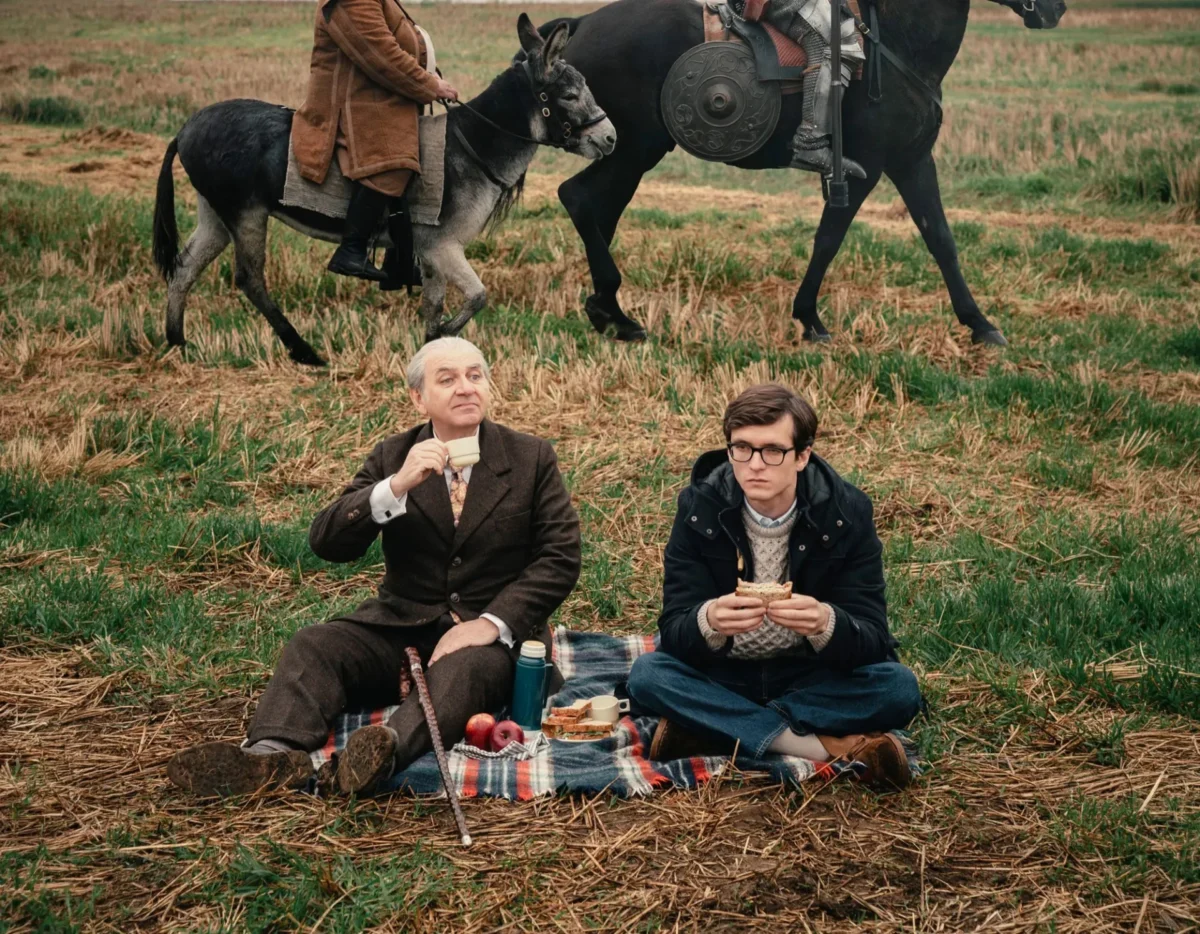
Jay Parini’s 2020 memoir, "Borges and Me: An Encounter," chronicles a singular, almost fantastical episode from his youth: a road trip through the majestic Scottish Highlands undertaken in the 1970s with the legendary Argentine literary titan, Jorge Luis Borges. What unfurls in the memoir, and subsequently in director Marc Turtletaub’s amiable screen adaptation, is an anecdote so rich and improbable it feels destined to be retold and savored by any writer. The film, while charming, stretches this potent narrative, existing as both a tall tale and, at times, a thin one, yet it undeniably retains the captivating essence of its source material.
The cinematic realization of "Borges and Me" is significantly enhanced by its breathtaking Scottish locale. Director of Photography Christopher Norr captures the tawny, textured splendor of the autumnal landscape with a dewy crispness, imbuing the film with a palpable sense of place that resonates throughout. This setting perfectly complements the film’s mellow, quietly sentimental tone, making its premiere at the Edinburgh Film Festival feel like a homecoming. The production, a transatlantic co-production weaving together British, South American, and North American talent, is poised to win over audiences on the festival circuit and beyond, aiming for global arthouse distribution. Central to its appeal are the deliberately contrasting leads: the venerable Chilean actor Luis Gnecco, who embodies the twinkly-eyed, genius Borges with remarkable verve, and Fionn Whitehead, whose earnest portrayal of the young, perpetually English-seeming American Jay Parini serves as the perfect foil. Whitehead, known for his roles in "Dunkirk," imbues Parini with an appealingly upright, albeit somewhat out of his depth, sensibility as the writer’s exasperated minder.
Fionn Whitehead’s portrayal of the young Parini is key to establishing the film’s emotional core. As an English literature doctoral student at St. Andrew’s University, Parini, a native Pennsylvanian, is a quintessential fish out of water. His character is depicted with a disarming blend of academic prowess and an almost childlike innocence, emphasized by his slightly askew tortoiseshell glasses and an oversized duffel coat that speaks to his youthful awkwardness. This unworldly quality makes him an easy target for the good-humored teasing of his supervisor, the bohemian poet Alastair Reid, played with characteristic charm by Alan Cumming. Reid, a scholar of South American literature and a prominent translator of Borges’ work, becomes the catalyst for the extraordinary encounter. He invites Borges, his esteemed colleague, to stay with him at his ramshackle coastal cottage. Parini, a graduate student deeply immersed in the academic study of South American literature, finds himself both bewildered and captivated by the presence of the brilliant, eccentric, and sightless septuagenarian literary icon.
The narrative pivots when Reid is unexpectedly called away to London at the last minute, leaving Parini in charge of Borges. The responsibility thrust upon Parini is far beyond what he anticipated; he is essentially tasked with being Borges’ babysitter. Reid offers minimal guidance, leaving Parini with a list of Borges’ medications but little else. This unexpected turn of events coincides with Parini’s own planned excursion into the Highlands to interview his doctoral thesis subject, the reclusive and enigmatic poet George Mackay Brown, who makes a memorable, mischievous appearance courtesy of Peter Mullan in an extended cameo. Thus, an unlikely cross-generational road trip unfolds, a journey that quickly deviates from Parini’s academic itinerary with a series of unexpected sightseeing detours. Despite his blindness, Borges possesses an insatiable appetite for local color and sensory experiences, delighting in every detail of their surroundings. This constant immersion in the present moment, however, proves wearisome for Parini, who is tasked with describing the vast Scottish landscapes and the nuances of their experiences to his elder in suitably lyrical terms, a task that highlights the burgeoning creative and observational skills he is developing as a writer.
Audiences are likely to find common ground with Parini’s predicament and his evolving perspective. Luis Gnecco delivers a performance brimming with eccentric mannerisms and a captivating energy, portraying Borges as a figure of equal parts impish wisdom, earthy vulgarity, and childlike wonder. He rarely allows a moment of silence to pass without an eager, often insightful, observation or query. The film takes a welcome turn when the narrative momentarily shifts focus from Borges to Parini’s burgeoning romantic life. The virginal Parini, who has thus far experienced romantic poetry only through intellectual study, finds a genuine connection with Ailith, a smart and kindly pub worker portrayed with warmth and authenticity by Freya Mavor. Their stolen moments together, away from Borges’ constant presence, allow the film to breathe and showcase a more tender, personal side of Parini’s journey. In these scenes, the film offers a poignant contrast to the more outwardly extraordinary experiences with Borges, highlighting the universal human desire for connection and the awakening of deeper emotional understanding.
Borges’ presence undeniably orchestrates some of the film’s most amusing and even poignant episodes. A bumbling boat excursion on the famously enigmatic Loch Ness, replete with a dash of spectral speculation, and a hallucinatory visit to a long-forgotten battlefield, where the echoes of history seem to whisper, are memorable vignettes. However, it is in the film’s quieter moments that its most profound emotional impact is felt. These scenes are largely centered on Parini and his internal anxieties, including his complex feelings about his less academically inclined brother’s experiences as a soldier in the Vietnam War. Whitehead imbues "Borges and Me" with the necessary stillness to prevent it from veering into mawkishness or overt sentimentality. Screenwriter Oren Moverman, working from an earlier adaptation by Parini and Ross Clarke, skillfully navigates between moments of graceful literary reflection and simpler, feel-good emotional beats.
Ultimately, the film leans slightly more towards the latter, prioritizing sentiment over deep engagement with Borges’ intellectual legacy. For instance, there is minimal direct exploration of Borges’ own seminal literary works, a deliberate choice that may leave some viewers yearning for a more substantive literary analysis. Those seeking a deeper dive into Borges’ oeuvre might find themselves drawn to more comprehensive documentaries, such as the forthcoming five-hour-plus "Life of Jorge Luis Borges." The potential for complementary distribution strategies between these two films could offer a richer, more multifaceted cinematic experience for enthusiasts. "Borges and Me" is suffused with a warm feeling and a nostalgic embrace of the porous, knowledge-gathering naivety of youth. The film ultimately treats Borges not as a strictly historical figure to be meticulously dissected, but rather as a general, buoyant, and heavily imagined spirit, a representation of the profound impact a singular encounter can have on a developing artist. This approach, while perhaps less academic, is undeniably likable and resonates with a universal truth about the transformative power of mentorship and unexpected journeys. The film’s charm lies in its gentle evocation of a specific time and place, and the enduring magic of encountering a literary legend who not only shaped literature but also profoundly influenced the lives of those fortunate enough to cross his path, even if only for a winding road trip through the Scottish Highlands. The success of the film in capturing the essence of this extraordinary encounter is a testament to its thoughtful direction, compelling performances, and the enduring allure of Parini’s unforgettable memoir.
