
 By Lina Irawan
The United States, as the world’s largest economy, wields immense influence over global trade and investment flows. Its recent aggressive stance on tariff policies, particularly targeting strategic sectors and trading partners, has injected significant uncertainty into international supply chains and corporate earnings forecasts. Simultaneously, the unparalleled surge in U.S. investment into Artificial Intelligence, while promising technological leaps, has also fueled speculative bubbles and market concentration, drawing capital away from other regions and creating a sense of anxiety about competitive disparities. Compounding these factors, the Federal Reserve’s tightening monetary policy, marked by successive interest rate hikes aimed at taming domestic inflation, has had profound ripple effects globally, strengthening the dollar, increasing borrowing costs for emerging markets, and dampening investor appetite for riskier assets worldwide. These interconnected policies have often created a tumultuous environment, making the Thanksgiving holiday a welcome, albeit temporary, reprieve.
During this brief hiatus from American market activity, a peculiar phenomenon unfolded across global exchanges. In Asia, major indices broadly rose, with the Nikkei 225 in Tokyo gaining over 1.5% and the Hang Seng in Hong Kong seeing a solid 1% increase, buoyed by regional optimism and perhaps a temporary detachment from U.S.-China trade tensions. European markets followed suit, demonstrating even stronger performance. The Euro Stoxx 50 surged by an impressive 2.3%, while Germany’s DAX and the UK’s FTSE 100 each climbed by more than 1.8%, reflecting investor confidence in their respective economic recoveries and a potential reallocation of capital away from perceived U.S. risks.
Even with New York closed for the holiday, the undercurrent of positivity managed to penetrate the American market’s periphery. S&P 500 futures, traded continuously on global platforms, registered an uptick, signaling a potential bullish open when markets resumed. More tellingly, Nasdaq 100 futures, representing the tech-heavy segment, were up a notable 0.63%, and Nvidia, a bellwether for the AI sector and a darling of recent market rallies, saw its shares climb an additional 1.29% in after-market trading. This pre-market enthusiasm, particularly in technology, was surprising given the broader narrative dominating financial headlines.
"None of this should be happening!" This emphatic declaration encapsulated the prevailing sentiment among many financial professionals, who found the market’s resilience perplexing in the face of what they perceived as an onslaught of negative indicators. The optimism permeating global trading floors seemed to fly in the face of deeply entrenched concerns about the future trajectory of the U.S. and global economies.
Indeed, a chorus of voices from the financial hubs of Wall Street and London City echoed a dire outlook. In a flurry of emails exchanged with Fortune, multiple analysts painted a bleak picture, asserting that "There is nothing but bad news on the horizon." This consensus of gloom underscored a fundamental disconnect between market performance and expert prognosis, setting the stage for a potentially volatile end to the year.
Among the most dramatic warnings came from Joachim Klement, a highly respected strategist at Panmure Liberum, whose insights are often shared through his well-regarded Substack, aptly subtitled: "Thoughts on financial markets by a grumpy, middle-aged German. What more do you want?" Klement, known for his candid and often contrarian views, delivered a stark message in a recent video talk that sent ripples through the investment community. He announced the unprecedented step of selling all the equities—a complete divestment—from his personal investment portfolio. This drastic move, he explained, was a direct response to the recent, albeit seemingly temporary, selloff in the S&P 500, which he interpreted as a harbinger of much deeper troubles.
Klement’s forecast was chilling: "I think that we are heading towards a major bear market with more than 30% drawdown risk." Such a significant correction would wipe out trillions in market value and represent one of the most severe downturns in recent history. Looking further ahead, his official forecast for 2027 painted an even grimmer picture, predicting the S&P 500 would sink to 5,000. At a time when the index was trading significantly higher (let’s assume around 4,500-4,800 based on the "seems unthinkable" context), a target of 5,000 three years hence implied not just stagnation but a prolonged period of market contraction, making his projection appear truly "unthinkable" to many investors conditioned by years of tech-driven growth.
A key technical indicator fueling Klement’s concern was the S&P 500’s position relative to its 200-day moving average. This widely watched metric serves as a crucial barometer of long-term market trends, with prices consistently above it typically signaling a bull market and prices below it suggesting a bearish trend. Klement highlighted that the index was currently trading below this critical threshold, a signal he found deeply troubling. He invoked the wisdom of legendary investor Paul Tudor Jones, who famously stated, "nothing good happens below the 200-day moving average." This adage underscores the psychological and algorithmic importance of this technical level, with many institutional investors and quantitative trading systems adjusting their strategies once this line is breached. For Klement, this technical breakdown, combined with macroeconomic headwinds, signaled an impending period of sustained market weakness.
"It doesn’t look like the Santa Claus rally is in store for us this year"
The confluence of these pessimistic outlooks led many analysts to conclude that the much-anticipated "Santa Claus rally" — a historical pattern where stock markets tend to experience gains during the last five trading days of December and the first two of January — was unlikely to materialize this year. This traditional end-of-year boost, often attributed to holiday spending, institutional window dressing, and optimistic investor sentiment, is a cherished expectation for many, and its potential absence amplified the prevailing sense of unease.
Three primary factors were identified as driving this pervasive gloom, each contributing to the narrative that market buoyancy was unsustainable:
Firstly, inflation remains stubbornly high, refusing to recede to the Federal Reserve’s target levels. The Fed’s preferred metric for gauging price pressures, the Personal Consumption Expenditures (PCE) price index, showed a year-over-year increase to 3.8% in October, marking an undesirable uptick from 3.7% the month prior. This acceleration, however slight, was a significant concern for policymakers. As Lawrence Werther and Brendan Stuart of Daiwa Capital Markets noted in a client brief, the data was "undesirably strong," indicating that inflationary forces were more entrenched than previously hoped. This persistent inflation, significantly above the Fed’s 2% target, almost certainly pointed towards a continuation of aggressive monetary policy. Analysts widely anticipated that this would push the Federal Reserve into raising interest rates further in December, making money scarcer and borrowing more expensive. Such a scenario typically augurs poorly for stock markets, as higher rates increase the cost of capital for businesses, reduce corporate earnings, and diminish the present value of future cash flows, thereby dampening investor enthusiasm.
The sentiment was reinforced by a pivotal speech given earlier in the week by John Williams, the President of the New York Fed. Williams, a key voice within the Federal Open Market Committee (FOMC), all but telegraphed the central bank’s imminent decision to further hike rates. His remarks emphasized the Fed’s unwavering commitment to its mandate: "We must take actions over time that will ensure that we get inflation back to our 2 percent goal in a timely manner and on a sustained basis. There is still work to do to get that done." This unambiguous language, interpreted by market participants as a clear signal of continued hawkishness, solidified expectations for a December rate hike. Economist Claudia Sahm provided a compelling analysis of Williams’ speech, highlighting the Fed’s resolve and the implications for future monetary policy, further cementing the market’s conviction that more tightening was on the horizon.
Secondly, the U.S. economy is exhibiting remarkable strength, paradoxically empowering the Fed to maintain its restrictive monetary policy. While a robust economy is generally positive, in an inflationary environment, it means the central bank feels it has the "breathing space" to continue dampening demand without immediately triggering a recession. Recent data underscored this economic vigor. New jobless claims, a key indicator of labor market health, came in near their three-year low, signaling a tight labor market where employers are reluctant to shed workers. Furthermore, the long-term trend in jobless claims continued to point downwards, as observed by Thomas Simons and Blake Birkins of Jefferies, suggesting sustained employment strength.
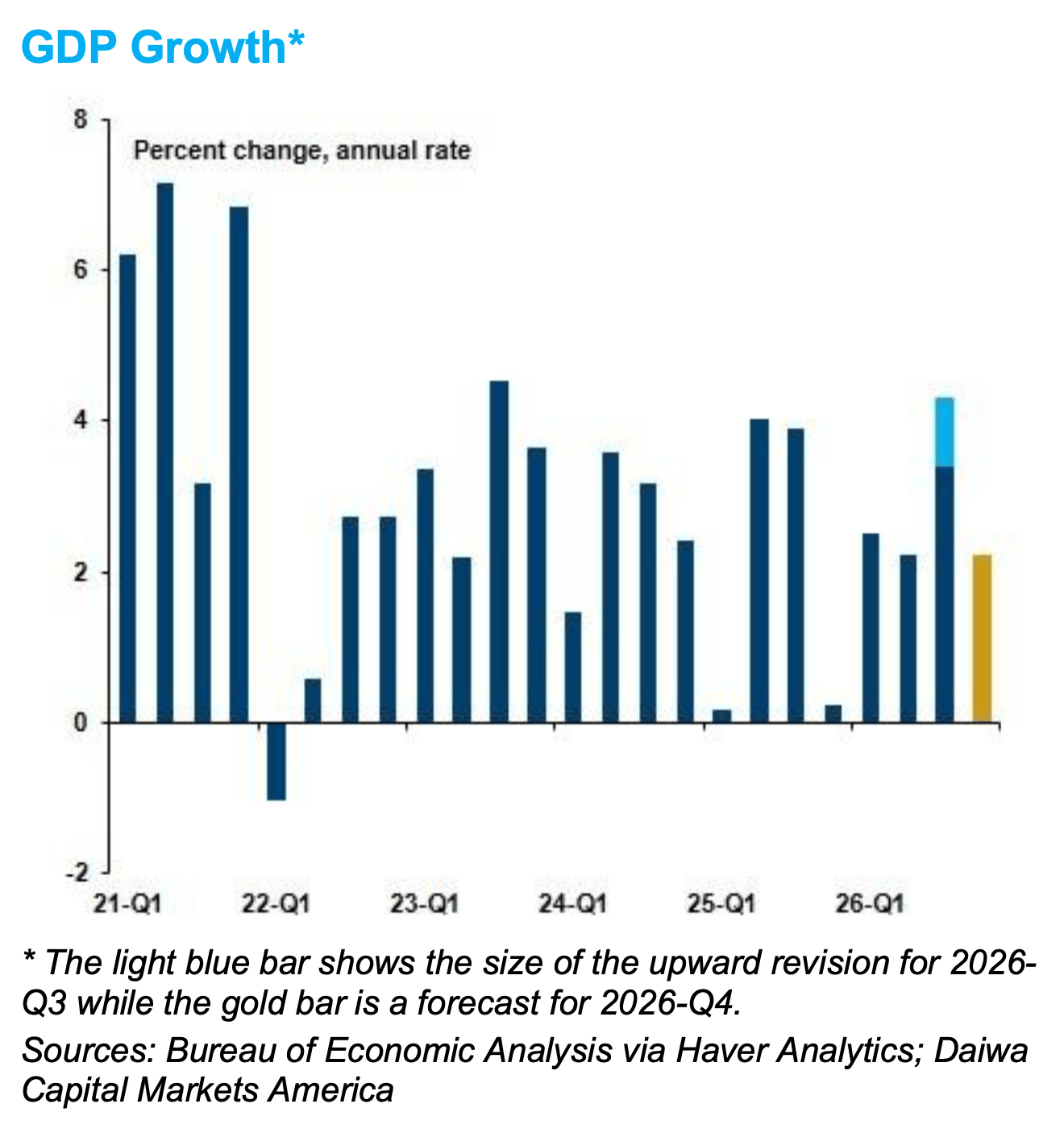
Adding to this picture of economic resilience was the impressive Gross Domestic Product (GDP) growth. "The big highlight… is GDP, which at 4.3% shows that the economy is booming," Chris Zaccarelli, chief investment officer at Northlight Asset Management, told Fortune via email. This robust growth figure, likely representing the annualized rate for the third quarter, significantly outpaced expectations and historical averages, indicating strong consumer spending and business investment. However, Zaccarelli quickly appended a crucial caveat: "unfortunately, the inflation data is still too high and is unlikely to convince the Fed to remain on hold." The paradox for investors was clear: good news about the economy was, in fact, bad news for stocks, as it removed any incentive for the Fed to pause its rate-hiking campaign.
Thirdly, the intertwined concerns of "AI angst and the newly announced tariffs" were casting long shadows over market sentiment. Zaccarelli explicitly linked these factors to the gloomy outlook for the traditional Santa Claus rally. The "AI angst" refers to a complex set of anxieties surrounding the rapid proliferation of Artificial Intelligence. While AI companies like Nvidia are experiencing explosive growth, there’s growing concern about market concentration, with a few mega-cap tech companies dominating the AI landscape, leading to fears of an unsustainable bubble. Investors also grapple with the broader economic implications, including potential job displacement and the enormous capital expenditure required for AI infrastructure, which could strain corporate balance sheets in the long run. The speculative nature of some AI investments, reminiscent of past tech bubbles, has fueled apprehension among cautious analysts.
Simultaneously, the "newly announced tariffs" have added another layer of uncertainty. While specific details were emerging, these tariffs, likely targeting goods from key trading partners in sectors deemed strategically important or unfairly subsidized by the U.S. government, threatened to disrupt global trade flows once again. Such protectionist measures typically lead to higher import costs, which can either be passed on to consumers (contributing to inflation) or absorbed by businesses (eroding profit margins). They also provoke retaliatory tariffs from affected nations, escalating trade wars that damage international commerce and corporate earnings. For many analysts, these tariffs represented a direct challenge to global economic stability, further clouding the investment horizon.
Hold that thought! Amidst the deluge of negativity and the dire predictions from market seers, a compelling counter-narrative began to emerge, suggesting that the picture was far more nuanced than the headlines implied. While it was true that U.S. aggregate stock performance, particularly that of the S&P 500, might appear to be sliding, this was largely attributed to what some characterized as a "tech sector fiasco." This wasn’t necessarily a universal collapse, but rather a re-evaluation of highly valued tech stocks, perhaps driven by profit-taking, concerns over AI sustainability, or the impact of higher interest rates disproportionately affecting growth-oriented companies.
Crucially, outside the narrowly focused tech sector, and particularly evident in the outperformance of European stocks versus their U.S. counterparts, "things are going rather well." This divergence highlighted a broader market health that was being obscured by the tech-centric narrative. Deutsche Bank’s Jim Reid, a keen observer of market dynamics, pointed out a significant detail from the trading day before the Thanksgiving holiday: out of the 500 constituents of the S&P 500, a substantial 372 stocks moved higher. This indicated widespread positive momentum across a majority of companies, not just a select few. More tellingly, the equal-weight S&P 500 index, which assigns the same weight to each stock regardless of its market capitalization, was up a healthy 0.82% on the day. This metric is critical because the traditional market-cap-weighted S&P 500 can be heavily influenced by the performance of a handful of mega-cap tech giants. The strong performance of the equal-weight index suggested that the broader market, beyond the FANG+ stocks, was demonstrating underlying strength and resilience, offering a glimmer of hope that the prevailing bearish sentiment might be overly concentrated on a specific, albeit influential, segment of the economy. This suggested that while the spotlight remained on the dramatic warnings, a quieter, more positive story was unfolding beneath the surface of the market’s apparent turmoil.
