
 By Rifan Muazin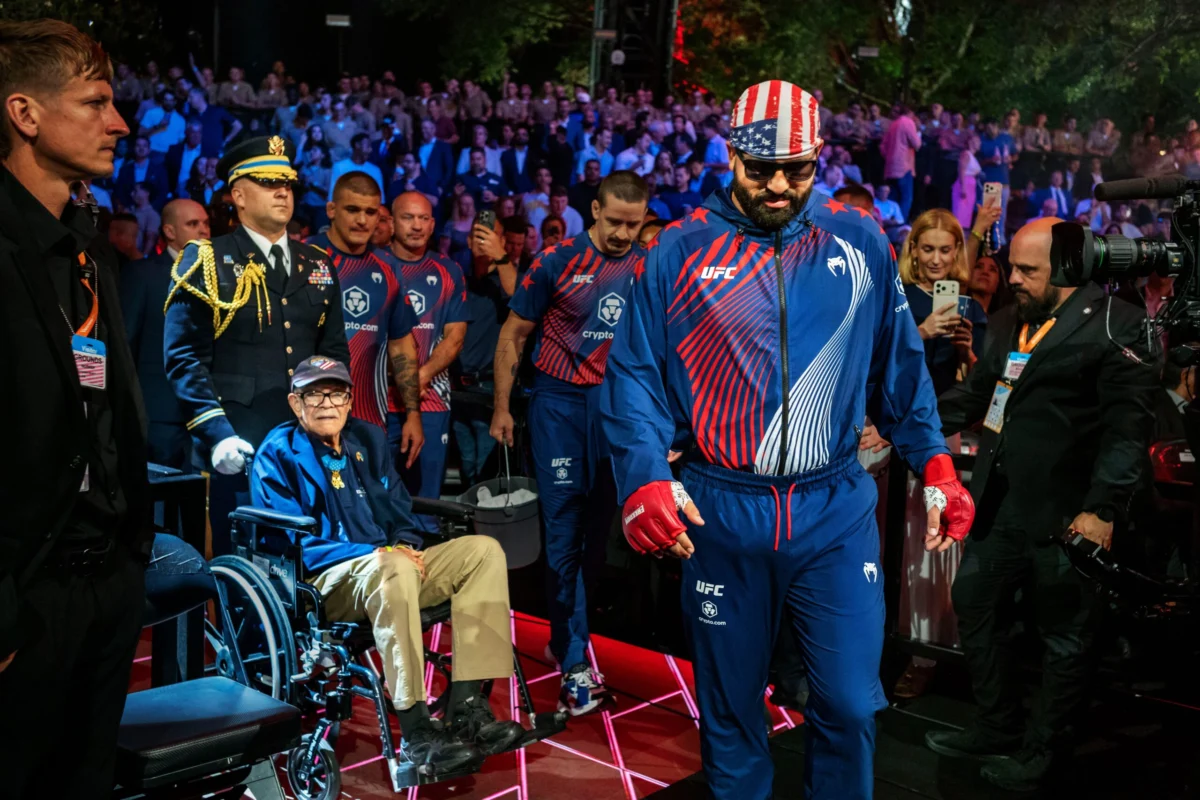
The moment was a shock, a breach of decorum that even Hokit seemed to immediately regret, but it served as the opening salvo for a week that would see the Ultimate Fighting Championship occupy the most hallowed ground in American democracy. Assembled to celebrate the 250th birthday of the United States and the 80th birthday of President Trump, this collection of fighters, coaches, and "content creators" felt less like a professional sports league and more like a bag of cats let loose in a cathedral. Dana White, the UFC’s indomitable CEO, has long championed a brand of radical free speech that allows his athletes to say whatever they like, but as the week progressed, it became clear that with unwieldy mavericks come difficult, often vulgar, consequences.

By 6:00 a.m. the following morning, the contrast between the old guard of journalism and the new wave of combat sports media was on full display. On the steps of the Eisenhower Building, a UFC organizer divided the press pool: content creators to the right, print journalists to the left. The result was a staggering demographic shift. Ninety-eight percent of the pool surged to the right—a sea of neck tattoos, muscle shirts, and men calling each other "brother." The print line was a lonely quartet: myself, and representatives from the Toronto Star, Business Insider, and The New York Times. This was the new reality of sports media—a world where "legacy" outlets are treated as suspicious relics while influencers with ring lights are given the keys to the kingdom.
We were led to the South Lawn to inspect "The Claw," a towering architectural anomaly of metal, lasers, and industrial scaffolding built startlingly close to the White House. The structure was so imposing, so physically intimate with the Executive Residence, that one could easily imagine bits of cartilage landing on the Truman Balcony. While the mainstream media, led by voices like Joe Rogan, had predicted a disaster fueled by thunderstorms and DC’s notorious humidity-driven insect swarms, the content creators were in a state of religious awe. Subramanian, the man who had tried to save Hokit’s press conference, stood on the lawn and spoke into his phone with tears in his eyes, telling his followers to "chase your dreams." For him, and for many in the UFC orbit, this wasn’t a vulgar display of power; it was the ultimate validation of a sport that saves as many lives as it endangers.

Mixed martial arts is a sport built on raw emotion and the terrifying honesty of physical combat. As Subramanian explained during a meeting in the Marriott basement, it is perhaps the only arena left where men are permitted to be their unvarnished selves, facing true fear in front of the world. This honesty was personified by Derrick "The Black Beast" Lewis, a man who rose from the drug-addicted streets of New Orleans and a three-year prison stint to become a global superstar. During Media Day, Lewis was awarded a lapel pin by Trump’s drug czar, Sara Carter, for remaining drug-free. His reaction—a muttered "What the fuck was that?"—was naturally funny and authentic, a stark contrast to Hokit’s forced "shtick."
The week’s tension peaked on Friday night at the Lincoln Memorial. In 1963, Martin Luther King Jr. stood on these steps to articulate a dream of equality; in 2026, Josh Hokit stood on them to claim that fellow fighter Ilia Topuria was too short to see himself in a bathroom mirror. The crowd, sweltering under a sky forked by lightning, was less than moved. The chaos continued into Saturday’s Fan Fest on the Ellipse, a sprawling event that felt like a "MAGA Coachella." Over a hundred thousand fans engaged in punching games and AI face-morphing tents run by Meta. The highlight was a homing bald eagle that soared so low its talons nearly grazed the audience—a literal manifestation of American symbolism harnessed for entertainment.

Among the multitudes was Sean "Suga" O’Malley, the UFC’s wiry, colorful heartthrob. O’Malley is a man of modern contradictions: he meditates, journals for his anxiety, and practices cold plunges, yet he delights in the memory of "mentally breaking" an opponent until they "fall." In a private interview, O’Malley revealed a more somber side, admitting that his highly publicized "open marriage" had collapsed after he "pushed the boundaries" too far. He chose to change rather than lose his family, a rare moment of vulnerability in a week defined by bravado. It suggested that even for these "kings" of the octagon, the boundary-less lifestyle promoted by figures like Andrew Tate often hits a wall when it meets the complexities of real human connection.
Sunday’s fight night was a logistical feat of Secret Service precision. The few reporters allowed on the lawn were sequestered for six hours in the White House press briefing room, a cramped corridor that felt more like a submarine than a legendary hall of power. We were joined by Bruce Gilden, the 79-year-old legendary street photographer commissioned by GQ. Gilden, a maverick in his own right, nearly got us all kicked out when he began lunging at high-ranking officials to take their portraits. He hugged Transportation Secretary Sean Duffy, which went well, but when he tried the same tactic with Stephen Miller, the White House staff went into a panicked huddle. Gilden, wearing a utility vest and a bucket hat, was the only person in the room who refused to be obedient. He was a "knuckle-head" in a suit-and-tie world, trusting his instincts even as he flirted with a Secret Service takedown.

When we were finally ushered onto the South Lawn, the transformation was complete. The Palm Room gave way to a Vegas-style arena where 4,300 attendees, including Mark Zuckerberg and 1,300 "physically fit" military personnel, sat under swiveling lasers. The night was historic: seven fights, seven knockouts. The adrenaline of the setting seemed to sharpen the brutality. Sean O’Malley won his bout handily, leaping from the cage to have his hand tenderly patted by President Trump. It was a moment of imperial theater, a blend of combat and statecraft that felt uniquely suited to the era.
However, the night was nearly derailed by Josh Hokit. After defeating the legendary Derrick Lewis, Hokit attempted to overcompensate for his earlier "groin cup" gaffe by placing a gold chain around Trump’s neck and shouting offensive, conspiracy-laden insults about Michelle Obama. The silence that followed was different from the Marriott basement; it was the silence of a man who had finally broken the golden rule. He had made the night about himself, stealing the thunder from both the sport and the President. Trump looked visibly displeased, removing the chain as Hokit was ushered away.

The finale was a bloodbath. Justin Gaethje pummeled Ilia Topuria into a pulp, fracturing the bones around Topuria’s eyes. As blood poured onto the canvas, the "Mar-a-Lago" crowd—wealthy donors and socialites—stared with a mixture of horror and rapt curiosity. "Let them fight!" the crowd roared, a chant that echoed off the walls of the Executive Mansion. It was a visceral, jarring conclusion to the nation’s 250th birthday celebration.
Twelve days later, Dana White reflected on the event with a mix of pride and frustration. He called the night "perfect," save for Hokit’s behavior. While White remains a "big free speech guy," he characterized Hokit’s outbursts as "mental illness" or "weird insecurity" rather than genuine expression. He refused to control his fighters, noting that the beauty of his business is that eventually, the "knuckle-heads" get their comeuppance in the cage. As the UFC packed up its lasers and metal scaffolding, leaving the South Lawn to return to its quiet, manicured state, the week left behind a lingering question about the state of the union. In a country celebrating its 250th year, the intersection of the White House and the Octagon suggested a culture that is increasingly comfortable with the raw, the bloody, and the unfiltered, even when the truth it reveals is difficult to stomach.
