
 By admin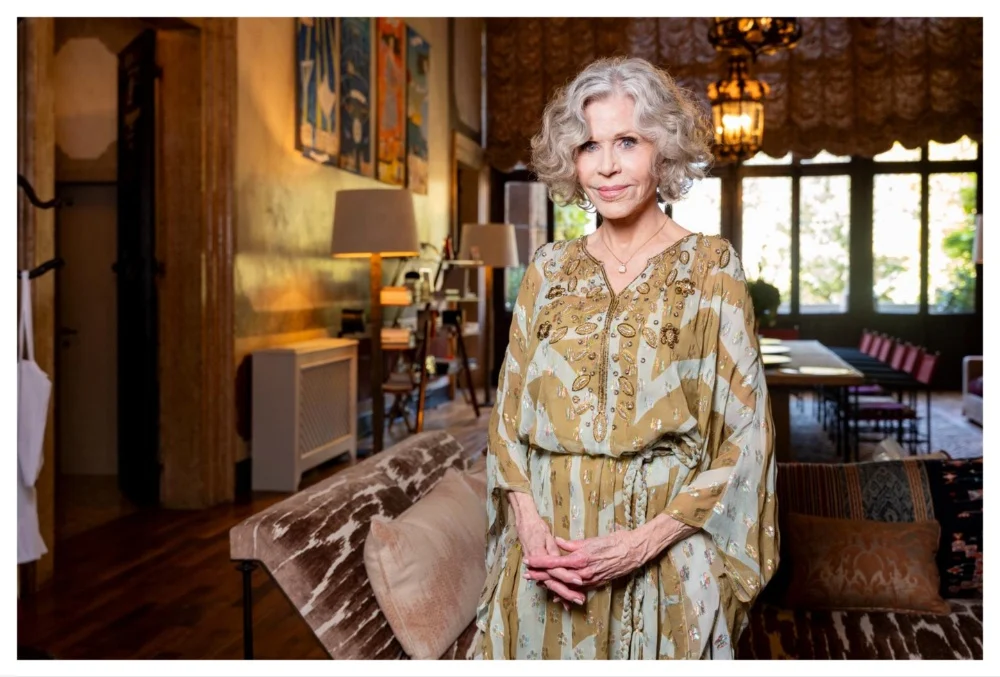
In a spirited address that underscored her enduring commitment to activism and sharp critique of contemporary power structures, 88-year-old cinematic icon Jane Fonda unequivocally voiced her opposition to the proposed Paramount-Warner Bros. merger. Speaking to a select group of journalists on the sidelines of the Venice Film Festival, prior to being honored at the DVF Awards, Fonda also articulated her deep-seated aversion to Donald Trump and a chilling observation on the perceived desire of "tech bros, oligarchs and billionaires" for extended lifespans, a pursuit she characterized as a grim irony given their alleged role in precipitating the demise of others. The DVF Awards, established by fashion designer Diane von Furstenberg, celebrated extraordinary women, with Fonda sharing the spotlight with luminaries such as Prime Minister Mia Amor Mottley of Barbados, photojournalist Lynsey Addario, Kenyan social entrepreneur Wawira Njiru, and French feminist icon Gisèle Pelicot.
While the heart of Fonda’s discourse revolved around pressing political issues, her unwavering activism, and a pointed critique of the unchecked influence of the tech elite, the two-time Oscar winner also offered a welcome update on her continued engagement with the acting profession. Pre-production is reportedly in its final stages for "The Correspondent," a Lionsgate film adaptation of Virginia Evans’ best-selling novel. The book chronicles the life of a retired lawyer who finds solace and order in the intricate art of letter-writing amidst a complex world. Fonda expressed optimism that filming would commence in January, contingent on the director’s schedule. She also hinted at other forthcoming projects, though she remained tight-lipped about specific details, stating, “I just can’t mention them.” This eagerness to return to the screen is palpable, a sentiment she articulated with poignant honesty: “After five years of not working as an actor, I have to confess that – as much as I love the work that I do with my comrades in the movement – I miss the process of becoming somebody else. It is such a thrilling process. I love it. I miss it.”
Fonda’s robust stance against the Paramount-Warner Bros. merger is rooted in a multifaceted concern for the health of the entertainment industry and its consumers. She expressed hope that the proposed consolidation could be thwarted, highlighting the significant debt burden carried by entities like the Ellisons, which has led to postponements in substantial financial obligations. “The merger would be terrible for consumers,” Fonda asserted, forecasting a rise in prices and a devastating impact on employment, with “thousands and thousands of people” potentially losing their jobs. From a creative perspective, she elaborated, “the fewer studios there are, the fewer places that we can take our products. We lose bargaining power. Unions lose their power.” Fonda acknowledged a growing and “robust movement” dedicated to halting such mergers, a sentiment that, while aligned with her activism, carries a personal note of regret. She expressed a fondness for David Ellison, whose company Skydance financed her seven-year Netflix run on "Grace and Frankie," stating, “I like David Ellison very much… But that doesn’t change things. This is not a personal thing. This is what it will do to the entertainment industry, which is already suffering terribly.”
When queried about how Ted Turner, a pioneer of cable news, might have reacted to the prospect of Paramount owning CNN, Fonda’s response was emphatic. “Oh, I think he would be terribly upset,” she declared. “He didn’t want to sell back in the day when he sold, and I was still with him then. And I remember all of the big thinkers, you know, the John Malones, the Gordie Crawfords. They were all saying, ‘You’ve got to do this.’ Ted didn’t want to do it, but he did. And now David Zaslav did. Ted would be absolutely heartbroken.” This historical context underscores Fonda’s understanding of media consolidation and its potential erosion of independent journalistic voices.
Fonda’s defense of Mark Ruffalo against accusations of antisemitism, following his vocal opposition to the merger, brought to light her concerns about a contemporary form of Hollywood “blacklist.” She described the accusation as a deliberate tactic employed by powerful figures, specifically naming Larry Ellison. “Larry Ellison, because he doesn’t like Mark Ruffalo’s position on the merger, accuses him of antisemitism, when he said nothing that isn’t within his constitutional right to say,” Fonda stated, adding, “It’s a tactic they’re using. He should be ashamed of himself, Larry Ellison.” She emphasized the significant support Ruffalo received, noting that “a lot of people came forward,” reinforcing her belief that solidarity is crucial in confronting such challenges.
Reflecting on her own journey into political activism, which began at age 33, Fonda described her pre-activist life as “so silly. So nothing. So meaningless.” Her awakening as an activist connected her with “entirely different kinds of people.” She recalled the anti-Vietnam War movement of the 1970s, noting the existence of a backlash but emphasizing her participation in a larger, supportive movement. “I was part of a movement. I was not alone,” she underscored, drawing a parallel to Ruffalo’s situation: “Mark is part of a movement. He’s not alone. This is a time when we have to stick together. We can’t be alone. They can’t pick us off when we’re alone.”

The rise of Donald Trump has undeniably altered the political landscape, but Fonda asserted that for her, speaking out has not become more difficult. “Not for me. No. I’ve had my life. He can do nothing to me. I’m not scared,” she explained. However, she acknowledged that this sense of invulnerability is not universal, stating, “But that’s not true for everyone, and I understand that.” This understanding fuels her commitment to encouraging others to join the movement. She elaborated on the re-establishment of the Committee for the First Amendment, an organization founded in the 1940s and 50s to counter McCarthyism and the “witch hunts,” an initiative her father had supported. With “thousands and thousands of members,” the committee aims to foster community and collective action.
Fonda expressed concern for ordinary citizens who may find it more challenging to voice their opinions. She observed an increasing trend of people speaking out, driven by the existential threat to their livelihoods. “Their whole lives are at risk right now,” she stated, citing the potential job displacement by AI and the environmental degradation caused by data centers being erected in their communities. This has led to a discernible shift in public sentiment across the political spectrum, with both Republicans and Democrats increasingly vocal in their opposition to such developments. “Republicans and Democrats alike are standing there saying, ‘No. You’re not going to put a data center in my community.’ No, you’re not going to put a detention center.” Furthermore, she noted a growing disillusionment even among MAGA supporters, who are reportedly disaffected by leaders who "profit off misery and cruelty" and by the prevailing "chaos" and mistreatment of immigrants.
Looking ahead to the 2028 presidential election, Fonda expressed a cautious approach, deeming it “too soon” to endorse a specific candidate. However, she identified several younger politicians who have captured her attention and admiration. She specifically mentioned Jon Ossoff and Justin Pearson, a Tennessee State Representative running for Congress. She also highlighted Peggy Flanagan, the Lieutenant Governor of Minnesota and an Ojibwe woman running for the U.S. Senate. Fonda envisioned a transformative shift in governance if such leaders, who possess a long-term perspective, were to hold office: “I mean, imagine if we had senators who thought, ‘Hmm, the decision I’m going to make now. How is it going to affect people seven generations from now?’”
Fonda’s most profound and unsettling observations were reserved for the contemporary obsession with longevity among global elites. She articulated a stark vision: “They want to live forever, while they’re killing the rest of us.” She elaborated on two interconnected facets of this phenomenon. Firstly, she suggested that many of these individuals, the “tech bros and these oligarchs and billionaires,” operate with a sense of impunity, believing that societal laws and even the “laws of physics. Natural laws” do not apply to them. Their pursuit of immortality, she posited, is an extension of this perceived exceptionalism. Secondly, Fonda offered a speculative, yet chilling, prognosis: the inability of these ageless elites to procreate naturally might lead them to “create robots” as their offspring, while turning the rest of humanity into “tradwives, who have a lot of babies too.” This dystopian future, she warned, could culminate in the erosion of democratic rights, including the right to vote. “Can you believe it? And we’re not going to stand for it. They’re not going to win, because we’re not going to stand for it.” The most critical challenge, Fonda emphasized, is the unprecedented nature of this potential crisis in human history. While in past eras, the promise of eventual victory was a source of hope, the escalating climate crisis casts a long shadow, diminishing the available time to avert irreversible catastrophe. “There’s a point where if it gets too hot. Then there’s no going back.”
This interview has been edited and condensed for clarity.
(Image caption: Jane Fonda and Diane von Furstenberg at the DVF Awards. Stafano Trovati|SGPC/Courtesy DvF)
