
 By Titik Puspa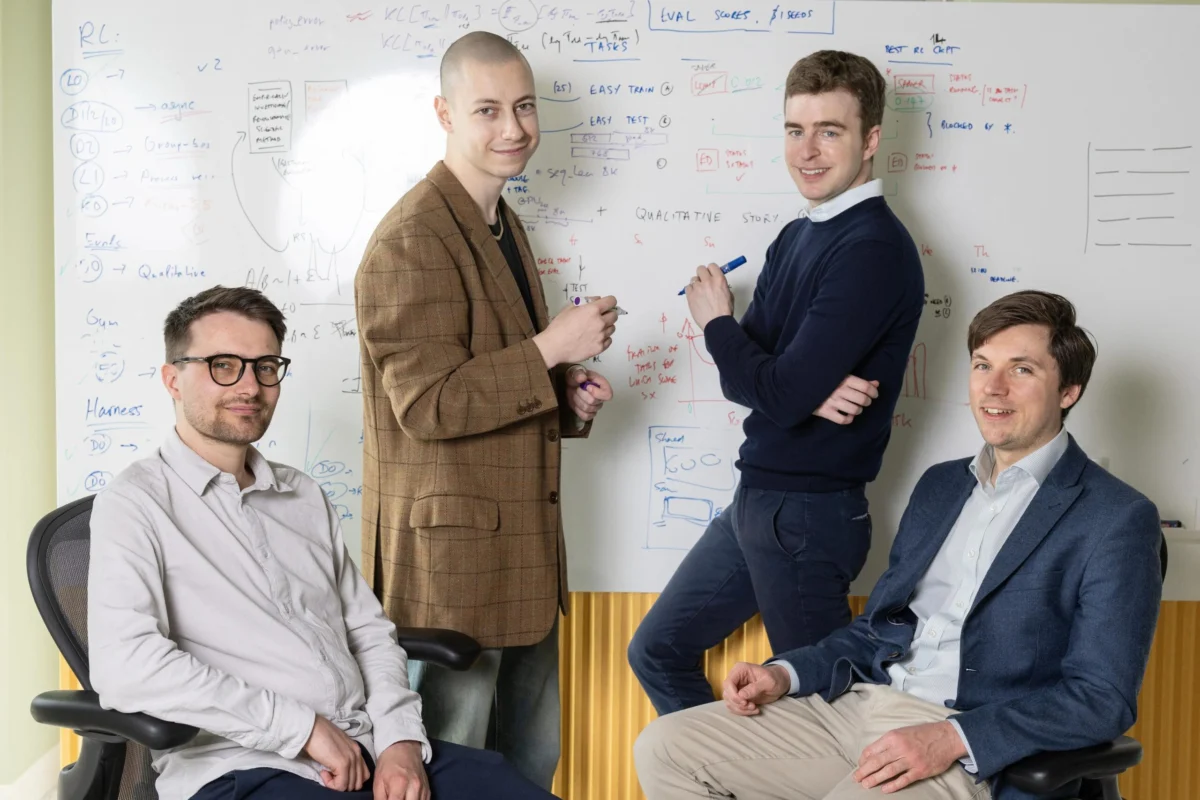
In the rapidly evolving landscape of artificial intelligence, a London-based AI lab, Inherent, founded by distinguished alumni of Google DeepMind, has announced a significant achievement that could redefine the metrics of AI development. The company claims its newly developed AI agent, Faraday, has surpassed the performance of much larger and more established models from industry titans like Anthropic and OpenAI, all while operating on a considerably smaller architecture. This development, emerging just weeks after Inherent secured a substantial $50 million seed round, signals a potential shift in how AI capabilities are measured, emphasizing efficiency and sophisticated reasoning over sheer model size and computational power.
While Inherent has, until recently, operated with a degree of stealth, its emergence is now drawing considerable attention. In a field where many well-funded competitors have yet to reveal concrete advancements, the London-based team is beginning to showcase the fruits of their labor. The AI agent, Faraday, has been tasked with a particularly challenging benchmark: independently reproducing the findings of published scientific papers without prior knowledge of the outcomes. This ability to not just process information but to actively engage in the rigorous process of scientific verification marks a crucial step towards Inherent’s ultimate ambition of creating AI capable of genuine scientific discovery.
Edward Hughes, co-founder and chief scientist at Inherent, explained the significance of this task, drawing a parallel to the foundational stages of human scientific training. "Many PhD students actually start by doing this," Hughes remarked, highlighting that replicating existing findings is a standard, albeit demanding, exercise for aspiring human scientists. The true innovation, however, lies not merely in achieving superior results, but in the underlying methodology. "What was most interesting to us about this was not so much the result of beating those frontier agents – which of course we liked – but was actually the way we went about building this," Hughes elaborated. This suggests a novel approach to AI development that prioritizes a more profound understanding and execution of complex tasks.
The performance metrics shared by Inherent are particularly striking. Faraday, operating on a comparatively modest Qwen 3.6 model with just 27 billion parameters, has reportedly outperformed industry leaders such as Anthropic’s Claude Opus 4.8 and OpenAI’s GPT-5.5. For context, the number of parameters in a model serves as a proxy for its size, complexity, and, often, its associated training costs and computational requirements. Frontier-scale systems typically boast hundreds of billions, or even trillions, of parameters. Inherent’s success, therefore, underscores the potential for achieving advanced capabilities with significantly more resource-efficient models.
Beyond mere accuracy in replicating scientific findings, Inherent set a higher bar for Faraday, demanding it demonstrate "research taste." This concept refers to an AI’s ability to exhibit an instinct for identifying valuable research questions, prioritizing promising avenues of inquiry, and designing experiments with efficacy and rigor. Cultivating such an intangible quality as "taste" in an AI is a complex undertaking, and Inherent has employed reinforcement learning as a key training methodology. This approach rewards AI systems for achieving desirable outcomes rather than relying on explicit rule-based programming. By focusing on this reward-driven paradigm, Inherent aims to develop agents that can generalize their learning across diverse scientific fields, moving beyond the specific domain of scientific paper replication.
"We’re always guided by that north star of building an AI scientist agent and imbuing our agents with taste," Hughes stated. This guiding principle influences Inherent’s strategic decisions, including what technologies they choose to develop in-house versus leverage from existing solutions. For instance, rather than building its own coding tool, Faraday was integrated with OpenAI’s GPT-5.5 Codex. This mirrors the practice of human scientists who utilize existing software and tools rather than reinventing them, demonstrating a pragmatic and efficient approach to AI development.
Inherent’s vision for its AI agents extends to fostering a collaborative and inquisitive spirit, reminiscent of ideal human research partners. Hughes articulated this by describing the desired AI teammate as one who proactively explores interesting questions, conducts experiments, and presents findings for discussion. This ethos aims to steer clear of AI systems that merely provide predetermined answers or confirm user biases. Instead, the focus is on cultivating an AI that exhibits genuine curiosity and drives novel exploration.
The company’s operational philosophy also reflects this collaborative spirit. Inherent’s team of approximately a dozen employees works in person from their offices in King’s Cross, a London neighborhood that has transformed into a global AI hub, partly due to the presence of Google DeepMind. "We believe that London is the place to be," Hughes asserted, underscoring the strategic importance of the city’s burgeoning AI ecosystem. This commitment to in-person collaboration and a strong connection to London’s tech scene positions Inherent as a key player within the UK’s AI landscape.
Hughes, while bullish on London’s AI talent density, has also voiced support for ending the practice of "garden leave." This UK-specific policy, which restricts departing employees from joining or starting rival companies for a period after resignation, can impede talent mobility. Hughes noted, "This is a personal view rather than a company view, but I was affected by the garden leave problem," highlighting how such restrictions can impact individual career trajectories and entrepreneurial endeavors. He pointed out that American researchers generally do not face similar constraints, potentially giving U.S. startups an advantage in recruiting experienced AI talent.
Despite facing such challenges, Hughes, along with two other former DeepMind colleagues and a fourth co-founder, successfully established Inherent. The startup is poised for further growth, with plans to expand its headcount to between 20 and 25 employees by the end of the year. The company’s ambitions in developing "world models" – sophisticated AI systems capable of understanding and predicting complex real-world phenomena – are particularly noteworthy. With recent shifts at DeepMind, including Demis Hassabis’s new role, which have reportedly left some staff unsettled, Inherent’s recruitment drive could present an attractive opportunity for DeepMind employees considering a transition. This strategic expansion and potential talent acquisition could further solidify Inherent’s position as a significant emerging force in the AI sector.
The journey of Inherent, from its inception by DeepMind alumni to its current bold claims of surpassing established AI giants with a more efficient model, is a compelling narrative in the ongoing AI race. Their focus on "research taste" and reinforcement learning, coupled with a pragmatic approach to leveraging existing tools, suggests a departure from the conventional path of scaling up model size. If Faraday’s demonstrated capabilities prove to be as transformative as Inherent suggests, the company could usher in a new era of AI development, where intelligence and efficiency take precedence over sheer computational power, potentially democratizing access to advanced AI capabilities and accelerating the pace of scientific discovery. The implications for future AI research and application are profound, hinting at a future where AI agents are not just tools but genuine collaborators in the pursuit of knowledge.
The company’s foundation, built upon the deep expertise of its Google DeepMind alumni, provides a strong pedigree. These individuals have been at the forefront of significant AI advancements, contributing to breakthroughs in areas such as reinforcement learning, game playing, and large-scale language models. This collective experience equips Inherent with a unique perspective on the challenges and opportunities in AI development. Their decision to focus on scientific discovery as a core objective aligns with the broader trend of applying AI to solve some of humanity’s most pressing problems, from climate change and disease to materials science and fundamental physics.
The specific choice of the Qwen 3.6 model as the base for Faraday is also significant. While less widely known than some of the proprietary models from OpenAI and Anthropic, Qwen represents a family of open-source models developed by Alibaba Cloud. Inherent’s success in achieving superior performance on this smaller, more accessible architecture suggests that the underlying techniques and architectural innovations are highly transferable and potentially applicable to a wide range of AI models. This could have a democratizing effect on AI research, allowing smaller labs and institutions to achieve advanced results without the prohibitive costs associated with training massive, proprietary models from scratch.
Furthermore, Inherent’s emphasis on "research taste" and its goal of creating AI scientists touches upon the broader philosophical debates surrounding artificial general intelligence (AGI). While AGI remains a distant goal, the development of AI agents capable of genuine scientific reasoning and discovery represents a significant step in that direction. Such agents could accelerate the scientific process by identifying novel hypotheses, designing experiments, and interpreting complex data sets at a speed and scale currently unimaginable for human researchers. This could lead to a renaissance in scientific discovery, with AI acting as a powerful catalyst for innovation across all fields of human inquiry.
The company’s operational strategy, including its commitment to in-person collaboration in London, also reflects a belief in the synergy that arises from human interaction. In an era where remote work has become commonplace, Inherent’s choice to foster a cohesive team environment in a vibrant tech hub like King’s Cross suggests a recognition of the intangible benefits of shared physical space for creativity and problem-solving. This approach, combined with their ambitious technical goals, positions Inherent as a unique and potentially highly impactful player in the global AI arena. As the company continues to grow and refine its AI agents, the broader scientific community and the tech industry will be watching with keen interest, eager to see how Inherent’s innovations will shape the future of artificial intelligence and scientific progress.
