
 By Rifan Muazin
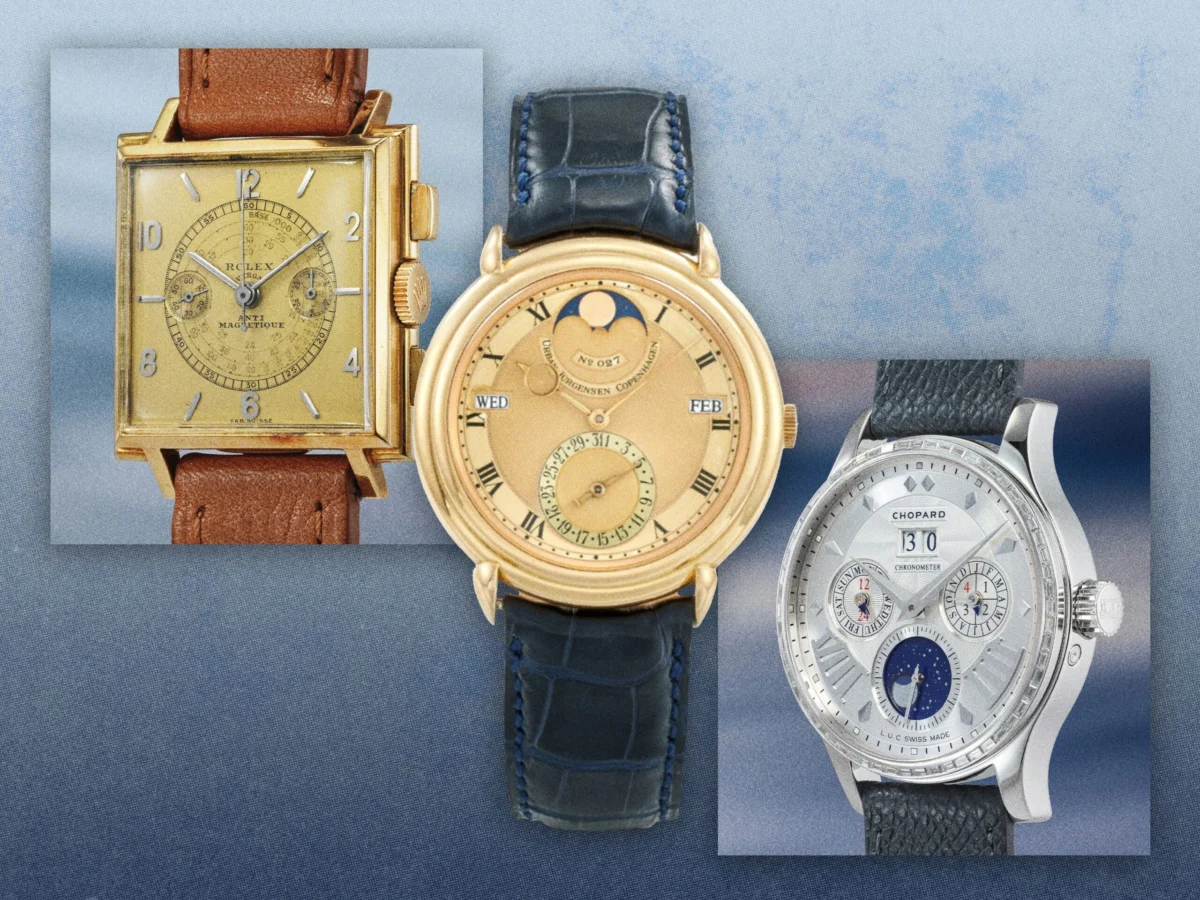
As we look toward the podiums in Geneva over the next few days, several lots stand out as potential record-breakers. Among them is a unique Rolex with a square case that defies the brand’s modern design language and a Patek Philippe split-seconds chronograph in stainless steel that represents the absolute apex of mid-century watchmaking. To navigate this dense landscape of horological treasures, experts Oren Hartov and Cam Wolf have meticulously analyzed hundreds of lots to curate a selection of the most significant pieces hitting the block. These watches are not merely tools for telling time; they are historical artifacts, works of art, and significant financial assets that reflect the evolving tastes of the global elite.

The Experimental Rarity: Rolex ref. 3830 Anti-Magnetique "Verga"
Leading the charge for Rolex is the ref. 3830 Anti-Magnetique, known among scholars as the "Verga." With a starting estimate in excess of $1,210,000, this watch occupies a rarefied space in the brand’s history. Before Rolex became the monolithic entity known for the standardized silhouettes of the Submariner and the GMT-Master, it was a manufacturer characterized by a surprising degree of experimentation. During the early 1940s, Rolex frequently produced one-off pieces and small-batch prototypes, often in collaboration with specific retailers or for high-profile clients.
The ref. 3830 is a "most probably unique" square-cased chronograph. Its architectural, blocky aesthetic is a jarring but fascinating departure from the rounded Oyster cases that would soon define the brand. Interestingly, the case shape bears a prophetic resemblance to the Heuer Monaco, a watch that would not arrive for another quarter-century. This specific example last appeared at auction in 2004, and its reappearance two decades later is a major event for the market. Auction houses often set low estimates to stimulate bidding wars, but when the starting point is seven figures, it signals that the house expects a historic result. The "Verga" is a testament to a forgotten era of Rolex design, making it a "holy grail" for collectors who value uniqueness over the ubiquity of modern professional models.

The Pinnacle of Complication: Patek Philippe ref. 1436 in Stainless Steel
If there is a hierarchy in the world of vintage Patek Philippe, the top tier is reserved for complicated watches cased in stainless steel. Historically, Patek Philippe reserved its most sophisticated movements for precious metals like gold and platinum. Steel was considered a utilitarian material, and very few high-complication watches were ever produced in it. The reference 1436 is a split-seconds (rattrapante) chronograph, a complication that allows the wearer to time two separate events simultaneously. It is one of the most difficult movements to manufacture, requiring a level of watchmaking skill that few brands possessed in the mid-20th century.
This particular ref. 1436 is one of only two known examples in stainless steel. With a high estimate of $4.8 million, it is the crown jewel of the Geneva weekend. Beyond its mechanical complexity, the watch is in extraordinary condition, a factor that can double or triple the value of a vintage piece. For the ultra-high-net-worth collector, a steel 1436 represents the ultimate "stealth wealth" statement—a watch that looks modest to the uninitiated but is recognized by experts as one of the rarest mechanical objects on the planet.

The German Icon: A. Lange & Söhne Lange 1 in Stainless Steel
While Geneva is the heart of Swiss watchmaking, the German manufacture A. Lange & Söhne has earned a seat at the table of the "Big Three." The Lange 1, with its asymmetrical dial and outsize date, is the brand’s most iconic design. Like Patek Philippe, Lange almost exclusively uses precious metals. However, in the late 1990s, a very small number of Lange 1 models—estimated at around 30 pieces—were produced in stainless steel.
The example appearing this weekend features a striking two-tone blue dial, a configuration that was not original to the watch but was later fitted by the manufacture, making it one of only two known stainless steel Lange 1s in this specific navy-blue setup. With a high estimate of approximately $365,800, it reflects the growing "Lange-mania" among collectors who appreciate the brand’s uncompromising finishing and Teutonic design language. The rarity of steel Langes cannot be overstated; they are the "white whales" of the brand’s modern era.

The Independent Revival: Urban Jürgensen ref. 2
The market for independent watchmaking has exploded in recent years, and Urban Jürgensen is currently experiencing a renaissance. This is largely due to the brand’s relaunch under the guidance of legendary watchmaker Kari Voutilainen. While Voutilainen has since transitioned from CEO to a board role, his influence has brought renewed scrutiny to the brand’s back catalog.
The ref. 2 from the early 1990s is a masterpiece of neo-classical design. Housed in a 37.7mm yellow gold case, it features "cornes-de-vache" (cow horn) lugs and a perpetual calendar with a moonphase. The dial work is quintessential Jürgensen, featuring the brand’s signature observatory-style hands. With a high estimate of roughly $121,940, it represents a significant opportunity for collectors who are priced out of vintage Patek perpetual calendars but want the same level of hand-finishing and historical weight. The brand has even caught the attention of cultural tastemakers like Timothée Chalamet, further cementing its status as a "connoisseur’s choice."

Technical Artistry: Chopard L.U.C. Lunar One ref. 171927
Chopard’s L.U.C. division (named after founder Louis-Ulysse Chopard) is often described as the "best-kept secret" in high-end Swiss watchmaking. The Lunar One is a technical tour de force, being the first Chopard watch to combine a perpetual calendar with an orbital moonphase. This particular reference, estimated at $36,600, is a visual marvel. The icy aesthetics of the dial, paired with Roman numerals that seem to stretch and curve under the weight of the complications, give it a unique architectural presence.
What makes this lot particularly interesting are the accompanying accessories. The watch comes with onyx prayer beads and a diamond-set pen and ring, suggesting it was originally commissioned for a client with a penchant for coordinated luxury. For the collector, the L.U.C. Lunar One offers a level of horological "haute couture" that rivals the Holy Trinity (Patek, Vacheron, Audemars) but at a more accessible price point.

The History of the Oyster: Rolex ref. 3525 ‘Bariletto’
While the Daytona dominates modern Rolex headlines, the ref. 3525 ‘Bariletto’ is far more important to the brand’s technical history. Dating to the 1940s, the 3525 was the very first Rolex chronograph to be housed in the water-resistant Oyster case. This specific example is unique because it bears the signature of "Proud’s," a prominent Rolex retailer in Sydney, Australia.
Coming from the legendary collection of Pucci Papaleo, the world’s foremost authority on Rolex chronographs, this stainless steel piece is estimated at $609,000. Its compact 36mm size and "beads-of-rice" bracelet represent the elegance of 1940s tool watches. The "Bariletto" (Italian for "little barrel") earned its nickname from its thick, sturdy case profile. It is a watch for the "scholar-collector"—someone who values the evolution of waterproof technology as much as the aesthetics of the dial.

The Academic Sleeper: Patek Philippe ref. 2509 ‘School Watch’
Not every million-dollar watch looks like one. The Patek Philippe ref. 2509 "School Watch" is a perfect example of a "sleeper" lot. On the surface, it is a clean, 35mm stainless steel dress watch. However, a closer look at the dial reveals the signature "Ecole d’Horlogerie Geneve" instead of the Patek Philippe logo. This watch was assembled and finished by a student at the Geneva Watchmaking School in the 1960s using Patek Philippe components.
The movement is signed by the student, Norbert Henry, making this a unique piece of horological history. School watches are highly prized because they often exhibit a level of finishing that exceeds standard production models, as the students were being graded on their perfectionism. With a high estimate of $30,400, it is a relatively affordable way to own a unique Patek Philippe movement with a fascinating academic provenance.

Mid-Century Elegance: Vacheron Constantin ref. 4072
Vacheron Constantin is often unfairly overshadowed by Patek Philippe at auction, but the ref. 4072 is proof that Vacheron’s mid-century chronographs are second to none in terms of beauty. This yellow gold example from the late 1940s features a multi-scale dial with both tachymeter and telemeter scales, used for measuring speed and distance, respectively.
The condition of the dial is remarkable, with crisp printing and applied Roman indices that have aged gracefully. Powered by the cal. V 492, this watch is a masterclass in proportion and lug design. With an estimate of approximately $48,777, it offers a level of sophistication and rarity that would cost hundreds of thousands of dollars if it bore a Patek logo. It is a watch for a collector who prioritizes aesthetic purity over brand hype.

The Art of Enamel: Universal Genève Cloisonné
Before its decline in the late 20th century, Universal Genève was a giant of Swiss horology. This pink-gold model features a cloisonné enamel dial depicting Saint George and the Dragon. Cloisonné is an incredibly difficult technique where thin gold wires are used to create "cells" that are then filled with colored glass powder and fired in a kiln.
The result is a dial with vibrant, permanent colors that look more like a stained-glass window than a timepiece. As Universal Genève prepares for a high-profile relaunch under the ownership of Breitling, interest in vintage UG pieces is surging. This enamel piece, estimated at $36,600, is not just a watch; it is a miniature piece of wearable art that celebrates the ancient legend of chivalry.

The Cult of the Independent: F.P. Journe Accessories
The market for F.P. Journe has reached such a fever pitch that collectors are now vying for the brand’s ephemera. This weekend, auction houses are selling everything from empty boxes to toys resembling the founder. However, the standout non-wristwatch lot is a large stainless steel wall clock designed to look like the Octa Réserve de Marche.
Estimated at $73,200, this clock brings Journe’s iconic design language into the home. While it is powered by a quartz battery—a fact that might disappoint mechanical purists—its visual impact is undeniable. It serves as a symbol of the "Journe-mania" that has gripped the market, where anything touched by François-Paul Journe is treated with religious reverence.

The Aviator’s Legacy: Longines Lindbergh Hour Angle
For those seeking historical significance without the seven-figure price tag, the Longines Lindbergh Hour Angle is a compelling lot. Based on a design developed by Charles Lindbergh in 1931 to help pilots calculate longitude, this 1980s reissue captures the spirit of the golden age of aviation.
With its icy-blue dial, Roman numerals, and specialized rotating bezel, it is a highly functional tool that happens to be exceptionally elegant. Paired with a "beads-of-rice" bracelet, its estimate of $2,500 makes it one of the few accessible entries in an otherwise hyper-expensive weekend. It proves that great design and history can still be found at more modest price points.

The Culture of Rolex: The GMT-Master Poster
Finally, as a testament to the cultural power of watch brands, a vintage Rolex advertisement is hitting the block with a high estimate of $4,900. The poster features a GMT-Master wearing a tiny, snow-dusted Rolex-branded beanie. In the world of "Rolexiana," such items are highly collectible, reflecting a time when the brand used whimsy and charm to sell its professional tools. It serves as a reminder that the world of vintage watches is not just about gears and springs; it is about the stories, the marketing, and the community that has grown around these tiny mechanical wonders. As the hammers begin to fall in Geneva, the results will provide a definitive map of where the luxury market is headed in 2025 and beyond.
