
 By admin
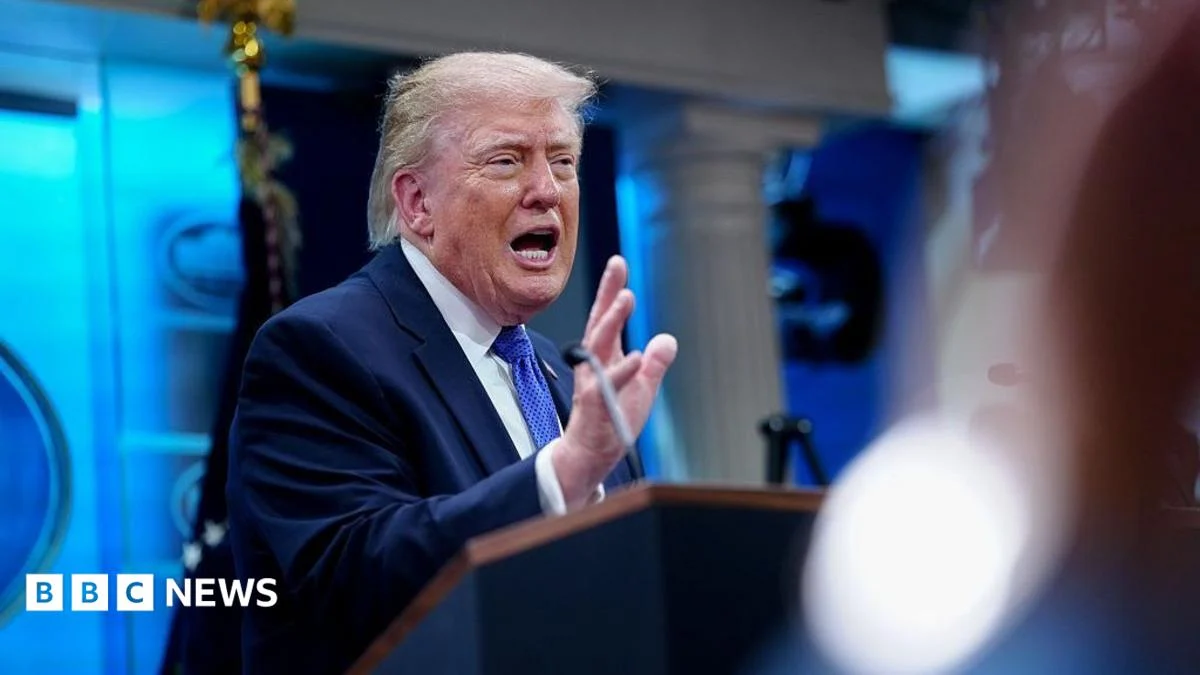
In a bold and potentially disruptive declaration, former President Donald Trump has announced his intention to impose a "tremendous tax" on American technology companies that choose to build Artificial Intelligence (AI) data centers overseas, signaling a strong desire to repatriate such critical infrastructure to the United States. Speaking to reporters following his return from an international trip to Asia, Trump stated, "We’re going to keep it all in this country," articulating a vision where the burgeoning AI sector, and its foundational data centers, remain firmly within American borders. The announcement, however, was characterized by a distinct lack of detailed policy specifics, with Trump himself admitting that many within his administration were hearing about the potential directive for the first time. This impromptu revelation suggests a policy still in its nascent stages, driven by a protectionist impulse and a concern for national economic and technological sovereignty.
The issue of data centers has emerged as a significant point of contention in recent political discourse. Earlier in November, data centers were a central focus during the midterm elections, with numerous Democratic candidates pledging to implement stricter regulations on their construction and operation. These calls for regulation stem from growing concerns regarding the environmental impact of data centers, particularly their substantial energy consumption and water usage, as well as issues like noise pollution and their visual impact on rural landscapes. Trump’s pronouncement, while seemingly aligned with a desire to bolster domestic industry, offers a contrasting approach, prioritizing national control over development rather than regulatory oversight for environmental or community concerns.
The move by Trump directly challenges the current trajectory of major tech giants such as Meta and Google, who have actively entered into agreements to establish data centers in foreign territories. These international expansions are often driven by a confluence of factors, including access to cheaper energy, favorable regulatory environments, proximity to growing markets, and the availability of skilled labor. Trump’s proposed policy, if enacted, would create a significant financial disincentive for these companies, potentially forcing them to reconsider their global expansion strategies. The practicalities and enforcement mechanisms of such a policy remain highly ambiguous, raising questions about how the government would monitor and penalize companies for overseas construction.
"We’re not going to allow our companies to build data centers outside of our country," Trump reiterated, framing the issue as a matter of national security and economic competition, particularly with China. He explicitly stated, "Because China will take all of them, and we’re not allowing that to happen." This sentiment underscores a broader geopolitical anxiety about China’s growing technological prowess and its potential to leverage advanced computing infrastructure for its own economic and military advantage. The fear is that if American companies offshore their data center construction, they may inadvertently contribute to China’s technological dominance by providing resources or expertise that could be co-opted.
The timing of Trump’s statement is also noteworthy, coming shortly after a significant announcement by the U.S. government that would restrict the export of advanced computer chips and control access to the computing power they provide. This earlier directive, issued earlier in the week, mandates that firms require a license to purchase advanced chips, enabling U.S. officials to monitor their end-use and prevent them from reaching Chinese companies or being smuggled into China. This dual approach – restricting chip exports and now aiming to control data center construction – reflects a coordinated strategy to safeguard American technological leadership and mitigate perceived risks associated with China’s rise. The impact of these policies extends to Southeast Asian countries that have invested heavily in data centers, often with the expectation of serving Chinese companies seeking to rent computing power from overseas locations.
Data centers are the indispensable bedrock of the current AI revolution. These vast, warehouse-style facilities house the sophisticated computer chips and powerful servers that are essential for processing the immense datasets and complex algorithms that drive advanced AI programs like OpenAI’s ChatGPT and Anthropic’s Claude. The demand for data center capacity has surged exponentially as AI capabilities have advanced, leading to a global race to build and expand these critical infrastructure hubs.
According to data from the Pew Research Center as of April, the United States was home to approximately 3,000 operational data centers, with an additional 1,500 in various stages of planning and construction. Many of these facilities are strategically located in rural areas, often chosen for their access to abundant and affordable electricity, as well as available land. However, their proliferation has also sparked local opposition, with residents and environmental groups raising concerns about noise pollution generated by cooling systems, the significant demand on local power grids, and the potential strain on water resources. These community-level concerns have influenced political campaigns, as evidenced by the successes of Democratic candidates who promised tougher regulations on data center construction in the recent midterm elections.
Trump’s approach, however, offers a different perspective on how to leverage the benefits of data centers while mitigating potential downsides. "You ought to take advantage of the data centers. Make them pay you, make them pay your community, but take advantage don’t shut them off," he advised, suggesting a model where communities can profit from hosting data centers while ensuring their development is beneficial. He emphasized the existing opportunities, stating, "We have a lot of places that want them badly, and they’re great places. They have energy and they have everything. They’re tremendous assets." This framing suggests a focus on incentivizing and controlling development to maximize national and local economic gains, rather than imposing restrictive regulations.
The phenomenon of "AI hyperscalers," referring to the large tech firms making massive investments in AI, has also led to global diversification of data center development. Canada, for instance, has actively sought to position itself as an attractive alternative location for these facilities. The Canadian government and provincial authorities have made efforts to streamline approval processes and address local concerns, leading to increased investment. Meta has already broken ground on a significant data center project in Alberta, and Anthropic, another prominent AI company, has secured a long-term lease for a proposed data center in Nova Scotia. These developments highlight the global competition for AI infrastructure and the strategic importance of attracting these investments.
Google, a major player in the AI space, also announced a substantial investment of approximately £13 billion (equivalent to $15 billion USD) in AI infrastructure in Finland earlier in September. This investment included funding for three new data centers. However, the construction of two of these centers faced a significant hurdle last month when building work was halted due to environmental concerns regarding the clearance of over 300 hectares of forest land. Trump specifically called out this Finnish development, stating his administration would have prevented such an occurrence, reinforcing his commitment to keeping AI infrastructure within the U.S.
The implications of Trump’s proposed policy are far-reaching. If enacted, it could fundamentally alter the global landscape of AI infrastructure development. Tech companies would face a stark choice: either absorb the "tremendous tax" on overseas construction or significantly scale back their international expansion plans. This could lead to a concentration of AI computing power within the United States, potentially accelerating domestic innovation but also raising concerns about increased domestic energy demand and environmental impact. Furthermore, it could stifle the growth of AI ecosystems in other nations that are seeking to leverage this technology for economic development.
The statement also raises questions about the practical feasibility of such a policy. The U.S. government would need to establish robust mechanisms for monitoring international investments by tech firms, which could prove to be a complex and resource-intensive undertaking. Defining what constitutes an "AI data center" and how to track its construction and operation across international borders would require intricate regulatory frameworks. Moreover, imposing such a tax could invite retaliatory measures from other countries, potentially leading to trade disputes and a fragmentation of the global digital economy.
The rhetoric surrounding AI and data centers is increasingly intertwined with national security and economic competition. As AI becomes more sophisticated and integrated into critical sectors, the control over the infrastructure that powers it is seen as a strategic imperative. Trump’s proposal, while potentially protectionist, taps into a growing sentiment that the benefits of this powerful technology should accrue to the nation that fosters its development. However, the path from a public declaration to a fully implemented and effective policy is often fraught with challenges, and the specifics of how Trump intends to achieve his goal remain to be seen. The tech industry will undoubtedly be watching closely as this narrative unfolds, grappling with the potential ramifications for their global operations and future investments. The debate over where and how AI infrastructure is built is no longer just a technical or economic consideration; it has become a significant geopolitical and national strategic issue.
