
 By Rifan Muazin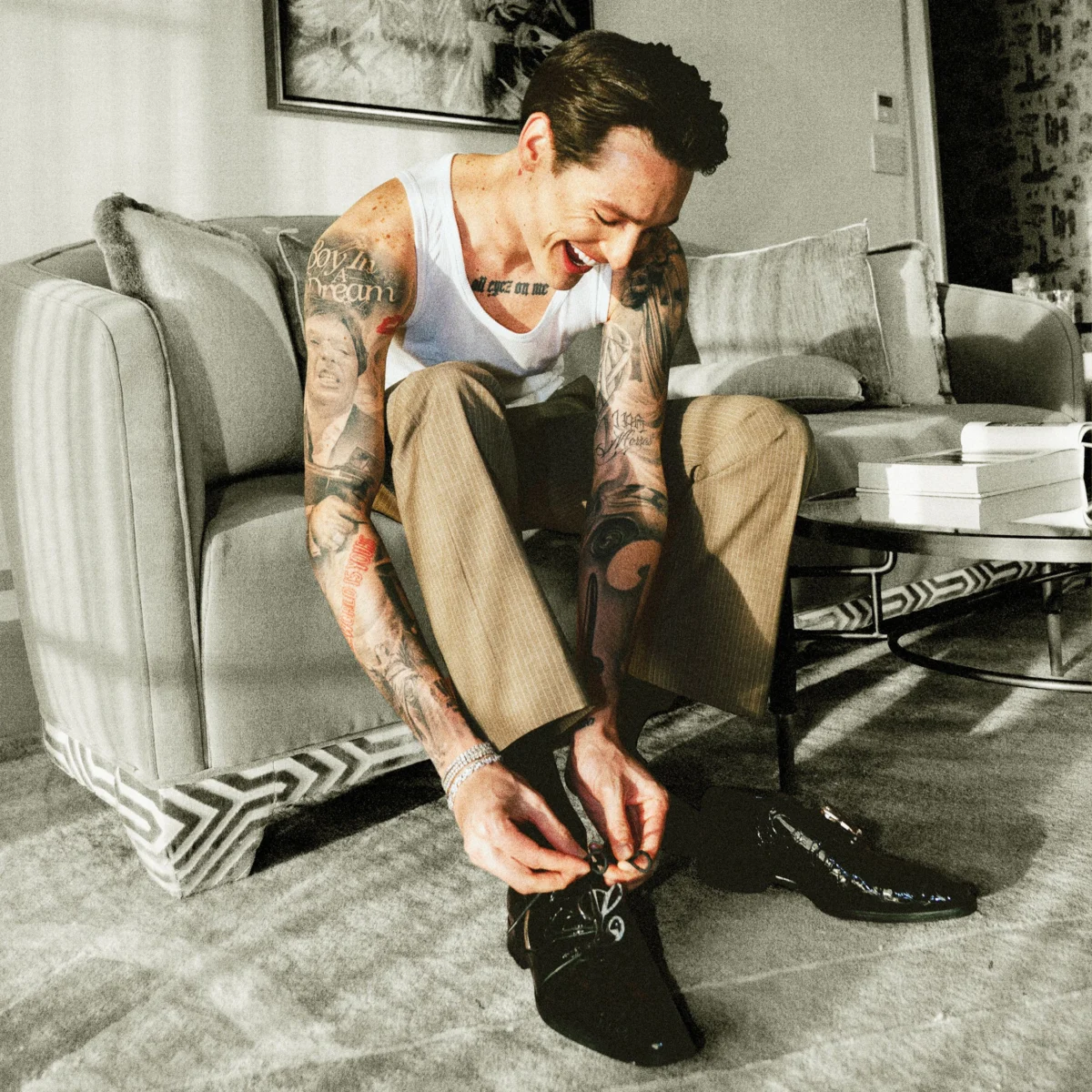
If you have to take an hourlong drive to a show during New York Fashion Week, you might as well do it at sunset on the Westside Highway, overlooking the orange-glazed Hudson River, blasting “Chan Chan” by Compay Segundo out the window of a blacked-out Escalade, dripping in diamonds with a massive Chanel bag in tow. This is not just a commute; it is a curated experience, a cinematic transition from the chaotic energy of Manhattan to the architectural grandeur of Queens. This is how Peso Pluma—the Mexican powerhouse who has single-handedly redefined the global reach of regional Mexican music—approaches the world of high fashion.
When the 25-year-old singer, rapper, and record label CEO, born Hassan Emilio Kabande Laija, is asked to introduce himself for a ride-along video, he does so with the effortless bravado that has become his trademark. Grabbing the microphone with a grin that balances youthful mischief with the confidence of a veteran mogul, he declares: “Hi GQ, I’m him. The Double P. Peso Pluma in the house.”
The "Double P" is currently in the midst of a career trajectory that defies traditional industry logic. Having dropped his critically acclaimed album DINASTÍA last year, following the massive success of Génesis, he has moved beyond the labels of "regional" or "niche." He is a global phenomenon, a Billboard chart-topper, and now, a front-row fixture at the most prestigious events in the fashion calendar. On this particular Monday evening, he is en route to the Luar Spring/Summer ’27 show, held at the iconic Unisphere in Flushing Meadows-Corona Park.
The choice of the Unisphere—a 120-foot-wide stainless steel globe commissioned for the 1964 World’s Fair—is significant. Standing adjacent to the grounds of the recently concluded US Open, the location serves as a homecoming for Luar’s founder and creative director, Raul Lopez. Lopez, a Dominican-American designer who grew up in Queens, has become one of the most influential voices in contemporary fashion, known for his ability to blend "uptown" luxury with "downtown" grit.

The show, titled “Christopher Street Columbus,” is a complex exploration of identity, history, and geography. It represents a convergence of two distinct "Christophers" in Lopez’s psyche: Christopher Street, the historic epicenter of New York’s queer nightlife and a place of liberation for the designer; and Christopher Columbus, the figure who represents the haunting, inextricable legacy of colonization for the Dominican diaspora. For Peso Pluma, the trek from the city to the outer boroughs was a small price to pay to witness Lopez’s vision.
“I got invited by Raul to last year’s runway, and it was pretty dope,” Peso says, reflecting on his growing relationship with the brand. “It was a different runway from the ones that I’ve been to, and I just loved it. I just love how the Latino community was supported by Raul.”
This support is a two-way street. As Peso Pluma brings the sounds of the Mexican streets to the global stage, designers like Lopez are bringing the aesthetic of the Latino diaspora to the runways of New York and Paris. Peso is fully fitted out in Luar for the evening, though the oppressive New York humidity means he is only wearing half the look for the ride. His jacket—a structured piece with an asymmetrical collar—remains in the trunk for safekeeping until he reaches the red carpet. For the drive, he keeps it relatively casual: light brown pinstripe trousers, sturdy black boots, and a ribbed white tank top that serves as a canvas for his extensive collection of tattoos. Some of these ink pieces, he notes, were finalized or discussed during his previous interactions with the fashion press, marking the milestones of his rapid ascent.
Peso Pluma describes himself as an “accessories guy,” and the details of his outfit bear this out. He has topped off the look with a pair of 1990s-style tiny sunglasses, a stack of diamond bracelets that catch the fading sunlight, and a timepiece that demands immediate attention from horological enthusiasts: an Audemars Piguet Royal Oak Flying Tourbillon Openworked. The watch is a masterpiece of Swiss engineering, a "grail" piece that signals both immense wealth and a sophisticated appreciation for craftsmanship.
However, the piece de resistance of his ensemble is his most recent big purchase. “Get me the Chanel bag,” he says with a smile, gesturing toward a massive bowling bag in rich brown suede. In an era where "micro-bags" once dominated, Peso is leaning into the return of the oversized carryall—a trend GQ has championed as the "ludicrously capacious" bag for the modern man. When asked what he keeps inside such a formidable accessory, Peso’s answer is as blunt as it is extravagant: “Cash, jewelry, watches, perfume.”

The aesthetic Peso is channeling—a mix of pinstripes, heavy jewelry, and oversized leather goods—is what he and his style icon Jay-Z might refer to as “drug dealer chic.” It is a look that subverts traditional notions of professional attire, infusing corporate silhouettes with the swagger of the street. When discussing his fashion lodestars, Peso lists an eclectic mix of influences: the timeless elegance of Yves Saint Laurent, the boundary-pushing provocations of Kanye West, and the modern heartthrob sensibilities of Jacob Elordi.
Yet, despite these influences, Peso Pluma is adamant about the importance of originality. “Always be you,” he advises with the conviction of someone who has had to fight for his own creative voice. “Don’t copy. Just go with whatever you love, whatever you like. Don’t care about what people are going to say or judge. You just go by your look, by what you like, by what you love, and just be you.”
This philosophy extends beyond clothing into the realm of personal grooming. For Peso, high fashion is nothing without a foundation of self-care. “Take a shower. Brush your teeth. Just be clean. And have your nails on point,” he says, emphasizing that the "Double P" brand is built on a standard of excellence that starts with the basics.
As the interview concludes, the interior of the Escalade is once again filled with music. This time, it is Peso’s own discography. Even the driver, a seasoned New Yorker who has likely seen it all, begins to nod along to the rhythm of the corridos tumbados. To the left, the Hudson River swallows the last of the sun, leaving a trail of orange and purple in its wake. A cool breeze enters through the cracked windows, providing a brief respite from the city’s heat.
The scene is a testament to the cultural shift currently taking place. For decades, the American music and fashion industries operated in silos, often relegating Latin American artists to specific categories or "Latin nights." Today, Peso Pluma is not an outlier; he is the center of gravity. His presence at a Luar show in Queens is a symbolic bridge between the traditional fashion establishment and the new global majority.

When the vehicle finally arrives at the Unisphere, the atmosphere is electric. The massive globe is illuminated against the night sky, and a crowd of fashion insiders, celebrities, and Queens locals has gathered to see Raul Lopez’s latest creation. Peso’s jacket finally emerges from the trunk, completing the pinstripe suit. With the high collar fastened and his Chanel bag slung over his shoulder, he steps out into the flashbulbs.
The Luar show itself is a triumph, a masterclass in storytelling through fabric. Lopez’s designs for the SS27 collection play with the idea of "The New World," reimagining colonial silhouettes through a queer, Caribbean lens. There are exaggerated shoulders, deconstructed tailoring, and a sense of drama that mirrors Peso Pluma’s own stage presence.
As the models circle the Unisphere, the significance of the moment is lost on no one. This is New York Fashion Week at its most vibrant—diverse, defiant, and deeply rooted in the community. For Peso Pluma, the evening is another chapter in his ongoing metamorphosis from a regional star to a global icon. As he navigates the crowd, stopping for photos and greeting fellow artists, it is clear that he is no longer just a guest in the world of high fashion; he is one of its most compelling protagonists.
The ride back to Manhattan will likely be just as loud and just as stylish. As for the interviewer, the night leaves a lasting impression—and a new addition to the playlist. The haunting, melodic strains of “Chan Chan” linger in the air, a reminder that whether in a recording studio in Mexico or a fashion show in Queens, Peso Pluma is always exactly where he is supposed to be. He is him. The Double P. And he is just getting started.
