
 By admin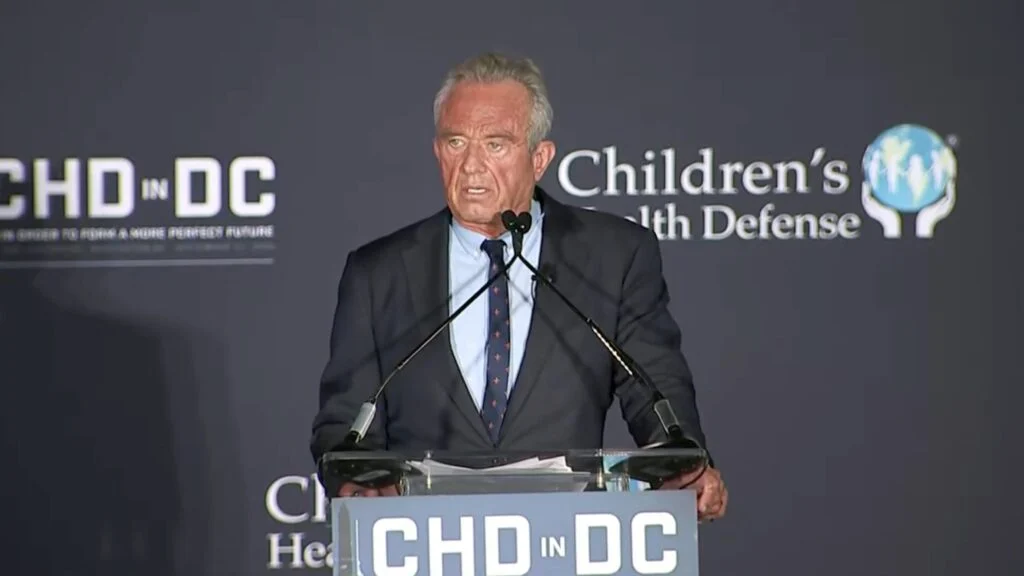
WASHINGTON — Health and Human Services Secretary Robert F. Kennedy Jr. returned to his ideological home on Thursday, delivering a provocative keynote address at a conference hosted by Children’s Health Defense (CHD), the influential anti-vaccine nonprofit he helped build into a global powerhouse. The appearance, which functioned as both a homecoming and a political victory lap, signaled a definitive shift in the administration’s public health priorities just weeks before midterm elections that many analysts view as a critical referendum on the "Make America Healthy Again" (MAHA) movement. While Kennedy has spent much of his tenure focusing on food safety and corporate influence in the pharmaceutical industry, his remarks on Thursday placed vaccine skepticism back at the center of the federal health agenda, marking a significant departure from decades of established medical consensus.
The atmosphere inside the conference ballroom was electric, filled with long-time supporters who have viewed Kennedy as a lone voice in the wilderness for nearly two decades. For Kennedy, the speech was an opportunity to reconcile his new role as the nation’s top health official with his legacy as a firebrand activist. In the early months of his appointment, Kennedy had frequently downplayed his specific focus on vaccines, choosing instead to emphasize broader "unity" themes such as removing ultra-processed foods from school lunches and scrutinizing the "revolving door" between regulatory agencies and big pharma. However, on Thursday, the rhetorical gloves came off. He framed his agenda not just as a reform of the Department of Health and Human Services (HHS), but as a total dismantling of the "orthodoxy" that has governed American medicine since the mid-20th century.
Kennedy’s address began with a retrospective of his first year in office, highlighting the administration’s efforts to "flip the food pyramid" and eliminate specific chemical additives from the American diet. He spoke at length about the HHS’s new scrutiny of hospital meals and the "toxic load" placed on children by environmental factors. Yet, the tone shifted noticeably when he moved into more controversial territory, discussing his agency’s ongoing investigations into electromagnetic frequencies (EMF) and the widely debunked theory of "chemtrails"—atmospheric phenomena that conspiracy theorists claim are chemical agents sprayed by aircraft. These topics served as a bridge to his primary focus: the safety and necessity of the U.S. childhood immunization schedule.
"The question we must ask, and the question this department is finally brave enough to ask, is: Should we be looking at the potential that some of these chronic illnesses are associated with vaccines?" Kennedy asked the crowd. As he spoke, a massive image of a package insert for the Hepatitis B vaccine was projected onto the screens behind him. Kennedy focused specifically on the "Adverse Reactions" section of the insert, pointing to a clinical trial that involved 147 healthy infants and children. He criticized the methodology of the study, noting that the subjects were monitored for only five days and that the trial lacked a traditional saline placebo. "There’s no way any other product would get FDA approval with that few people," Kennedy asserted, drawing a roar of approval from the audience.
To understand the weight of Kennedy’s critique, one must look at the history of the Hepatitis B vaccine. The Food and Drug Administration (FDA) and the Centers for Disease Control and Prevention (CDC) have long defended the approval process, noting that the trial of 147 participants cited by Kennedy was a "bridging study." This type of study is common in vaccinology; it compares a new version of a vaccine to an older, already proven version to ensure it elicits the same immune response. The safety profile of the Hepatitis B vaccine is supported by decades of post-marketing surveillance and larger-scale studies involving tens of thousands of children worldwide. Public health experts frequently point to the "newborn dose" of the vaccine as a miracle of modern medicine. Before universal newborn vaccination was implemented, thousands of children were infected with Hepatitis B annually, often through mother-to-child transmission at birth, which carries a 90% risk of the infection becoming chronic and leading to liver cancer or cirrhosis later in life. Since the policy’s inception, chronic Hepatitis B infections among American children and teens have plummeted by 99%.
However, the Trump administration’s recent decision to end the recommendation for universal newborn vaccination—a move heavily influenced by Kennedy—has created a rift in the medical community. Critics argue that removing the birth dose leaves infants vulnerable to transmission from household members or caregivers whose infection status may be unknown. Kennedy, conversely, argued on Thursday that the risk-benefit analysis has been skewed by "captured" regulators. He spent more than 20 minutes casting doubt on the safety of the entire vaccine schedule, suggesting that the American public has "no idea" about the true risk profile of shots that have been administered tens of millions of times. While he conceded that serious harm might be "very rare," he repeatedly suggested—without providing specific peer-reviewed evidence—that vaccines are a primary driver of the "epidemic of chronic illness" in the United States, including autism, ADHD, and autoimmune disorders.
This narrative relies heavily on a specific interpretation of vaccine package inserts. Federal law requires vaccine manufacturers to list every adverse event reported during clinical trials and post-marketing surveillance, regardless of whether a causal link has been established. As the Hepatitis B insert itself notes, "it is not possible to reliably estimate their frequency or establish a causal relationship to a vaccine exposure." Despite this disclaimer, Kennedy linked the 18 vaccines previously recommended for children to a list of 454 adverse events, including diabetes, Sudden Infant Death Syndrome (SIDS), and asthma. Medical experts, such as those at the American Academy of Pediatrics, have consistently noted that these conditions occur at similar rates in both vaccinated and unvaccinated populations, but Kennedy’s rhetoric has found a receptive audience among parents disillusioned with the healthcare system.
The Secretary’s speech also served as a policy roadmap for the coming year. He revealed that HHS is currently conducting "deep-dive" research into more than 150 of the most serious adverse events reported after vaccination. This initiative is part of a broader task force review of the safety, timing, and sequence of the childhood vaccination schedule—a project that Kennedy promised would be the most "transparent and exhaustive" in history. To support this, Kennedy is leveraging the vast health databases of Medicare, Medicaid, and private insurers to perform retrospective studies on "vax versus unvax" outcomes. This type of research has been a cornerstone of Kennedy’s demands for years, though mainstream scientists argue that such studies are often confounded by "healthy user bias," where families who choose not to vaccinate often have different socioeconomic backgrounds and health behaviors that influence long-term outcomes.
A major pillar of Kennedy’s reform plan involves the Vaccine Adverse Event Reporting System (VAERS). Kennedy has long criticized VAERS as a "broken, antiquated" system that captures only a fraction of actual vaccine injuries. On Thursday, he announced plans to automate the system and, notably, to compensate doctors for the time it takes to submit detailed reports of suspected side effects. "In our country, we care about rare illnesses and deaths," Kennedy said. "We care about every child who dies from measles. They get headlines." This mention of measles was particularly poignant, as the United States is currently grappling with several significant outbreaks, including a cluster in Pennsylvania that has resulted in at least four deaths. Public health officials have attributed these outbreaks to declining vaccination rates in specific communities, a trend they say has been exacerbated by the very rhetoric Kennedy championed at the conference.
The political stakes of Kennedy’s address cannot be overstated. By appearing at the CHD conference, he has effectively merged the "fringe" anti-vaccine movement with the mainstream of the executive branch. President Trump has increasingly embraced Kennedy’s ideology, recently signing an executive order that encourages "diversity of thought" in federal health recommendations and limits the ability of the CDC to issue mandates. Kennedy emphasized this alliance on Thursday, telling the crowd, "Let me be clear: You have a strong and steadfast friend at the White House." This partnership represents a tectonic shift in the GOP’s approach to health care, moving away from traditional deregulation of the insurance market toward a populist, "health freedom" platform that challenges the authority of scientific institutions.
As Kennedy concluded his remarks and walked offstage to a standing ovation, the symbolic weight of the event was driven home by the introduction of the next speaker: Andrew Wakefield. The former British physician, who was stripped of his medical license after his 1998 study linking the MMR vaccine to autism was found to be fraudulent and retracted by The Lancet, remains a pariah in the scientific community but a hero in the room on Thursday. The juxtaposition of the sitting Secretary of Health and Human Services sharing a stage—even sequentially—with the father of the modern anti-vaccine movement was a moment that many observers thought impossible only a few years ago.
The implications of this shift extend far beyond the borders of the United States. For decades, the U.S. FDA and CDC have set the "gold standard" for global health policy. If the United States moves to dismantle its vaccination infrastructure or officially questions the safety of long-standing immunizations, it could trigger a global cascade of vaccine hesitancy, potentially leading to the resurgence of diseases like polio and rubella that have been nearly eradicated. For the attendees at the CHD conference, however, this is not a risk, but a necessary correction. As the midterm elections approach, the "MAHA" movement’s influence will be tested at the ballot box, but within the walls of the HHS, the Kennedy era has already begun to rewrite the rules of American public health. The "victory lap" in Washington was more than just a speech; it was a declaration that the skepticism once confined to the margins of society now sits at the highest table of power.
