
 By admin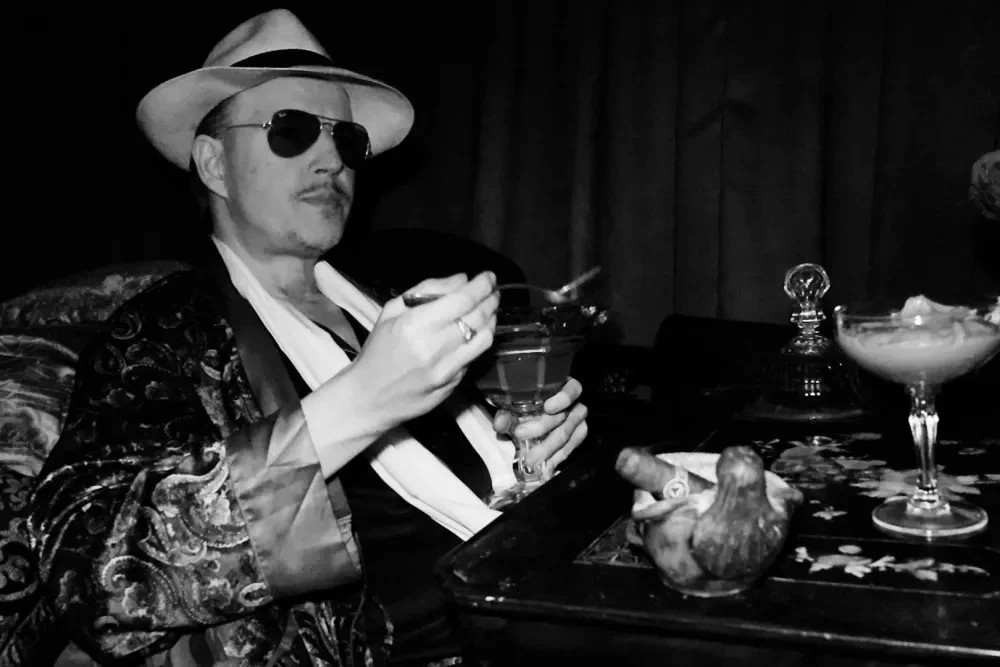
Yesterday’s punk, grunge, and rebel-outsider upstarts have an uncanny way of evolving into today’s elder statesmen of respectable infamy. Think of the enduring legacies of John Waters, Patti Smith, John Lydon, Henry Rollins, and Robin Byrd – artists who, while never fully shedding their provocative edges, have earned a certain reverence. However, it is highly doubtful that Dutch director Tom Six will ever find himself in such a pantheon of latter-day prestige. His deliberate and unwavering desire to stand apart, to remain defiantly outside the mainstream of critical acceptance and artistic accolades, is too profound to ever be reconciled with such a trajectory.
For those unfamiliar with his work, Tom Six is the architect behind the notoriously grotesque "Human Centipede" trilogy, a series of horror films so profoundly disturbing that the mere idea of enduring them would be an insurmountable deal-breaker for an overwhelming majority of moviegoers. Six, however, was never aiming for the broad appeal of the general public. His target audience was always the select three percent – those who actively seek out and thrive on shock, transgression, and the pushing of societal boundaries. This is the demographic that understands that a horror film capable of making even seasoned genre veterans squirm, forcing them to watch portions through interlaced fingers, is either a film that has irrevocably crossed a line into the unwatchable… or, conversely, a film that precisely defines the very essence of true horror. The "Human Centipede" films, particularly "The Human Centipede 2 (Full Sequence)," a hellacious, operatic "Götterdämmerung" of torture porn, definitively embodied both of these extremes.
Released in 2009, 2011, and 2015, and primarily consumed through Video on Demand services, the "Human Centipede" films carved out an extreme, almost cultish niche at the very periphery of global movie culture. Yet, despite their extreme nature, they inexplicably found a perverse yet undeniable mainstream foothold. They transcended their niche status to become a cheeky, often referenced meme, appearing in beloved shows like "South Park," "The Simpsons," "Saturday Night Live," "Unbreakable Kimmy Schmidt," the blockbuster film "Deadpool 2," the cult classic "Beavis and Butt-Head," and even in Childish Gambino’s music video for "Bonfire." Tom Six’s ambition was not to achieve respectability; his explicit goal was to journey as far as humanly possible in the opposite direction. However, he was undeniably courting notoriety and fame, a pursuit he masterfully executed by operating within the tradition of carny-barker freak shows and the self-marketing strategies of exploitation-world titans. Filmmakers like Herschell Gordon Lewis, Russ Meyer, Ted V. Mikels, and, of course, John Waters, all specialized in cultivating an aura of on-the-fringe danger, meticulously crafting an underground mystique that was intrinsically linked to their success. Waters, for instance, famously built his trash-art empire and considerable fortune on the back of midnight-movie circuit screenings of films like "Pink Flamingos," a testament to the power of transgressive marketing.
"The End of Tom Six," a DIY schlock-umentary that paradoxically functions as a genuine documentary, explores how Tom Six meticulously crafted and marketed his films with this very spirit of provocative exhibitionism. However, it also chronicles the tragic unraveling of his "dark dream" – a descent into personal horror after his diagnosis with multiple sclerosis (MS). Six first received this devastating diagnosis fourteen years ago. For a significant period, he managed to keep the symptoms of his progressive and incurable illness under control, and more importantly, in secret. But the relentless nature of MS has taken its toll. For the past six years, Six has lived as a recluse in his Amsterdam home, largely confined to his bed. His excursions are limited to twice-daily outings for decaf coffee, as regular caffeine is too harsh on his now-shattered nervous system. "The End of Tom Six" serves as a self-styled, confessional memoir, a space where Six courageously fuses his life, his career, and his debilitating illness into a profound and often unsettling parable. Through his narrative, he poses crucial questions about the contemporary landscape of cinema: Is there still room for films that deliberately stray over the line, that challenge comfort and convention? And if not, what does this profound shift signify for the future of artistic expression and societal discourse?
The film opens with stark, black-and-white, noirish imagery of an Amsterdam canal. The street lanterns cast an eerie glow, conjuring an atmosphere reminiscent of Victorian London from "Dr. Jekyll and Mr. Hyde." This visual preamble is accompanied by a doomy, romantic Hollywood/classical score, before the words "The End…" appear in old-fashioned lettering, followed by the poignant subtitle "…of Tom Six." This stylistic choice immediately signals that the film will indeed chronicle the twilight of Tom Six’s life. However, it quickly becomes apparent that the narrative is deeply interwoven with the story of how he made his films, how he meticulously cultivated and sold his provocative image, and how he continues to do so even in the face of extreme adversity. At moments, the audience may even question whether his public battle with MS is an elaborate, Andy Kaufman-esque performance art piece. While the reviewer states they do not believe this to be the case, they concede that such a possibility wouldn’t be entirely out of character for Six’s penchant for theatricality.
The film then transitions into the intimate confines of Six’s home. We find him reclining on an antique Chinese opium bed, clad in a paisley silk bathrobe, sporting a dandified mustache, a Panama hat, and dark aviator sunglasses. He is seen smoking a Havana cigar, exuding an aura that suggests a fascinating collision of Hunter S. Thompson’s rebellious spirit, Michael O’Donoghue’s darkly comedic sensibility, and a svelte, Europeanized version of Rainer Werner Fassbinder. Six is not alone; he is surrounded by a small, carefully curated crew and entourage. His paramour, Marci (Maartje Willems), beams and insinuates with a Morticia Addams-like charm. The film’s director, also portrayed by Six himself, wields a megaphone. The cinematographer, boom operator, and even a butler are all played by the dwarf actor Edwin Alofs, adding a layer of surreal spectacle. A uniformed Nazi figure (Servaes Nelissen) looms, seemingly tasked with the grim duty of identifying trigger warnings and potential subjects for censorship. Rounding out this peculiar ensemble is a first assistant director (Demian Kurosa), who sports the look of a tattooed circus performer and speaks with a post-operative vocoder.
Six expertly intercuts scenes of himself with this eccentric gallery of characters, injecting the narrative with B-movie dialogue reminiscent of "All About Eve," such as the exchange, "Alcohol is killing you slowly, baby." "That’s okay, I’m not in a hurry." This playful banter effectively lightens the tone, purging the film of excessive self-pity and breaking up what is essentially an extended, amusing, and irascibly witty monologue of self-justification from Tom Six. The question arises: Is "The End of Tom Six" strictly for fans of his previous work? Unequivocally, yes. However, the reviewer counts themselves among the rare three percent who, after enduring "The Human Centipede 2," found a glimmer of the awesome within its profound awfulness. This experience is likened to reading the Marquis de Sade’s "The 120 Days of Sodom" – works that are not recommended for general consumption but, in their own disturbing way, can be seen to expand one’s understanding of human evil.
The reviewer expresses a keen interest, after fifteen years, in discovering the true nature of Tom Six as a person. They are eager to hear his explanations to his audience regarding his artistic motivations for creating such controversial films, how this creative process shaped his life and experiences – evidenced by his statement, "To this day, I get marriage proposals and death threats" – and to listen to his personal diary of debilitating illness. "The End of Tom Six" is not a work of conventional true-life body horror. Six articulates his symptoms and his extensive drug regimen, including Oxycodone for chronic pain, with a disarming, tough understatement. However, at one point, he candidly admits, "I’m a fucking living X-ray. I’ve got massive brain fog from all the medications. My thoughts are like scrambled eggs." This raw honesty underscores the personal toll his illness has taken.
A significant portion of Six’s narrative is dedicated to his most recent cinematic endeavor, "The Onania Club," a film he made after the completion of the "Human Centipede" trilogy. This film, he explains, centers on a group of chic women in Los Angeles (with Chloë Sevigny among the cast) who derive sexual arousal from the suffering and misery of others. Six describes it as a story about the antithesis of empathy, a commentary on the erosion and potential demise of our capacity for compassion.
Tom Six completed "The Onania Club" in 2019. Despite his struggles to secure distribution for the "Human Centipede" films, he had ultimately succeeded. With those films having permeated popular consciousness, he anticipated no difficulty in finding a distributor for a project he considered less grotesque and more thematically serious. To his profound disappointment, however, no distributor would touch "The Onania Club." The consistent refrain he received was, "The marketplace has changed." This euphemism clearly indicated a reluctance to engage with the controversy that such a film might ignite in an increasingly censorious cultural climate. Six claims that the immense stress stemming from this professional rejection exacerbated his illness, portraying his health crisis as a crucifixion reinforced by a clampdown society. While the reviewer acknowledges they must take his word on this assertion, and admits to not having seen "The Onania Club" due to its unreleased status, they offer a definitive concluding thought. "The End of Tom Six," a curious artifact of underground cinephilia, is undeniably worth viewing for the vital question it compels the audience to confront: Do we desire the arena of cinema to be a space where anything can happen, a frontier for unfettered artistic exploration, or do we prefer it to be a safe, sanitized space, devoid of challenging or uncomfortable content?
