
 By Rifan Muazin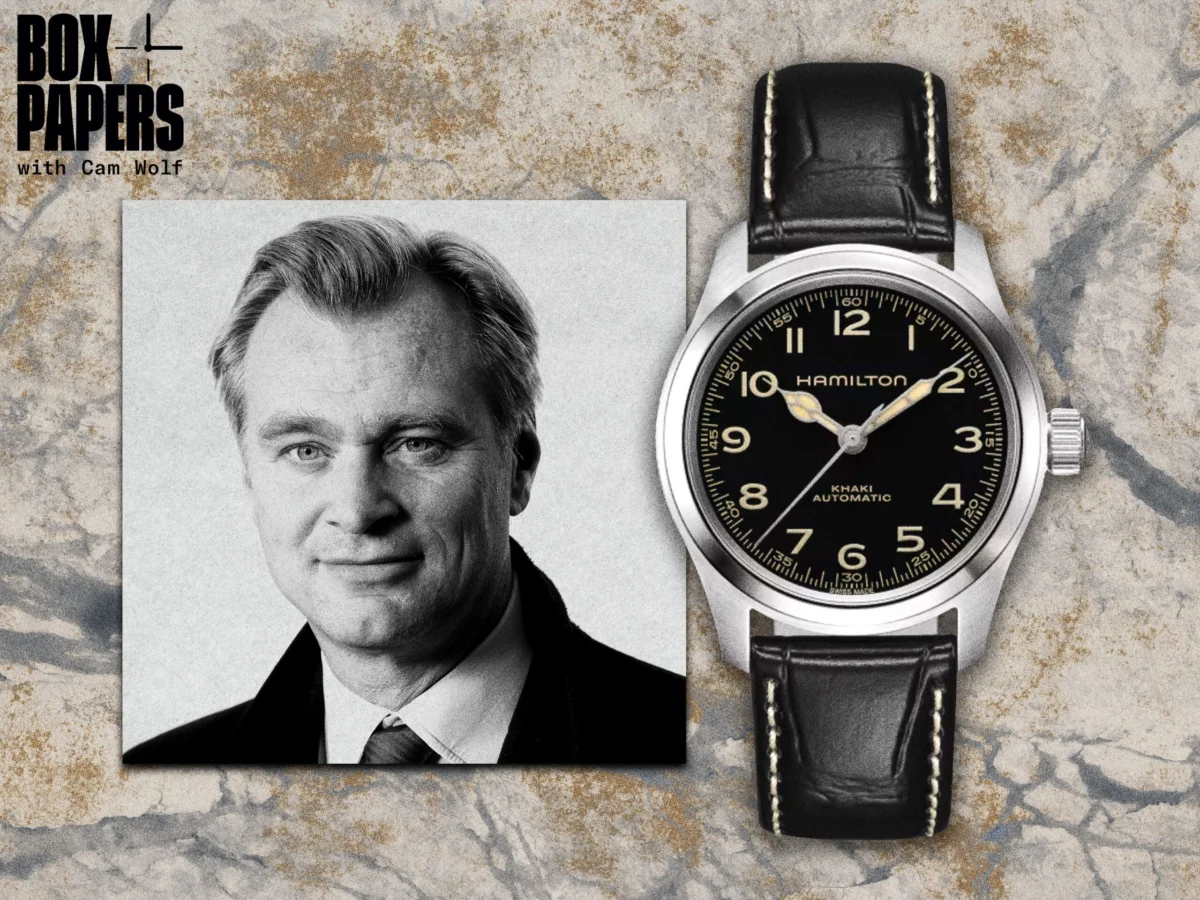
Early in Christopher Nolan’s 2014 science fiction masterpiece Interstellar, the protagonist Joseph Cooper, played by Matthew McConaughey, offers a poignant lesson in semantics to his inquisitive young daughter, Murphy. As she questions why she was named after something that implies bad luck, Cooper explains, “Murphy’s law doesn’t mean that something bad will happen. It means that whatever can happen, will happen.” This line serves as more than just a comforting father-daughter moment; it establishes the thematic foundation for a film where the impossible becomes inevitable through the medium of time, gravity, and a very specific wristwatch. In the narrative, the character of Murph eventually grows up to save the human race from extinction, but in the parallel reality of the watch industry, the timepiece that shares her name has achieved its own form of immortality, evolving from a fictional prop into an essential cornerstone of the entry-level luxury market.
The Hamilton Khaki Field Murph was not a product of traditional market research or a trend-following design board. Instead, it was born out of a specific cinematic necessity. When Christopher Nolan was filming Interstellar, he required a watch that could serve as a literal bridge between dimensions—a conduit through which a father could communicate Morse code to his daughter across the vastness of a fifth-dimensional tesseract. Hamilton, a brand with a deep-seated history in Hollywood dating back to 1932, was tasked with creating a watch that felt both historically grounded and narratively significant. The result was a vintage-inspired variation of their iconic Khaki Field line. However, for five years after the film’s release, the "Murph" remained a phantom. It existed only on screen and in the feverish dreams of watch enthusiasts who flooded forums with requests for a commercial release. When Hamilton finally yielded to public demand in 2019, they didn’t just release a movie tie-in; they unleashed what would become an unlikely patron saint of the horological community.
In the half-decade since its commercial debut, the Murph has transitioned from a piece of memorabilia to a staple of the Hamilton catalog. Its popularity is perhaps most visible in the digital trenches of Reddit, specifically the r/watches subreddit, where it is treated with a level of reverence usually reserved for watches ten times its price. Nicholas Franklin, a seasoned collector and moderator of the community, notes that for many entering the hobby with a budget between $700 and $1,000, the Murph is often the first recommendation. The watch has achieved a rare "timeless" status, a term frequently tossed around in the industry but seldom earned by pieces with such a specific, pop-culture origin. On digital forums, the purchase of a Murph is often celebrated as a rite of passage. Users post photos of their new acquisitions with captions that border on the religious, claiming the watch is so versatile and well-designed that it has effectively "ruined" the rest of their collection.
What makes the Murph’s ascent so fascinating is how it has managed to shed its "movie watch" label while retaining the soul of the story that created it. To understand its appeal, one must look at the design language of the Hamilton Khaki Field family. The standard Khaki Field is arguably Hamilton’s most famous model, defining the "field watch" aesthetic in the same way the Rolex Submariner defines the diver. Its roots trace back to the 1940s, when Hamilton produced over a million watches for the U.S. military during World War II. The traditional Khaki Field is a masterclass in utility, often featuring a 24-hour inner track and a rugged, brushed finish. However, some enthusiasts find the standard dial a bit "busy." The Murph offers a cleaner, more sophisticated alternative.
The Murph’s dial is a study in understated elegance. It eschews the cluttered military tracks of its siblings in favor of a layout that takes cues from early 20th-century "trench" watches and mid-century explorer pieces. The most striking features are the cathedral-style hands—a vintage flourish that adds a touch of romanticism to an otherwise utilitarian tool. The hour hand, with its distinctive "onion" bulb, provides a visual weight that balances the slim, needle-like seconds hand. In a subtle nod to the film, the original 42mm release featured the word "Eureka" printed in Morse code on the seconds hand—a detail so fine it is almost invisible to the naked eye, mirroring the way the watch functioned in the movie.
The watch’s crossover appeal was solidified when it began appearing on the wrists of figures far removed from the sci-fi fandom. Recently, it was spotted on Tim Walz, the vice-presidential candidate, during his 2024 campaign trail. For a politician looking to project an image of reliability, tradition, and "everyman" pragmatism, the Hamilton Murph is a perfect choice. It is a watch that suggests its wearer values substance over flash, and history over hype. It is a "GADA" watch—Go Anywhere, Do Anything—equally at home in a muddy field as it is under the cuff of a dress shirt.
The technical specifications of the Murph further justify its cult status. Beneath the dial beats the H-10 automatic movement, a workhorse caliber produced by the Swatch Group (Hamilton’s parent company). The H-10 is a significant upgrade over the standard ETA movements found in many watches at this price point, offering a staggering 80-hour power reserve. This means a wearer can set the watch down on a Friday evening and pick it up on Monday morning without needing to reset the time—a luxury typically associated with high-end Swiss horology. The case is finished with a mix of brushed and polished surfaces, and the sapphire crystal ensures durability against the rigors of daily life.
However, the Murph’s journey wasn’t without its critiques. When the 42mm version was first released, many enthusiasts with smaller wrists complained that the long lug-to-lug distance made it wear too large. Hamilton, in a move that demonstrated a rare level of attentiveness to the enthusiast community, responded in 2022 by releasing a 38mm version. This "Baby Murph" became an instant sensation, offering the same cinematic DNA in a package that adhered to the modern trend toward smaller, more vintage-appropriate proportions. This responsiveness from the brand helped cement the Murph’s place as a "fan-favorite" in the literal sense.
The success of the Murph highlights a unique phenomenon in the relationship between Hollywood and the watch industry. Traditionally, brands pay for product placement to associate their watches with the glamour of a character—think James Bond and his Omega Seamaster or Steve McQueen and the TAG Heuer Monaco. In those cases, the watch is an accessory to the man. In Interstellar, the watch is a character in its own right. As Francesca Ginocchio, Hamilton’s CEO, points out, time is not merely a measurement in Christopher Nolan’s films; it is a narrative force. Because the watch was integral to the plot’s resolution, it carries a weight of "purpose" that most marketing-driven collaborations lack.
Hamilton’s relationship with cinema is unparalleled. From the futuristic, triangular Ventura worn by Elvis Presley in Blue Hawaii and later by the agents in Men in Black, to the custom-made "BeLOWZERO" diver used in Tenet, the brand has positioned itself as the go-to collaborator for directors who care about the mechanical reality of their worlds. Nolan, in particular, has returned to Hamilton repeatedly. For his 2023 film Oppenheimer, the brand sourced authentic vintage watches from the 1940s to ensure historical accuracy, and for Tenet, they spent months developing a digital-analog hybrid that could withstand the rigors of a high-action set. Yet, despite these high-profile projects, none have achieved the standalone commercial and cultural success of the Murph.
The reason for this may lie in the "Black Hole" effect Nicholas Franklin describes. The Murph has reached a point where its quality and design are so self-evident that its origin story is no longer its primary selling point. People like Patrick Branigan, a newcomer to the watch world, are buying the Murph simply because it is a "really damn good watch." Branigan, who purchased his Murph after seeing it in a boutique in Dallas, admitted he didn’t even know it was a movie watch until after he had already fallen in love with it on his wrist. This is the ultimate goal for any collaborative product: to transcend its source material and become a classic in its own right.
As the watch industry continues to grapple with the rise of smartwatches and the fluctuating secondary market for luxury "hype" pieces, the Hamilton Khaki Field Murph stands as a testament to the enduring power of good design and honest storytelling. It occupies a "Goldilocks" zone in horology—expensive enough to feel like a significant achievement for a new collector, yet accessible enough to remain a democratic choice. It is a watch that honors the past through its aesthetic and the future through its cinematic heritage. Whether it’s being used to save a dying planet through the power of gravity or simply being worn by a teacher-turned-politician on a campaign bus, the Murph proves that whatever can happen, will happen—and usually, it happens on a Hamilton.
