
 By Rifan Muazin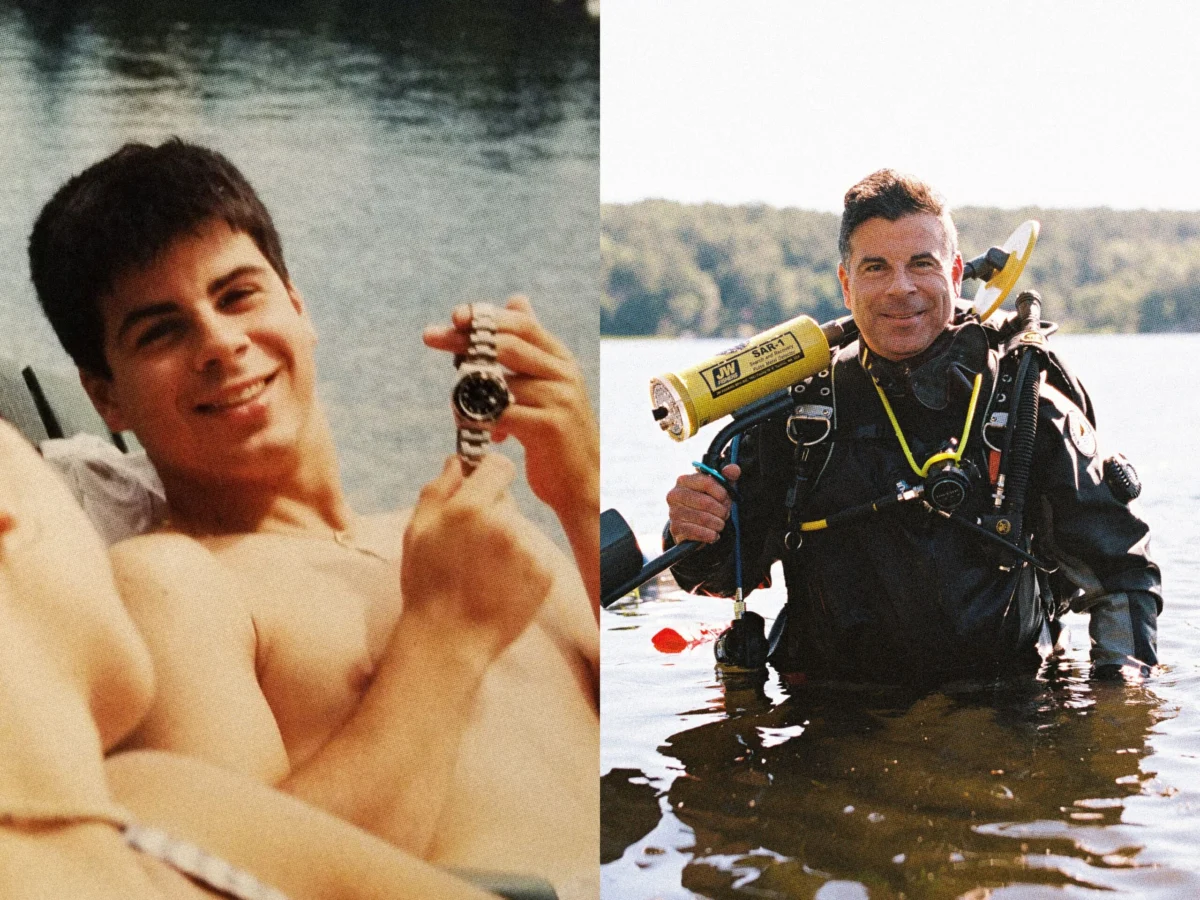
Deep within the rugged expanse of the Adirondack Mountains, where the dense canopy of hemlock and pine swallows the reach of modern cellular networks, sits Trout Lake—a glacial remnant of pristine water and quiet isolation. For Tom Place, a 48-year-old veteran of the Hollywood stunt industry, this landscape is more than a retreat; it is the site of a decades-long archaeological mission. While the world may recognize Place through his formidable IMDb credits—performing high-octane sequences as a gun-toting henchman, a precision driver, or a gritty New York City officer—the residents of this Upstate New York community know him for a different kind of persistence. For over thirty years, Place has been a regular fixture beneath the surface of Trout Lake, a SCUBA tank strapped to his back, methodically scouring the silty bottom for a piece of his own history: a Rolex Submariner lost in the summer of 1996.
The story of the lost watch is inextricably linked to the trajectory of Place’s life and the traditions of a family built on grit and professional excellence. The Place family’s connection to the Adirondacks dates back to 1979, and by 1991, they had established their own cabin on the shores of Trout Lake. This setting served as the backdrop for Tom’s formative years, a place where he honed the physical resilience that would later define his career in film and television. Even now, as an "old head" in a grueling industry, Place maintains the discipline of a younger man, often running the six-mile perimeter of the lake in the early morning mist. He entered the stunt world in the 1990s, observing early on that many veterans lacked the cardiovascular endurance required for long, repetitive fight scenes. Determined not to suffer the same fate, Place has treated his body as a high-performance machine, a necessity in a profession where the margin for error is measured in inches and milliseconds.
The Rolex Submariner was meant to be the mechanical counterpart to that physical discipline. In the Place household, a Rolex was not merely a luxury item; it was a symbol of survival and success. Tom’s father, a veteran of the Vietnam War, returned from service to find success as a commodity trader at the New York Cotton Exchange, then located at #4 World Trade Center. To celebrate his professional ascent, he purchased matching Rolex watches for himself and his wife. For the next two decades, those watches were permanent fixtures on their wrists. Tom recalls his father wearing his Datejust while performing oil changes, painting the family shed, and even SCUBA diving. This "one-watch" philosophy—the idea that a high-quality mechanical timepiece should accompany a man through every trial and triumph of life—deeply influenced Tom.
In 1996, at the age of 18, Tom decided to cement his own adulthood by purchasing a Rolex Submariner Date, reference 16610. It was an ambitious purchase for a teenager, costing $3,100—his entire life savings at the time. When adjusted for inflation, that amount represents roughly $6,100 in today’s currency, but the market value of a well-maintained 16610 has surged far beyond that, often fetching between $10,000 and $14,000 on the secondary market today. At the Mayor’s Jewelers in Brandon, Florida, Tom had faced a choice: he could have opted for a more affordable Tudor Submariner for just $990, or a GMT-Master II with the iconic "Coke" bezel. However, the Submariner’s reputation as the ultimate "tool watch" won him over. Built with a 3135 caliber movement—widely considered one of the most robust and reliable mechanical movements ever produced—the 16610 was designed to withstand 300 meters of water pressure and the rigors of professional diving. It was the perfect watch for a burgeoning stuntman.
The loss of the watch occurred just months later, during a summer afternoon defined by the kind of reckless bravado unique to 18-year-olds. Tom and his brother were out on the family’s 17-foot speedboat, the Calypso 2000, practicing a self-invented sport they called "power jumping." The activity involved sprinting across the deck of the boat and launching into the lake with various flips, rolls, and dives. During one fateful leap, Tom’s foot slipped on the wet deck. As he tumbled sideways toward the water, his Submariner caught on the boat’s railing. In a fraction of a second, the tension was too much for the watch’s spring bar—the small, spring-loaded metal pin that secures the bracelet to the watch case. As Tom fell into the depths, he watched in slow-motion horror as the $3,100 timepiece flew in the opposite direction, disappearing into the dark, cold waters of Trout Lake.

Since that day, the search for the Submariner has evolved from a frantic immediate recovery effort into a lifelong obsession. Searching for a small metallic object in a glacial lake is a monumental challenge. Trout Lake, like many Adirondack bodies of water, features a bottom composed of thick silt, decaying organic matter, and fallen timber. An object as heavy as a stainless-steel Rolex can quickly sink into the soft sediment, becoming invisible to the naked eye within hours. Furthermore, the lake’s thermoclines—layers of water with drastically different temperatures—and limited visibility make sustained underwater searches physically demanding.
Despite these obstacles, Place has never truly given up. Over the decades, his search methods have matured alongside his career. He has utilized modern SCUBA gear and refined his search grids, treating the lake floor like a forensic site. To an outsider, the search might seem futile, but to Place, the watch represents more than its weight in 904L stainless steel. It represents the "grail" in the truest sense—an object of immense personal value that was lost just as his journey into adulthood and the film industry was beginning.
The technical endurance of the Rolex itself provides a glimmer of hope. Unlike electronic devices, a mechanical Rolex Submariner is remarkably resilient to the elements. If the crown remained screwed down tight, the interior movement could theoretically remain dry for decades. Even if water eventually breached the seals, the high-grade steel and sapphire crystal would likely remain intact, waiting to be cleaned and serviced. There are documented cases of Rolex watches being recovered from the ocean floor after years of submersion and being restored to perfect working order. This possibility fuels Place’s persistence.
The search also serves as a meditative counterpoint to the chaos of Place’s professional life. In Hollywood, his days are filled with controlled explosions, high-speed chases, and choreographed violence. The Adirondacks offer the opposite: silence, cold water, and the slow, rhythmic sound of a respirator. The quest for the watch has become a ritual of the summer, a way to stay connected to his family’s history and the cabin that has been a constant in his life since 1991.
From a collector’s perspective, the story of Tom Place’s lost Submariner adds a layer of "provenance" that money cannot buy. In the world of vintage watches, the story behind the piece is often as valuable as the piece itself. Should he ever find it, the watch would not just be a 16610; it would be the "Stuntman Submariner," a survivor of thirty years in the Adirondack depths.
As the sun sets over Trout Lake, casting long shadows across the dirt road that leads to the Place cabin, Tom Place remains undeterred. He knows the odds are against him, and he knows the lake does not give up its secrets easily. Yet, the same grit that allows him to take a fall on a concrete movie set and get back up for a second take keeps him returning to the water. The watch is out there, buried beneath three decades of silt and memory, and as long as Tom Place has air in his tank and strength in his limbs, the search will continue. It is a testament to the enduring power of a "grail" watch—not just as a tool for telling time, but as a vessel for the stories we tell about ourselves. For Place, the Submariner is not just a lost luxury; it is the one that got away, and in the quiet depths of the Adirondacks, he is determined to bring it home.
