
 By admin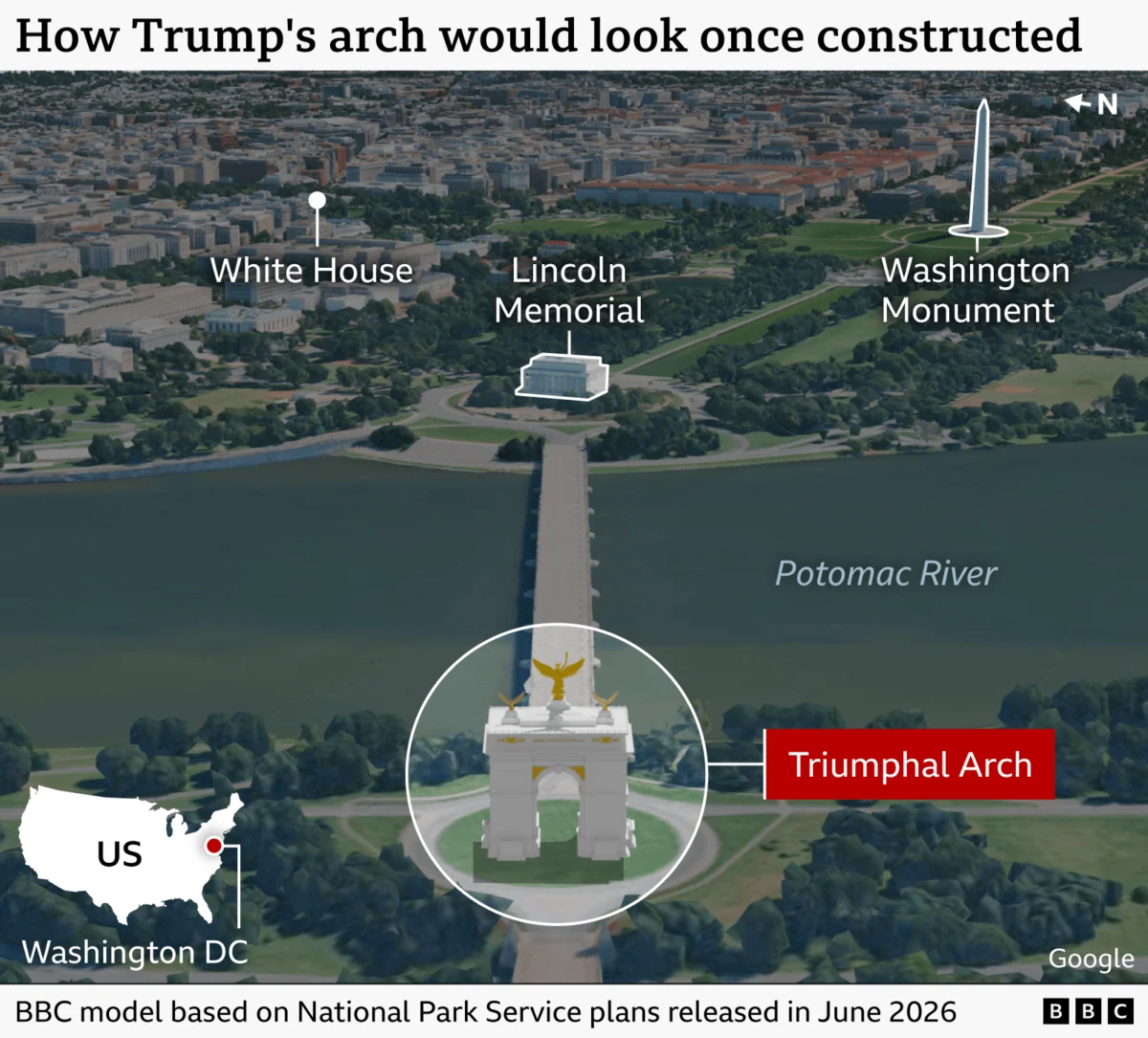
In a startling escalation of his ambitious architectural vision for the U.S. capital, former President Donald Trump has announced that his proposed triumphal arch will be significantly reimagined as a state-of-the-art military complex. This repurposed monument, intended to stand as a symbol of national pride and power, will now incorporate advanced military capabilities, including facilities for drone deployment and strategically positioned sniper nests. Trump revealed these updated plans on his social media platform, Truth Social, asserting that the modifications were made at the "strong request" of the U.S. military and are deemed crucial for "national security purposes."
The envisioned structure, described by Trump as a "top grade" military complex, is slated to "house, store, and have the rapid ability to use large numbers of drones, plus Snipers, on both the roof and plaza areas, and additionally have and hold large quantities of sniper ammunition in storage." This ambitious integration of military hardware into a public monument marks a significant departure from its initial conceptualization and raises profound questions about the intersection of national symbolism, defense strategy, and public infrastructure. Details regarding the precise construction timeline and the specific logistical requirements for such a sophisticated military installation remain undisclosed. It is also unclear what additional governmental approvals or inter-agency coordination would be necessary to realize this dual-purpose project, especially given its proximity to sensitive national landmarks.
Trump’s pronouncements underscore his continued fascination with monumental architecture and his desire to leave a tangible, imposing legacy on Washington D.C. He expressed his belief that this unique structure would be unparalleled globally, stating, "There will be no facility like this anywhere in the World." He further elaborated on his rationale, asserting that among "the 59 top cities and Capitals," Washington D.C. is "the only one in the world that does not have a triumphal arch," though he did not specify the list of these 59 cities or the criteria for their selection. This assertion, while subjective, highlights a perceived gap in symbolic urban design that Trump aims to fill with his monumental project.
The original design for the arch, revealed earlier this year, depicted a majestic 250-foot structure positioned across the Potomac River from Washington D.C., near Arlington National Cemetery. Initial renderings showcased a golden, winged Statue of Liberty crowning the apex, flanked by two golden eagles. The sides of the arch were to be inscribed with the patriotic phrases "One Nation Under God" and "Liberty and Justice for All." At its planned 250-foot (76-meter) height, the arch would significantly dwarf the 99-foot Lincoln Memorial and stand at half the height of the iconic Washington Monument, thus becoming a prominent and dominant feature of the capital’s skyline. The scale and ambition of the original design already positioned it as one of Trump’s most significant infrastructural aspirations during his tenure.

The evolution of the project into a military complex suggests a confluence of aesthetic ambition and perceived strategic necessity. The inclusion of drone deployment capabilities and sniper positions implies a proactive, albeit controversial, approach to national security architecture. Drones, in their various forms, have become indispensable tools for surveillance, reconnaissance, and even offensive operations in modern warfare. Their integration into a public monument raises questions about the intended audience and purpose of such a facility. Is it a purely symbolic deterrent, a training ground, or a forward operating base integrated into the heart of the nation’s capital?
The strategic placement of snipers, ostensibly for defense or rapid response, also invites scrutiny. While urban environments often necessitate security measures, embedding such capabilities directly into a monumental structure could be interpreted in various ways. It could be seen as a demonstration of unwavering vigilance and a commitment to immediate threat neutralization, or conversely, as an unsettling projection of an omnipresent security apparatus. The reference to storing "large quantities of sniper ammunition" further emphasizes the operational readiness envisioned for this complex.
The Department of Defense, when contacted for comment on these developments, declined to provide further details, adding an element of official reticence to the unfolding narrative. This lack of transparency, while not uncommon in matters of national security, fuels speculation about the scope and implications of Trump’s latest pronouncements.
Trump’s administration has been characterized by a series of high-profile construction and renovation projects aimed at reshaping the physical landscape of Washington D.C. These initiatives have included a lavish gilded makeover of the Oval Office, the construction of a new White House ballroom estimated to cost around $400 million, the controversial paving over of the White House Rose Garden, and renovations to the Lincoln Memorial Reflecting Pool. The triumphal arch project, particularly with its newly announced military functions, represents the most ambitious and symbolically charged of these endeavors. Each of these projects, while presented under the guise of enhancing the capital’s grandeur and functionality, has also drawn scrutiny for their cost, aesthetic choices, and underlying political messaging.
The concept of triumphal arches itself carries a rich historical precedent, dating back to ancient Rome. These structures were typically erected to commemorate military victories, honor emperors, and serve as powerful symbols of imperial power and achievement. They were designed to awe and impress, projecting an image of strength and dominance to both citizens and foreign visitors. Trump’s proposed arch, while drawing on this historical lineage, seeks to imbue it with a contemporary, and in this case, explicitly military, purpose. The fusion of a historical symbol of triumph with modern military hardware creates a complex and potentially unsettling juxtaposition.

From a strategic perspective, the positioning of such a complex near Arlington National Cemetery and with a commanding view of Washington D.C. suggests a deliberate choice to create a highly visible and potentially formidable military presence. The proximity to the nation’s capital, a hub of political power and national symbolism, amplifies the significance of this development. It raises questions about the normalization of military infrastructure in civilian spaces and the potential impact on public perception and the psychological landscape of the capital.
Expert opinions on such a project are likely to be divided. Military strategists might acknowledge the potential tactical advantages of such a centralized and fortified structure, especially in urban security scenarios. However, urban planners and architectural historians might express concerns about the aesthetic impact, the erosion of public space, and the potential militarization of national symbols. Civil liberties advocates could also voice apprehension regarding the increased surveillance capabilities and the potential for a heightened security state.
The narrative surrounding the triumphal arch project has consistently been one of grand ambition and a desire to assert a particular vision of American strength and exceptionalism. The addition of military functionalities, however, introduces a new layer of complexity, shifting the focus from pure symbolism to operational capability. Whether this project ultimately materializes as envisioned, and what its long-term implications will be for the U.S. capital and its symbolic landscape, remains to be seen. The evolving plans, however, offer a compelling glimpse into the mind of a former president who views architecture not just as a means of beautification, but as a powerful tool for projecting national identity and asserting strategic might. The "top grade" military complex disguised as a triumphal arch is a testament to this unique and often controversial approach to governance and legacy-building.
