
 By admin
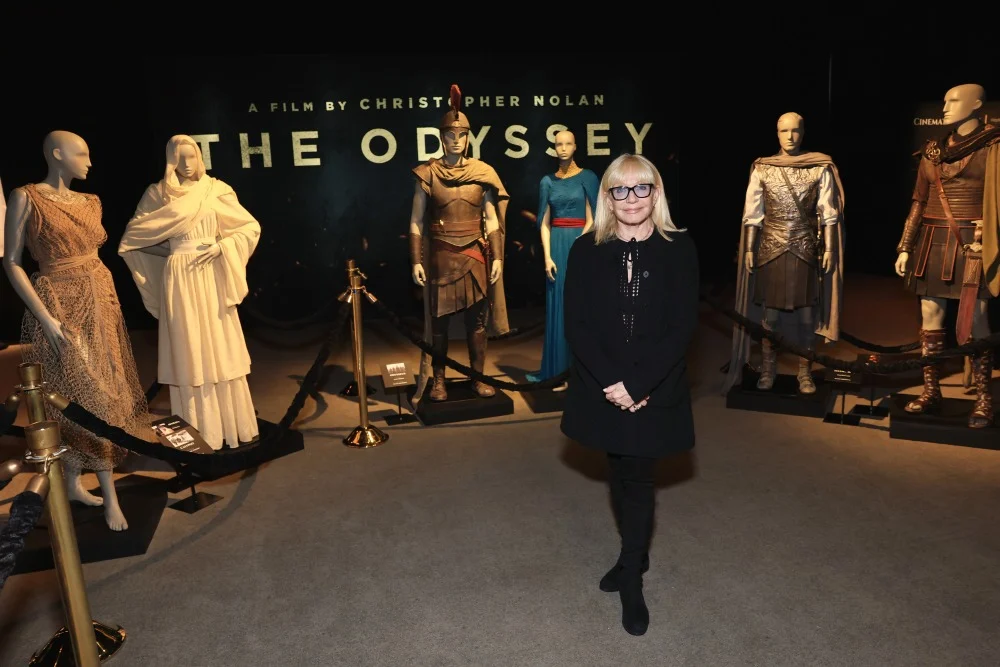
The assertion that "making movies is hard" resonated deeply following the premiere of "Behind the Scenes of The Odyssey," a comprehensive 75-minute documentary that peeled back the curtain on the monumental creation of Christopher Nolan’s critically acclaimed $1.8 billion blockbuster. The film, which debuted Tuesday evening at the prestigious Spielberg Theater on the Universal Studios lot, offered an unflinching look at the intricate tapestry of artistry, innovation, and sheer willpower required to bring Homer’s epic poem to the silver screen. Nolan himself, with characteristic wit, acknowledged the challenges during his introduction, quipping, "I have absolutely mastered the art of talking a lot and revealing absolutely nothing. And so I’m told I need to get out of the way."
While the full 75-minute documentary was a special one-time presentation, a condensed version is slated for inclusion with the film’s digital home release on November 17th, though Universal has yet to disclose which segments will comprise this shorter cut. The exclusive screening was followed by an illuminating hour-long Q&A session, masterfully moderated by star Matt Damon, who embodies the legendary Odysseus. Damon engaged in a deep dive with twelve key department heads, including producer Emma Thomas, production designer Ruth De Jong, editor Jennifer Lame, composer Ludwig Göransson, visual effects supervisor Andrew Jackson, special effects supervisor Scott Fisher, costume designer Ellen Mirojnick, casting director John Papsidera, supervising sound editor Craig Henighan, production sound mixer Willie Burton, head of makeup Luisa Abel, and head of hair Gloria Casny. The esteemed gathering was attended by a select audience of guild voters and influential social media personalities, including comedian and actor Evan M. Williams. The evening concluded with attendees mingling in the lobby, surrounded by exhibits showcasing the film’s remarkable artisan achievements, fostering lively discussions and numerous photo opportunities.

This premiere marks the commencement of Universal’s ambitious awards-season campaign for "The Odyssey," a film that has already cemented its status as the highest-grossing of Nolan’s illustrious career. The studio is strategically positioning the film for accolades across all major categories, with the ambitious goal of matching or surpassing the record-breaking 16 Oscar nominations achieved by Ryan Coogler’s "Sinners" earlier this year. The campaign’s momentum will continue with a series of high-profile events. On Wednesday, Robert Downey Jr. will moderate an IMAX 70mm screening at the TCL Chinese Theatre, followed by a discussion with Guillermo del Toro at AMC Universal CityWalk on Thursday. Steven Spielberg is slated to join Nolan for a conversation at the DGA Theater on November 17th, coinciding with the film’s digital release. Demonstrating his commitment to nurturing emerging talent, Nolan will also participate in a Q&A with "Digger" director Alejandro G. Iñárritu on Saturday.
The documentary and subsequent Q&A revealed a wealth of fascinating insights into the filmmaking process. Here are eight of the most revealing moments:
1. Matt Damon Didn’t Loop a Single Line on "The Odyssey"

In a remarkable feat for a production of this magnitude, star Matt Damon revealed that he did not have to re-record any dialogue for "The Odyssey." "I did not loop a line for this movie," he stated from the stage, directly addressing production sound mixer Willie Burton. Burton elaborated on Nolan’s stringent audio protocols, explaining, "There’s no ADR with Chris. Does not want to do ADR, and he also wants the boom mic to be on a cable." This commitment to capturing authentic on-set sound extended to the very environment of the film. Burton recounted being stationed below deck during storm sequences, running cables beneath floorboards and attaching microphones to the ship’s hull, all while water poured down on him. He even humorously recounted his role as the ship’s unofficial snack distributor, with crew members calling out, "Can you hand me potato chips?" during sound recording, eliciting laughter from the audience. The documentary further underscored the meticulous sound design, with supervising sound editor Craig Henighan dispatching a crew to record the ship’s sounds, including every oar stroke. Re-recording mixers Gary Rizzo and Kevin O’Connell noted that almost every sound in the final mix is organic, from hand-forged gongs to the authentic screams of the army.
2. The Cyclops Started as a Desk Lamp Test
Christopher Nolan’s vision for the Cyclops diverged sharply from the "cartoony, unthreatening" depictions of the past. His primary visual inspiration was Francisco Goya’s haunting "Saturn Devouring His Son," particularly the painting’s depiction of a blank, indifferent face. Production designer Ruth De Jong proposed a sideways orientation for the creature’s single eye, placing it centrally. Visual effects supervisor Andrew Jackson then conducted a rudimentary yet effective test: he filmed actor Bill Irwin, who portrays Polyphemus, improvising in a dimly lit Universal office with a desk lamp positioned on the floor. Jackson digitally manipulated one of Irwin’s eyes to the center of his face, obscuring the other. "It was quite phenomenal, actually, how effective it was," Jackson remarked. The documentary also revealed that the gargantuan creature was initially conceived with a rudimentary stick-figure puppet. The original plan was to film this sequence on an L.A. soundstage late in production. However, upon scouting Greece, Nolan and De Jong discovered a suitable real cave, necessitating the rapid completion of the puppet and its installation on a Greek mountain within a mere two months. Ultimately, the production constructed the creature’s rigid elements around this simpler framework, a constraint that, according to Jackson, paradoxically enhanced its effectiveness.

3. Tom Holland Asked for a Shorter Skirt, Robert Pattinson for a Long Wig – Both Rejected by Nolan
Emma Thomas, Nolan’s producing partner and wife, described a duality in the director’s approach: an intensely demanding phase during preparation, followed by an "incredibly pragmatic" demeanor once shooting commences. The documentary highlighted a running compilation of Nolan’s directives, illustrating his unwavering vision. For head of hair Gloria Casny, her first Nolan film brought an unexpected request from Robert Pattinson (Antinous) for a long wig on his initial fitting day. Casny recalled receiving the call while standing next to Nolan and Thomas, and the immediate, firm response: "The answer was no." Similarly, Tom Holland recounted a fitting where he subtly requested costume designer Ellen Mirojnick to shorten his skirt to appear taller. Six weeks later, the alteration was made, but Nolan’s keen eye caught it instantly. "Two seconds into taking in the costume, he was like, ‘How come the skirt is shorter?’" Holland shared. Nolan’s meticulous attention to detail is legendary, as evidenced by a story Damon shared about "Oppenheimer," where a missing hat caused a half-hour delay on a moving train. Thomas succinctly summarized the lesson: "He does not like hats." Even sound design choices were subject to Nolan’s precise preferences; he favored the starkness of dry bones cracking and knuckles popping over the more graphic, squelchy sounds proposed by Henighan for Samantha Morton’s Circe sequence.
4. Nolan Told His Marine Coordinator, "I Don’t Accept That" About Physics

During a challenging sequence in Scotland, a rogue wave splintered one of the production’s boats. Marine coordinator Neil Andrea informed the crew that repairing the vessel for the next day was "literally impossible" due to the damage to the transom and hull. Damon recounted Nolan’s resolute response: "And Chris turned to Neil and said, ‘I don’t accept that.’" Miraculously, the boat was seaworthy the following day, enabling filming to proceed. Thomas, ever the supportive partner, interjected with a touch of humor, "I promise you, he’s more pragmatic than that." The sea proved to be the production’s most formidable adversary. Nolan admitted to initially hoping to minimize boat sequences during the scriptwriting phase, but acknowledged, "It’s ‘The Odyssey.’ Of course, we’re going to be on this boat for months." Andrea’s team ingeniously converted Scandinavian Viking ship replicas into Greek warships by concealing small engines within them. The climactic storm destruction sequences were ultimately staged on the Universal backlot, where jet engines battered a ship mounted on a gimbal.
5. The Trojan Horse Got Stuck in Customs
Logistical hurdles extended to the iconic Trojan horse itself. In Morocco, Nolan expedited the start date by two days while the colossal prop remained impounded in customs. "I’m like, ‘What? The horse is in boxes in customs.’ And he’s like, ‘Yeah, anyways, carry on,’" De Jong recalled. Upon its eventual arrival and placement for the opening shot, the incoming tide toppled the structure. Nolan’s immediate reaction? "Great. Well, I’m gonna shoot this tomorrow." The fall of Troy was meticulously recreated through practical effects, with a sprawling 2.5-acre city constructed between late December and early February. Cinematographer Hoyte van Hoytema’s vision of illuminating the entire film with fire led to the design of hundreds of custom LED fixtures, dubbed "pyrahedrons," calibrated to mimic the precise color of firelight.

6. Nolan Sees His Entire Filmography Inside Homer
The documentary’s opening sequences effectively function as a masterclass in Nolan’s directorial philosophy, with Damon recalling the genesis of the project. A brief encounter with Nolan, lasting only ten to fifteen minutes, yielded the impactful two words: "The Odyssey." Nolan views Homer’s epic poem as the foundational text of Western literature, containing the very essence of his own cinematic oeuvre. He explained that adapting it involved recognizing the direct lineage from the poem to films like "Interstellar" and "The Dark Knight." Instead of emulating the Romantic-era paintings and mid-20th-century Hollywood epics that typically define the genre, Nolan applied the grounded, realistic approach honed in films such as "The Dark Knight," "Inception," and "Interstellar" to the realm of Greek mythology.
7. Ludwig Göransson Built the Score Around 35 Bronze Gongs

Damon humorously noted that when inquiring about composer Ludwig Göransson’s progress, Nolan’s sole response was invariably: "gongs." Göransson detailed his immersive process, isolating himself in his studio during the Los Angeles fires, surrounded by approximately 35 bronze gongs. He spent ten days mastering their nuances, drawing inspiration from his initial encounter with gongs in the theme song for "Mortal Kombat." His sonic exploration extended to seeking out musicians proficient in ancient instruments like the aulos and lyre, and he traveled to southern Albania to record traditional iso-polyphonic folk singing. The musical narrative culminates at Abbey Road with vocalist James Blake, and the end-credits song, "When I’m Home," was conceived to complete the song initiated by the bard, played by Travis Scott, incorporating his original vocal recording from the film.
8. Nearly 7,000 Extras Underwent Hair and Makeup, and Matt Damon Performs Pull-ups
The documentary powerfully illustrates the dedication to grounding Greek mythology in tangible reality through meticulous detail. Over 80 hair and makeup artists were employed in Morocco, with nearly 7,000 background performers passing through fittings. These teams worked tirelessly to eliminate any anachronisms, from tattoos and earring holes to the very shape of women’s eyebrows. Costume designer Ellen Mirojnick crafted distinct visual identities for the principal characters. Anne Hathaway’s Penelope, for instance, is adorned in vibrant colors, symbolizing her optimistic outlook that her husband will return, while Tom Holland’s Telemachus visually progresses from boyhood to manhood through increasingly lighter and brighter armor. Antinous is depicted wearing a leopard pelt. Casting director John Papsidera drew a parallel between Homer and the "Marvel films of his time," emphasizing the need for "superstars of ours" in the principal roles. However, for Odysseus’s warriors, Papsidera sought actors with "real bodies," stating, "You don’t want it to look like, you know, 2025 bodybuilding. They weren’t taking peptides." Papsidera, whose work concludes before filming begins, humorously expressed a desire to "meet this pragmatic Chris" and noted the challenging timeline of approximately 62 days to cast around 60 actors. Matt Damon, acutely aware of the physical demands of portraying Odysseus, was filmed performing pull-ups on a ladder, candidly reflecting, "I’m 54 years old, and I knew this was going to be really physical." Near the documentary’s conclusion, Damon delivered a poignant line that encapsulates the film’s spirit and the current landscape of filmmaking: "My whole life was kind of leading up to this movie, and I don’t know how long we’re going to get to make movies this way." Onstage, Emma Thomas directed attention back to Damon, highlighting his pivotal role and his yet-to-be-awarded Oscar. "I cannot believe we did it," she exclaimed, commending Damon for his unwavering dedication and positive attitude. Damon, in turn, lauded the crew’s extraordinary efforts, stating, "I’ve never seen more asked of a crew, never. And I don’t think I ever could again." He then paused, chuckling, and added, "That didn’t come out right."
