
 By Lina Irawan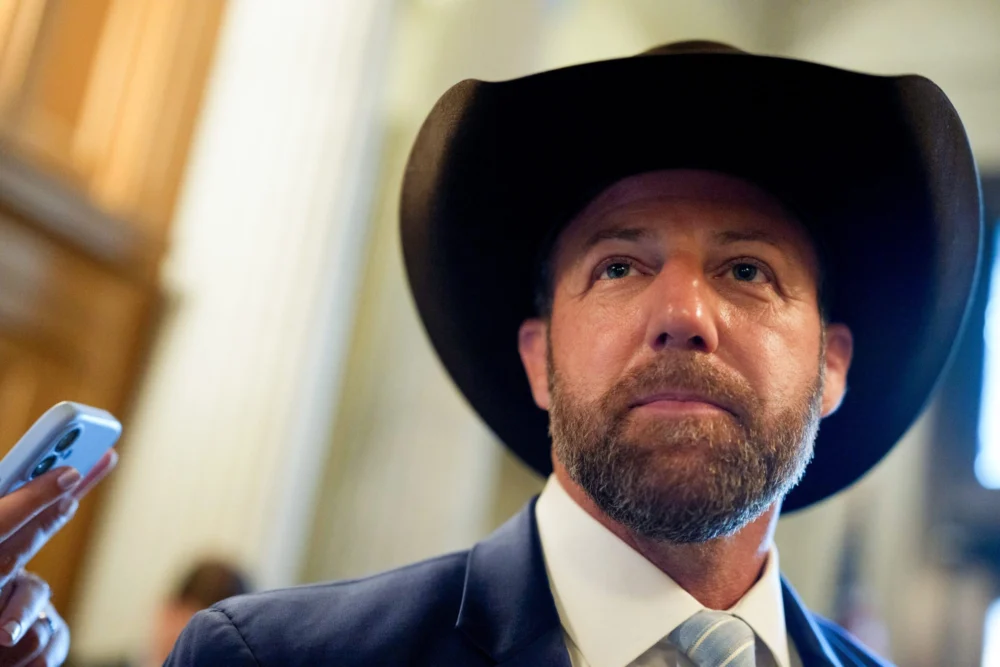
The tumultuous leadership of the Department of Homeland Security (DHS) under President Trump saw another significant shake-up on Thursday, as the President announced the replacement of Secretary Kristi Noem. After months of simmering infighting and public disagreements over the department’s aggressive handling of U.S. Immigration and Customs Enforcement (ICE) operations and broader immigration crackdown policies, Trump declared that Republican Senator Markwayne Mullin of Oklahoma, a junior senator with a colorful past, would take the helm.
The decision comes amidst a period of heightened scrutiny on U.S. border policies and internal divisions within the administration regarding their implementation. Noem’s departure signals a presidential desire for a DHS Secretary more closely aligned with the White House’s increasingly hardline stance on immigration. Her tenure, though relatively short, was marked by consistent reports of friction with the Oval Office, particularly concerning the pace and scope of immigration enforcement and the allocation of resources. Critics within the administration reportedly viewed her approach as insufficiently aggressive or strategically misaligned, leading to a breakdown in trust that ultimately paved the way for her removal.
Senator Mullin, reacting to the high-profile announcement, exuded confidence and loyalty. "The president and I are good friends," Mullin told reporters shortly after the news broke, his statement immediately signaling a departure from the reported tensions that plagued his predecessor’s relationship with the White House. He added, "We look forward to working closer with the White House," and with a knowing grin, "Obviously, I’m gonna be over there a lot more." These remarks were interpreted by political observers as a clear indication that Mullin intends to be a more pliable and directly collaborative figure for the President, potentially ushering in an era of more direct White House influence over the sprawling and critical department.
A History of Confrontation and Business Acumen
Markwayne Mullin’s path to potentially leading one of the nation’s largest and most complex federal agencies is anything but conventional. Before his election to the Senate in 2022, Mullin served a decade in the House of Representatives, representing Oklahoma’s 2nd congressional district. During his time in Congress, he cultivated a reputation as a conservative firebrand and a staunch advocate for business interests, often drawing on his own background as a successful entrepreneur.
However, it was a moment of unfiltered pugnacity that truly thrust him into the national spotlight in 2023. During a heated Senate hearing, Mullin famously challenged Teamsters President Sean O’Brien to a fistfight. The extraordinary exchange, which went viral, saw Mullin accuse O’Brien of being a "thug" and a "fraud," escalating a verbal spat into a physical dare. The confrontation stemmed from a long-standing dispute between Mullin and O’Brien, with Mullin specifically criticizing O’Brien’s $200,000 annual salary as a union leader, contrasting it with his own congressional salary of $174,000 at the time.
This incident, while controversial, cemented Mullin’s image among some as an unvarnished, no-nonsense politician willing to fight for his beliefs. Yet, it also raised questions about his temperament and suitability for a cabinet position requiring diplomacy and cool-headed leadership. "While his direct style may appeal to a certain segment of the electorate, leading DHS demands a nuanced approach to complex issues and international relations," commented Dr. Evelyn Reed, a political science professor specializing in executive branch appointments. "The department faces everything from counterterrorism to natural disaster response; it’s not a place for rhetorical skirmishes."
Further complicating his public image is a past claim regarding his personal income. During that same 2023 hearing, Mullin asserted that he paid himself only $50,000 annually when he ran his plumbing business prior to entering politics. However, financial disclosures from 2012, the year he was first elected to Congress, directly contradicted this claim, showing his self-reported salary from the business as $92,000 – nearly double what he stated under oath. This discrepancy fueled criticism about his transparency and honesty, raising concerns that are likely to resurface during his confirmation hearings.
The Multimillionaire "Working Man"
A deeper dive into Senator Mullin’s most recent financial disclosures from 2024 paints a picture of significant wealth, starkly contrasting with his occasional portrayal as an everyman businessman. These disclosures reveal that Mullin is, in fact, a multimillionaire with a diverse and extensive portfolio of businesses and properties.
The system for congressional financial disclosures allows members to report assets and liabilities within broad ranges, rather than exact dollar figures. Furthermore, personal residences are not required to be disclosed, making it challenging for the public to ascertain the precise net worth of their elected representatives. Despite these limitations, Mullin’s filings provide a clear indication of substantial personal wealth.
While his official Senate salary remains his only reported income from public service, Mullin’s entrepreneurial spirit has manifested in a robust network of private ventures. He and his wife, Christie, have owned Mullin Plumbing in Broken Arrow, Oklahoma, for 28 years, which his official Senate biography proudly describes as the largest service company in the region. This flagship business has been the foundation of his financial success.
Beyond plumbing, Mullin’s holdings extend into various sectors. He is a joint owner of Mullin Ranch LLC, a sprawling 1,600-acre cattle ranch and event venue in Oklahoma, estimated to be worth between $1 million and $5 million. In 2024, his wife sold Rowan’s Restaurant, a steakhouse in Stilwell, Oklahoma, which they both founded, for a reported sum between $1 million and $5 million.
His portfolio also includes stakes in other limited liability companies, such as Mullin Family Holdco LLC, whose value is unreported, and COP Hometown Parent LLC, valued between $500,000 and $1 million. These holdings are strategically distributed across himself, his spouse, and their children, with individual stakes often falling within the $500,001 to $1,000,000 range, indicating a carefully managed family enterprise.
Adding another layer to his business background, Mullin founded Mullin Environmental. This company notably received a Paycheck Protection Program (PPP) loan for $169,200 during the COVID-19 pandemic, which was later forgiven, according to ProPublica data. The forgiveness of such a substantial loan for a company owned by a multimillionaire congressman could draw renewed scrutiny, especially given the program’s intent to support struggling small businesses during the economic crisis.
Mullin’s real estate footprint is equally impressive. He is a full or joint owner of at least 30 commercial, residential, and land investment properties. Four of these properties alone are individually valued at over $1 million. While the majority are concentrated in his home state of Oklahoma, his reach extends to an investment property in Washington, D.C., and another in Englewood, Florida, showcasing a diversified real estate strategy.
His financial disclosures also list dozens of corporate securities and mutual fund holdings, ranging in worth from less than $1,001 to $1 million. This broad investment strategy further solidifies his status as a sophisticated financial player. In a significant financial move in 2024, Mullin also secured a substantial line of credit from the global financial services firm BNY, valued between $5,000,001 and $25,000,000. The purpose and terms of this considerable loan will undoubtedly be areas of interest during his confirmation process.
From Ranch to Reshaping Homeland Security
Mullin’s personal narrative is deeply rooted in Oklahoma. He grew up on his family ranch in Westville, where he continues to live with his wife, Christie, and their six children. His Senate biography highlights a challenging early life, detailing how he left Missouri Valley College, where he was on a wrestling scholarship, at the age of 20 to return home and save his family’s struggling business after his father fell ill. He later completed his education, earning a degree in Applied Science in Construction Technology from Oklahoma State University Institute of Technology in 2010. This "bootstraps" story has been a consistent theme in his political branding, emphasizing his practical experience and connection to working-class values, despite his considerable wealth.
Mullin is not an anomaly in the halls of Congress; he joins a growing number of multimillionaires serving in the U.S. Senate. This trend highlights the increasing financial success of individuals entering public service, often drawing criticism about potential detachment from the economic realities of average Americans. For instance, West Virginia Senator Jim Justice, a Republican, stands as one of the wealthiest senators, with an estimated net worth of approximately $664 million, primarily from his coal and mining companies and the luxury Greenbrier resort, according to fintech firm Quiver Quantitative. Quiver Quantitative also estimated Mullin’s own net worth could reach as high as $65.9 million, placing him firmly among the Senate’s most affluent members. On the Democratic side, Senator Mark Warner of Virginia is considered the wealthiest, with an estimated net worth between $76 million and $303 million, largely derived from investment funds, as reported by Business Insider.
The appointment of Mullin, a successful businessman with a pugnacious style and deep ties to the President, signals a clear intention from the White House to intensify its immigration policies and assert greater control over DHS. His extensive business holdings will undoubtedly lead to rigorous scrutiny during his Senate confirmation hearings, particularly concerning potential conflicts of interest. Experts will be watching closely to see how Mullin, if confirmed, navigates the complexities of leading a department with vast responsibilities, from border security and immigration enforcement to cybersecurity and disaster relief, all while managing his substantial personal financial empire. His tenure will likely reshape the direction of U.S. homeland security and immigration policy for years to come.
