
 By Lina Irawan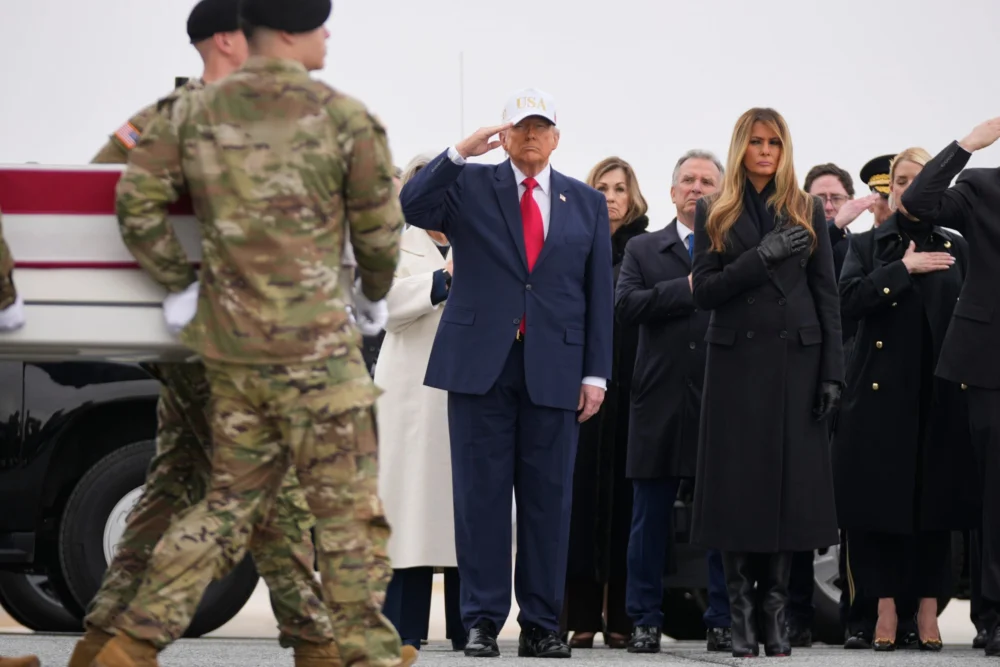
President Donald Trump underscored the profound gravity of this presidential responsibility on Saturday, as he stood witness to the dignified transfer ceremony at Dover Air Force Base in Delaware. The solemn event marked the return of six Army Reserve soldiers, tragically killed in a drone strike at a command center in Kuwait. This sacred ritual, a poignant reminder of the ultimate sacrifice made by service members, is consistently cited by presidents as one of the most emotionally challenging aspects of their office. Indeed, during his first term, President Trump had previously characterized bearing witness to these transfers as “the toughest thing I have to do” as president, a sentiment echoed by many of his predecessors who have borne this heavy responsibility.
"It’s a very sad day," President Trump told reporters aboard Air Force One later Saturday afternoon, reflecting on the ceremony as he returned to Florida. He expressed his relief that "we paid our respects" to the fallen and their grieving families. Describing the relatives of the deceased, he noted, "They’re great people, great parents, wives, family," adding that "the parents were so proud." These brief remarks, delivered after the private ceremony, provided a glimpse into the emotional weight carried by the nation’s highest office in moments of profound loss, highlighting the personal connection often forged between the Commander-in-Chief and the families of the fallen.
The ceremony itself unfolded with the solemn precision dictated by military protocol, yet imbued with palpable sorrow. President Trump, wearing a blue suit, red tie, and a white "USA" hat, maintained a respectful silence throughout the approximately half-hour ritual. As each flag-draped transfer case, bearing the remains of a fallen hero, was meticulously carried by a military honor guard from the military aircraft to awaiting transfer vehicles, the President rendered a crisp salute. These vehicles would then transport the fallen to a mortuary facility on base, where they would be prepared for their final resting place and eventual journey home. The families, gathered in quiet dignity, observed the heartbreaking procession, their silence a testament to their immeasurable grief. The entire scene was a stark tableau of national mourning and enduring sacrifice, a powerful reminder of the human cost of safeguarding national interests abroad.
A broad array of high-ranking officials and political figures joined President Trump and Vice President JD Vance at Dover, emphasizing the national scope of the tragedy and the collective reverence for the fallen. Both the President and Vice President were accompanied by their spouses, a gesture of shared national mourning. Among the top administration officials present were Defense Secretary Pete Hegseth, who had earlier conveyed his sentiments in a social media post, speaking of "an unbreakable spirit to honor their memory and the resolve they embodied." Attorney General Pam Bondi, White House Chief of Staff Susie Wiles, Special Envoy Steve Witkoff, and Tulsi Gabbard, the Director of National Intelligence, were also in attendance. Their collective presence underscored the comprehensive government commitment to honoring those who serve and acknowledging the profound impact of their loss. Further highlighting the national impact, governors and senators from Iowa, Minnesota, Nebraska, and Florida were also present, representing the home states of the six fallen soldiers and offering direct support to their constituents, bridging the gap between federal leadership and local communities grappling with grief.
The six members of the Army Reserve whose lives were tragically cut short were all part of the 103rd Sustainment Command, based in Des Moines, Iowa. This critical unit plays a vital, though often unheralded, role in military operations, responsible for providing essential logistical support, including food, fuel, water, ammunition, and the transport of equipment and supplies. Their mission ensures the continuity and effectiveness of frontline forces across various theaters. The drone strike that claimed their lives occurred at a command center in Kuwait, a strategically vital nation that hosts a significant U.S. military presence and serves as a crucial logistical hub for operations across the wider Middle East. The attack reportedly took place just one day after the United States and Israel had launched a military campaign against Iran, placing the incident within a broader, escalating geopolitical context in the region. While the specific nature and targets of this reported campaign were not fully detailed in the immediate aftermath, the timing underscored the volatile and dangerous environment in which U.S. forces operate, even in what might traditionally be considered rear-echelon positions. The use of drones by adversaries represents an evolving threat, complicating security for even well-established bases.
The fallen heroes represented a diverse cross-section of American life, united by their unwavering commitment to service:
Major Jeffrey O’Brien, 45, of Indianola, Iowa: Maj. O’Brien was a seasoned member of the Army Reserve, having served with distinction for nearly 15 years, according to his LinkedIn profile. His dedication to duty and country was a defining characteristic, embodying the citizen-soldier ideal. His aunt, in a heartfelt Facebook post, remembered him as "the sweetest blue-eyed, blonde farm kid you’d ever know. He is so missed already." This tender recollection painted a vivid picture of a man deeply rooted in his community and family, whose military service was an extension of his profound commitment to others. His extensive experience in the reserves would have made him a valuable leader within the 103rd Sustainment Command, likely contributing significantly to its complex logistical operations and mentoring younger soldiers. His loss leaves a void not only in his immediate family but also in the operational capabilities and institutional memory of his unit.
Captain Cody Khork, 35, of Winter Haven, Florida: Capt. Khork was remembered by his family as "the life of the party," a testament to his vibrant personality and ability to uplift those around him. They spoke fondly of his "infectious spirit" and "generous heart," qualities that endeared him to all who knew him. From childhood, Capt. Khork harbored a profound desire to serve in the military, a calling that shaped the trajectory of his entire life. "That commitment helped shape the course of his life and reflected the deep sense of duty that was always at the core of who he was," read a poignant statement from his mother, Donna Burhans, his father, James Khork, and his stepmother, Stacey Khork. His leadership, infused with his natural charisma and camaraderie, would have undoubtedly boosted morale and fostered a strong sense of unity and purpose within his unit, making his absence keenly felt by his fellow service members.
Chief Warrant Officer 3 Robert Marzan, 54, of Sacramento, California: CWO3 Marzan was described by his sister in a heartfelt Facebook post as a "strong leader" and a loving husband, devoted father, and cherished brother. Her message, "My baby brother, you are loved and I will hold onto all our memories and cherish them always in my heart," conveyed the deep personal loss felt by his family, highlighting the enduring bond they shared. His rank as a Chief Warrant Officer signifies a highly specialized technical and tactical expert, a crucial asset in any modern military operation. His extensive experience, accumulated over years of dedicated service, would have been invaluable to the 103rd Sustainment Command, particularly in managing complex logistical challenges in a demanding operational environment like Kuwait. His seasoned leadership and technical acumen would have been critical to the success and safety of his subordinates and the mission at large.
Sergeant 1st Class Nicole Amor, 39, of White Bear Lake, Minnesota: Sgt. 1st Class Amor was tragically killed just days before she was scheduled to return home to her husband, Joey Amor, and their two children. Her husband’s anguish was palpable in his statement: "You don’t go to Kuwait thinking something’s going to happen, and for her to be one of the first — it hurts." This heartbreaking detail underscores the suddenness and unexpected nature of the tragedy, particularly for families who are eagerly anticipating a long-awaited reunion. As a non-commissioned officer, Sgt. 1st Class Amor would have been a vital link between command and the enlisted ranks, responsible for training, welfare, and operational execution. Her dedication to both her family and her country represents the profound dual sacrifice many military personnel and their families make.
Sergeant 1st Class Noah Tietjens, 42, of Bellevue, Nebraska: Sgt. 1st Class Tietjens hailed from a proud military family, a lineage of service that profoundly shaped his own path. He had previously served alongside his father in Kuwait, a rare and profound experience that highlights the intergenerational commitment to duty within his family. A memorable moment from his service involved his joyous reunion with his wife in a local church’s gym upon his return home in February 2010, a testament to the enduring bonds and sacrifices of military families. His cousin, Kaylyn Golike, asked for prayers, particularly for Tietjens’ 12-year-old son, wife, and parents, as they navigate this "unimaginable loss." His long service, including multiple deployments to the same region, speaks to his resilience, experience, and unwavering dedication, making his loss particularly impactful for those who relied on his steady presence and expertise.
Sergeant Declan Coady, 20, of West Des Moines, Iowa: Sgt. Coady, posthumously promoted from specialist, was among the youngest in his class, trained to troubleshoot military computer systems – a critical and increasingly complex skill in modern warfare. Despite his youth, he made a strong impression on his instructors, demonstrating an exceptional aptitude for complex technical tasks and a keen dedication to his duties. His father, Andrew Coady, shared insights into his son’s character: "He trained hard, he worked hard, his physical fitness was important to him. He loved being a soldier." Beyond his professional dedication, Sgt. Coady was also described as "one of the most kindest people you would ever meet, and he would do anything and everything for anyone." His burgeoning career and profound sense of duty, cut short at such a tender age, serve as a stark reminder of the immense potential lost and the ultimate sacrifice of youth in service to the nation.
Republican Senator Joni Ernst of Iowa, a combat veteran herself, eloquently articulated the national sentiment following the identification of the fallen. "These soldiers engaged in the most noble mission: protecting their fellow Americans and keeping our homeland secure," she stated earlier in the week. "Our nation owes them an incredible debt of gratitude that can never be repaid." Her words resonated deeply, recognizing the selfless nature of military service and the profound, unquantifiable cost of war that impacts communities far beyond the immediate families.
Dover Air Force Base holds a singular and hallowed place in American military tradition. It is the primary port of entry for all fallen service members returning to the United States from overseas. The dignified transfer ceremony, meticulously orchestrated by the Air Force Mortuary Affairs Operations (AFMAO), is a sacred ritual designed to honor the dead and provide closure for grieving families. Since the Vietnam War, the sight of a President or Vice President personally attending these transfers has become a significant gesture, symbolizing national unity in grief and respect. President Trump has participated in several such ceremonies during his tenure, reflecting a consistent commitment to this solemn duty. His previous visits to Dover include honoring two Iowa National Guard members and a U.S. civilian interpreter killed in an ambush attack in the Syrian desert in December, a Navy SEAL killed during a raid in Yemen, two Army officers whose helicopter crashed in Afghanistan, and two Army soldiers killed in Afghanistan by an individual in an Afghan army uniform. Each visit served as a stark reminder of the ongoing costs of military engagements around the globe and the personal toll they exact on service members and their loved ones.
The return of these six soldiers to American soil at Dover Air Force Base is more than just a logistical exercise; it is a profound national moment of remembrance and reflection. It forces the nation to confront the human cost of its global commitments and the sacrifices made by those who volunteer to serve. For the families, it marks the painful culmination of their wait, the official return of their loved ones, even as their private grieving journey continues. The quiet dignity of the ceremony, the salutes rendered, and the shared silence of those present serve as a testament to the enduring honor of military service and the unbreakable spirit of a nation that remembers its fallen. The stories of Maj. O’Brien, Capt. Khork, CWO3 Marzan, Sgt. 1st Class Amor, Sgt. 1st Class Tietjens, and Sgt. Coady will now be woven into the rich fabric of American military history, a poignant reminder of the ultimate sacrifice made in the defense of freedom and national security. Their lives, and their deaths, stand as a testament to the bravery and dedication of the men and women who wear the uniform, reminding all Americans of the profound debt owed to those who serve.
