
 By Lina Irawan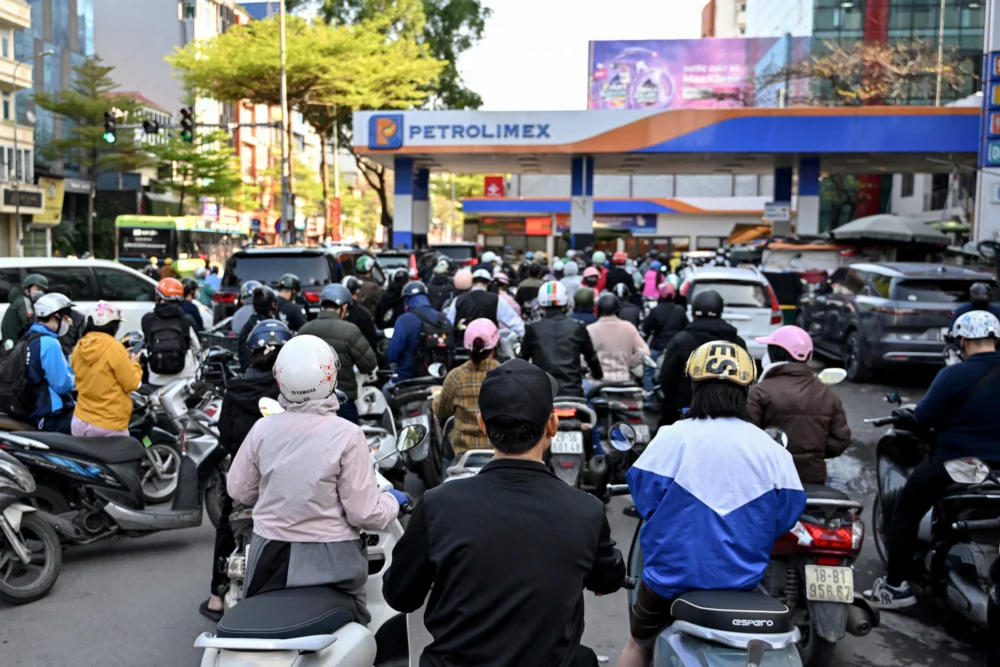
Asia’s economic powerhouses and developing nations alike are grappling with an unprecedented energy crisis, marked by closed schools, widespread work-from-home mandates, and emergency price caps. The region, critically dependent on Middle Eastern oil, finds itself at the epicenter of a global fuel shortage exacerbated by soaring international oil prices and the complete closure of the Strait of Hormuz. This geopolitical choke point, through which an estimated one-fifth of the world’s total petroleum liquids and a quarter of its liquefied natural gas (LNG) pass, has become impassable due to an escalating conflict, plunging global energy markets into turmoil and forcing Asian governments to adopt increasingly extreme measures to conserve dwindling fuel supplies.
The Strait of Hormuz, a narrow waterway separating Iran and Oman, is a maritime lifeline for crude oil, refined products, and natural gas shipments from major producers like Saudi Arabia, Iran, UAE, Kuwait, and Iraq. Its closure, reportedly due to heightened military activity and an ongoing "Iran war" as referenced in some reports, effectively severs the primary conduit for Middle Eastern energy exports to the global market. This disruption has immediate and devastating consequences, particularly for Asia, which relies on the Middle East for the vast majority of its oil imports. Japan, a technological giant, sources a staggering 90% of its oil from the region, while South Korea, another industrial powerhouse, depends on it for 70%. Beyond these two, economic titans like China and India, along with rapidly developing nations across Southeast Asia, also draw heavily on Middle Eastern crude, making the current blockade a potentially catastrophic blow to their economies and daily lives.
The immediate fallout has been a dramatic surge in oil prices, creating a ripple effect across global supply chains and domestic economies. Governments, caught between the imperative to maintain economic stability and the stark reality of dwindling reserves, are now implementing a mosaic of austerity measures and market interventions. These actions range from encouraging radical shifts in daily routines to direct manipulation of fuel prices and the desperate consideration of strategic oil reserve releases.
Southeast Asia’s Immediate Austerity Drive
In Southeast Asia, governments have wasted no time in imposing stringent energy-saving directives. Thailand, on March 10, initiated a sweeping campaign targeting its civil service. Bureaucrats have been ordered to forsake elevators for stairs, a symbolic yet practical effort to reduce electricity consumption, and to work from home for the duration of the crisis, minimizing commuting fuel usage. Air-conditioning temperatures in government buildings have been raised to a uniform 27 degrees Celsius, a noticeable shift in a tropical climate, accompanied by a directive encouraging employees to wear short-sleeved shirts instead of traditional suits to mitigate discomfort. These measures reflect Thailand’s precarious position, with Reuters reporting the country possesses approximately 95 days of energy reserves—a buffer that, while significant, is rapidly diminishing under the current pressures.
Neighboring Vietnam has echoed similar calls, urging businesses nationwide to implement work-from-home policies to "reduce the need for travel and transportation." This appeal highlights the critical role of personal mobility and logistics in national energy consumption. The Philippines, another rapidly growing economy, has gone a step further by pushing for a four-day work week for government employees, a move designed to drastically cut down on commuting and office energy use. Officials have also been explicitly instructed to limit all travel "to essential functions only," underscoring the severity of the crisis and the need to prioritize critical government operations. These measures, while necessary, carry significant implications for productivity, urban congestion, and the overall social fabric, testing the adaptability of millions.
South Asia Under Severe Strain
The energy crunch has hit South Asia with particular ferocity, compounding existing economic vulnerabilities in countries like Bangladesh, Pakistan, and India. Bangladesh, in an extraordinary move, brought forward the Eid-al-Fitr holiday, a major religious observance, to allow universities to close early. This unprecedented decision was aimed at significantly reducing the energy consumption of academic institutions, particularly their electricity demands for lighting, cooling, and operating facilities. The social and cultural implications of altering a national holiday, especially one of such spiritual significance, underscore the extreme pressure the government faces.
Pakistan, already grappling with a delicate economic situation, has instituted its own sweeping austerity measures. A four-day work week has been imposed on government offices, and all schools have been closed, mirroring the actions seen elsewhere but with potentially more acute social and educational consequences in a nation with high rates of illiteracy and limited access to remote learning. Al Jazeera reported these as "sweeping austerity measures" triggered by the "Iran war," indicative of the direct link between the geopolitical conflict and domestic hardship. The closure of educational institutions, while saving fuel, risks significant disruptions to the academic year and the long-term development of students.
India, a colossal energy consumer, has taken a more targeted approach, suspending shipments of liquefied petroleum gas (LPG) to commercial operators. This critical fuel, widely used in Indian households and businesses for cooking and heating, is now being prioritized for domestic consumers. This decision, while safeguarding essential household needs, has sparked considerable alarm within the hospitality sector, with hotels and restaurants expressing worries that they may be forced to close without adequate fuel supplies. The potential for widespread business closures, job losses, and a further blow to an already recovering economy is a grave concern. India’s reliance on imported energy, particularly for its burgeoning industrial and urban sectors, makes it acutely vulnerable to global price shocks and supply disruptions.
Direct Market Interventions and Fiscal Burdens
Beyond austerity, Asian countries are directly intervening in fuel markets, a move that comes with its own set of economic risks and fiscal burdens. South Korean President Lee Jae Myung announced on Monday that the country would introduce a price cap on petroleum products, acknowledging the "significant burden on the country’s economy." This measure aims to shield consumers and businesses from the immediate shock of soaring prices, but it also risks distorting market signals and potentially creating black markets or exacerbating supply shortages in the long run. The urgency is underscored by presidential policy advisor Kim Yong-beom’s revelation during a March 9 press briefing that approximately 1.7 million barrels of Korea-bound oil have been held back daily due to the ongoing conflict – a staggering volume for a nation so dependent on imports.
Japan, a nation historically sensitive to energy security due to its limited domestic resources, is also considering drastic measures. Ryosei Akazawa, Japan’s industry minister, did not rule out dipping into the country’s national oil reserves on Wednesday, stating that Japan "will take all possible measures to ensure stable supplies of energy." Japan maintains one of the largest strategic petroleum reserves (SPR) globally, designed precisely for such contingencies. Any release would be a significant signal of the crisis’s severity and would likely be coordinated with international partners to maximize its impact. The last major coordinated SPR release occurred in response to the 2022 Russia/Ukraine crisis, highlighting the rare and critical nature of such actions.
Indonesia, Southeast Asia’s largest economy, has committed a substantial portion of its state budget to absorb the shock of rising oil prices. On Monday, its finance minister announced a staggering 381.3 trillion rupiah ($22.6 billion) allocation for energy subsidies, earmarked to compensate state energy firms like Pertamina. The goal is to keep fuel and electricity prices affordable for its vast population, preventing widespread public discontent and inflationary spirals. While providing immediate relief, such massive subsidies place an immense strain on the national budget, potentially diverting funds from other critical development areas and risking long-term fiscal instability.
Thailand, in addition to its civil servant directives, plans to freeze cooking gas prices until May and is actively encouraging consumers to switch to alternative energy sources, such as biodiesel and benzene, through subsidies. Vietnam is also contemplating scrapping its tariffs on fuel imports, a measure that could reduce import costs and partially alleviate the burden on consumers and businesses. These interventions, while offering short-term relief, underscore the dire economic choices governments are forced to make to navigate this unprecedented crisis.
Global Market Turmoil and the International Response
The global oil market has experienced extreme volatility in recent days, reflecting the high stakes and uncertainty surrounding the crisis. WTI crude prices surged to over $115 per barrel on Monday, driven by fears of widespread supply disruptions, only to swing back and forth, eventually settling past $90 per barrel by Wednesday evening. This fluctuation was partly influenced by competing statements and speculation emerging from Washington, including rumors of potential diplomatic breakthroughs, further sanctions, or coordinated strategic reserve releases. The market remains on tenterhooks, highly sensitive to any news regarding the Strait of Hormuz or the geopolitical conflict.
In a significant international response, the International Energy Agency’s (IEA) 32 member countries unanimously agreed on March 11 to release a colossal 400 million barrels of oil from their emergency reserves. This constitutes the largest coordinated oil stock release in the IEA’s history, a testament to the severity of the current crisis. The move is designed to inject immediate supply into the market, temper price spikes, and provide a temporary buffer against the loss of Middle Eastern crude. However, the long-term effectiveness of such releases depends on the duration of the Strait’s closure and the ongoing dynamics of global demand.
The Dire Outlook: "Dimensionally Bigger" Crisis
The consensus among energy analysts is grim. Flows from the Middle East remain severely constrained, with the Strait of Hormuz effectively closed to maritime traffic. Simon Flowers, an analyst at Wood Mackenzie, delivered a stark warning in a research note: "While oil reached $150/bbl [per barrel] in inflation-adjusted terms during the 2022 Russia/Ukraine crisis, this situation could prove more severe…supply volumes at risk this time are dimensionally bigger—and real." Flowers elaborated that the sheer volume of crude transiting the Strait, coupled with the critical nature of the geopolitical conflict, makes this disruption potentially far more impactful than previous crises. "In our view," he concluded, "$200/bbl is not outside the realms of possibility in 2026."
A sustained period of $200/bbl oil would trigger a global economic recession of unprecedented scale, impacting inflation, trade, and economic growth across every continent. For Asia, which accounts for a significant portion of global energy demand and manufacturing output, the consequences would be particularly devastating. Businesses would face crippling operating costs, supply chains would seize up, and consumer purchasing power would plummet. Such a scenario would not only threaten economic stability but also carries the risk of social unrest and political instability in already fragile regions.
Beyond the immediate crisis, this event is forcing Asian nations to urgently re-evaluate their long-term energy security strategies. Diversification of supply sources, accelerated investment in renewable energy technologies, the expansion of nuclear power, and enhanced regional energy cooperation will likely become paramount. The current crisis serves as a brutal reminder of the fragility of global energy supply chains and the profound vulnerability of nations tied to single, volatile regions. As Asia navigates this tumultuous period, the decisions made today will undoubtedly shape its economic and geopolitical landscape for decades to come. The region faces not just a fuel shortage, but a profound challenge to its economic model and a test of its resilience in the face of an unprecedented global energy shock.
