
 By Lina Irawan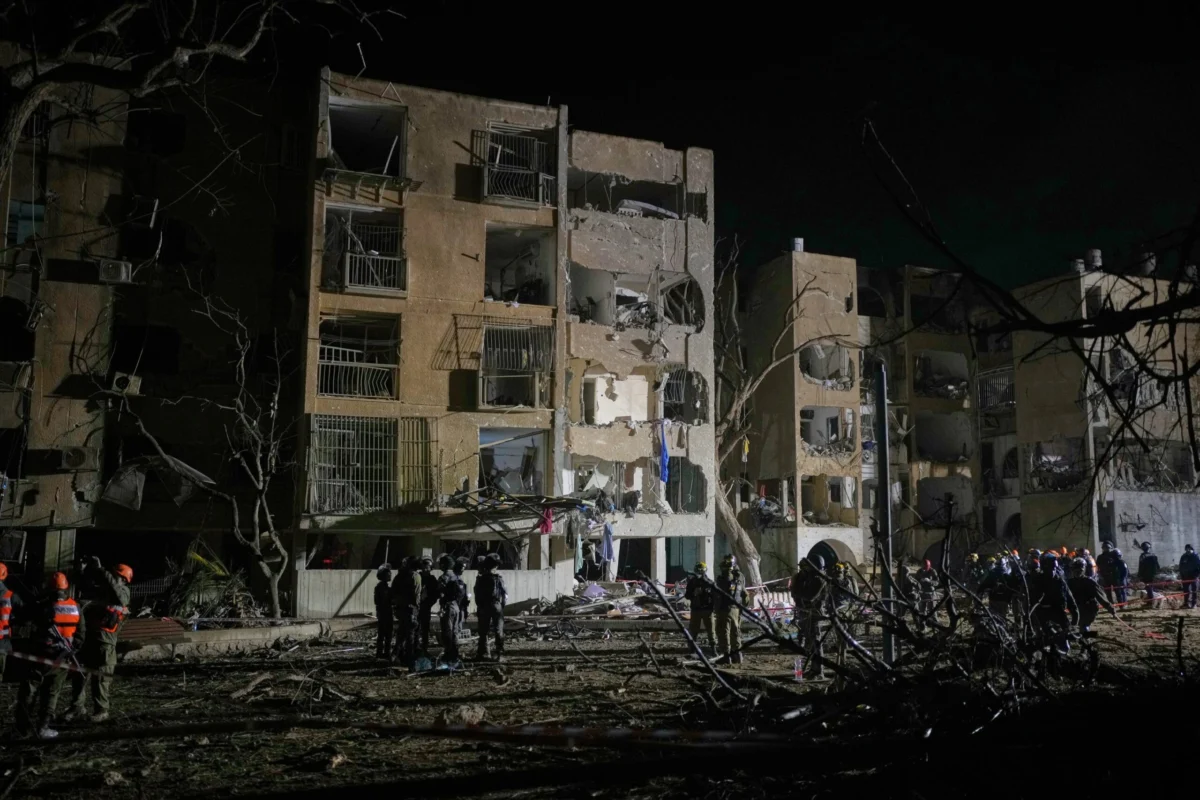
The Middle East conflict dramatically escalated late Saturday as Iran launched unprecedented strikes against two communities near Israel’s primary nuclear research center, shattering buildings and seriously injuring at least seven people, with later reports indicating 64 hospitalized in Arad. These attacks, hours after Iran’s main nuclear enrichment site was reportedly hit, mark a perilous new direction in the war, now entering its fourth week, by directly targeting facilities central to both nations’ nuclear capabilities.
For the first time in the protracted conflict, Israel’s highly sensitive Negev Nuclear Research Center near Dimona, a cornerstone of its strategic deterrence, found itself in the crosshairs. The Israeli military confirmed its inability to intercept the incoming missiles that struck the southern cities of Dimona and Arad, the largest population centers in the sparsely populated Negev desert region surrounding the nuclear complex. This failure to intercept in a heavily defended area sent shockwaves through Israel’s security establishment and signaled a significant advancement in Iran’s offensive capabilities.
Prime Minister Benjamin Netanyahu, addressing a nation on edge, acknowledged the severity of the situation, stating, "This is a very difficult evening." He pledged to dispatch more emergency resources to the devastated areas, while earlier in the day, Israel’s army chief, Gen. Eyal Zamir, had grimly warned, "The war is not close to ending." The attacks on Dimona, approximately 20 kilometers (12 miles) west of the nuclear research center, and Arad, about 35 kilometers (21 miles) north, underscore Iran’s intent to strike at the heart of Israel’s strategic infrastructure. Footage from Israel’s emergency services depicted a large crater adjacent to apartment buildings with outer walls sheared away, illustrating the destructive power of the missiles, though the primary impact appeared to be in an open area. Rescue workers detailed extensive damage across at least 10 apartment buildings in Arad, with three critically compromised and at risk of collapse.
Adding to the global alarm, Iran simultaneously targeted the joint U.K.-U.S. military base on Diego Garcia, a remote island in the Indian Ocean, approximately 2,500 miles (4,000 kilometers) away. This audacious long-range strike, even if ultimately unsuccessful, immediately raised concerns about the true reach of Tehran’s missile arsenal, suggesting capabilities far exceeding previously acknowledged limits. Military analysts speculated that Iran might have either deployed a new generation of long-range ballistic missiles or repurposed its burgeoning space program for an improvised launch, blurring the lines between its civilian and military space ambitions.
The strike on Diego Garcia, a vital logistical and operational hub for U.S. and allied forces in the region, particularly for operations in the Middle East and Afghanistan, signifies Iran’s willingness to project power across vast distances and target key Western assets. U.K. officials, while confirming the unsuccessful nature of the Friday strike, characterized Iran as "lashing out across the region." The exact proximity of the missiles to the island remains undisclosed, but the implications of Iran potentially possessing intercontinental ballistic missile (ICBM) capabilities, as suggested by Israel’s army chief Gen. Eyal Zamir who identified the weapon as a "two-stage intercontinental ballistic missile," are profound. Such a development would fundamentally alter the strategic calculus in the region and globally, raising the specter of Iran being able to strike targets far beyond its immediate neighborhood.
The Nuclear Chessboard: Natanz and Dimona
The Iranian strikes came hours after its main nuclear enrichment site at Natanz, located nearly 220 kilometers (135 miles) southeast of Tehran, was reportedly hit. While Israel, adhering to its long-standing policy of ambiguity regarding such operations, denied responsibility for the attack, the timing of Iran’s retaliation leaves little doubt about Tehran’s perception of culpability. The Natanz facility is a cornerstone of Iran’s nuclear program, known for its extensive underground centrifuges used for uranium enrichment. It has been the subject of numerous international concerns and previous sabotage attempts, including the Stuxnet cyberattack and other physical strikes, highlighting its critical strategic importance.
The Iranian judiciary’s official news agency, Mizan, reported no leakage or significant damage at Natanz, but the International Atomic Energy Agency (IAEA), the global nuclear watchdog, stated it was looking into the strike. The IAEA had previously indicated that the bulk of Iran’s estimated 970 pounds (440 kilograms) of enriched uranium was stored at its Isfahan facility, not Natanz, suggesting a potential strategic decision by Iran to disperse its most sensitive materials. However, any attack on a nuclear facility carries inherent risks of radiological release and severe environmental consequences, prompting Russian Foreign Ministry spokesperson Maria Zakharova to issue a stark warning about a "real risk of catastrophic disaster throughout the Middle East." The Pentagon, for its part, declined to comment on the Natanz strike, maintaining a strategic silence on operations attributed to its allies. This latest attack marks at least the third time Natanz has been hit since the war began on February 28, following an initial strike in the first week and another during a "12-day war" last June, underscoring its vulnerability and its status as a recurring flashpoint in the conflict.
The targeting of Israel’s Negev Nuclear Research Center at Dimona, conversely, represents a qualitative leap in Iran’s response. For decades, Israel has maintained a policy of "nuclear ambiguity," neither confirming nor denying the existence of its nuclear weapons program, though it is widely believed to be the only Middle Eastern nation possessing such capabilities. The Dimona facility, established with French assistance in the late 1950s, is understood to be the heart of this program. A direct strike near it, especially one that Israeli defenses failed to counter, sends a powerful message of deterrence and capability from Tehran. Iran’s Parliament Speaker Mohammad Bagher Ghalibaf immediately seized on this, stating on X (formerly Twitter) that if the "Israeli regime is unable to intercept missiles in the heavily protected Dimona area, it is, operationally, a sign of entering a new phase of the battle." The IAEA confirmed it had not received reports of damage to the Israeli center or abnormal radiation levels, but the psychological and strategic impact of the attack on such a symbolically significant site remains profound.
The Widening Gyre of Conflict
The conflict, now in its fourth week, has broadened significantly beyond its initial parameters, with the U.S. and Israel offering shifting rationales for their military actions. These rationales have ranged from an ambitious hope to foment an internal uprising that could topple Iran’s clerical leadership, to the more focused objectives of dismantling its nuclear and missile programs, and eliminating its extensive network of armed proxies across the region. However, concrete signs of an internal uprising within Iran remain elusive, largely obscured by severe internet restrictions that limit the flow of information.
The war’s reverberations are felt far beyond the immediate Middle East. Global commodity markets have been severely impacted, leading to significant increases in food and fuel prices, contributing to inflationary pressures worldwide. The sustained attacks and counter-attacks have also deepened the mystery surrounding the true extent of damage sustained by Iran from U.S. and Israeli strikes that began on February 28. Furthermore, questions persist about who is truly exercising ultimate authority within Iran’s complex power structure, especially given the unprecedented public absence of Supreme Leader Ayatollah Mojtaba Khamenei since his reported appointment to the role.
Global Maritime Security and Energy Market Turmoil
A critical dimension of the escalating conflict involves the vital Strait of Hormuz, through which a significant portion of the world’s seaborne oil passes. Iran’s repeated threats to disrupt shipping in this strategic chokepoint have spurred international alarm and a concerted response. The United Arab Emirates, a key regional player, joined 21 other nations, including major global powers like the U.K., Germany, France, and Japan, in expressing "readiness to contribute to appropriate efforts to ensure safe passage."
In a seemingly contradictory move aimed at easing global oil market anxieties, the Trump administration announced a temporary lifting of sanctions on Iranian oil that was already loaded on ships as of Friday. However, this measure does not address the fundamental issue of increasing oil production, which remains a central factor in surging global energy prices. Iran’s oil ministry, adept at evading sanctions for years, promptly retorted that it "essentially has no crude oil left in floating storage," indicating the limited impact of this sanctions relief on new supply.
Admiral Brad Cooper, head of U.S. Central Command, asserted that Iran’s ability to attack vessels on the strait had been "degraded." He cited recent operations, including the dropping of 5,000-pound (2,270-kilogram) bombs earlier in the week on an underground facility along Iran’s coast, believed to be used for storing anti-ship cruise missiles and mobile missile launchers. Reinforcing this commitment to regional security, the U.S. is deploying three additional amphibious assault ships and roughly 2,500 more Marines to the Middle East, according to anonymous U.S. officials, signaling a robust reinforcement of American military presence.
The broader Gulf region also experienced renewed hostilities. A missile alert blared across Dubai on Saturday night, and Saudi Arabia reported downing 20 drones in its eastern provinces, home to critical oil installations, highlighting the pervasive threat of drone and missile attacks emanating from the conflict.
Human Cost and Regional Spillover
The human toll of this intensifying conflict continues to mount. Iran’s state broadcaster, citing the health ministry, reported that the country’s death toll in the war has tragically surpassed 1,500. In Israel, 15 people have been killed by Iranian missiles, with an additional four fatalities in the occupied West Bank. The U.S. military has also suffered losses, with at least 13 service members killed, alongside well over a dozen civilians in various Gulf nations caught in the crossfire.
Beyond the direct confrontation between Iran, the U.S., and Israel, the conflict has ignited other fronts. In southern Lebanon, Israeli forces launched a "targeted ground operation," leading to clashes with Hezbollah militants in the village of Khiam and resulting in the deaths of at least four militants. This ground incursion marks a dangerous escalation in the long-simmering conflict between Israel and Hezbollah, an Iranian-backed Shiite militant group that wields significant political and military power in Lebanon. Lebanese government figures indicate that Israeli strikes targeting Hezbollah have already killed over 1,000 people and displaced more than 1 million, underscoring the devastating impact on civilian populations and infrastructure. Reports also suggest that Hezbollah’s "civilian assets," a term often used to describe facilities and infrastructure with dual civilian and military uses, have been deliberately targeted, further exacerbating the humanitarian crisis in Lebanon.
As the war enters its fourth week, the direct targeting of nuclear facilities, the demonstrated long-range missile capabilities, and the widening geographical scope of attacks signal a new and perilous phase in the Middle East conflict. The failure of Israeli air defenses in certain areas, coupled with Iran’s willingness to strike sensitive targets, suggests a deepening crisis with unpredictable consequences for regional and global stability. The world watches with bated breath as the two antagonists push the boundaries of conventional warfare, raising the specter of a catastrophic regional conflagration.
