
 By Lina Irawan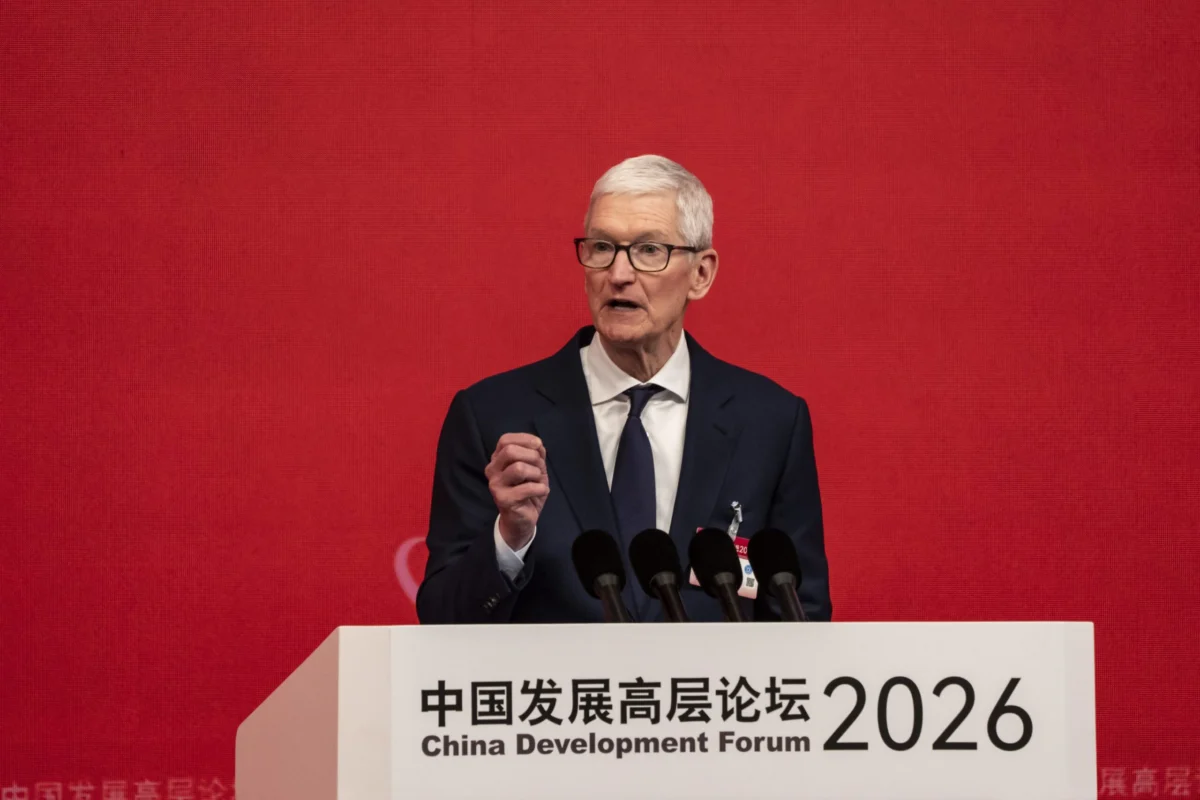
In a meticulously choreographed diplomatic maneuver, Apple Inc. Chief Executive Officer Tim Cook lauded Chinese developers and the company’s extensive network of partners in the country, just days after Beijing’s influential state media issued a sharp rebuke, accusing the iPhone maker of engaging in monopolistic practices. This high-stakes visit underscores the delicate tightrope Apple walks in China, a market vital for both its manufacturing prowess and its colossal consumer base, yet increasingly fraught with regulatory complexities and geopolitical tensions.
Speaking at the prestigious China Development Forum (CDF) in Beijing on Sunday, a gathering renowned for bringing together global business titans and top Chinese policymakers, Cook’s remarks were steeped in conciliation and shared ambition. He extolled the ingenuity of Chinese developers, whose creations populate Apple’s App Store, and praised the advanced automation prevalent in China’s manufacturing facilities, which form the backbone of Apple’s global supply chain. Beyond technological advancements, Cook articulated a vision of alignment, stating that Apple and China share profound common goals, particularly in the critical areas of green development and achieving carbon neutrality – initiatives that resonate deeply with Beijing’s national strategic objectives.
Cook’s overtures came on the heels of a pointed critique published by the People’s Daily, the official newspaper of the Communist Party of China. The state-run mouthpiece had urged Apple to address and rectify its “monopolistic policies,” specifically targeting the App Store’s operational model. This public admonishment followed Apple’s recent decision to lower the fees it collects from app developers in China, reducing the commission from 30% to 25% for certain developers. While seemingly a significant concession aimed at assuaging local regulators and mitigating the risk of antitrust intervention, the People’s Daily article signaled that Beijing’s appetite for further easing of App Store restrictions remains unsatisfied, highlighting the persistent pressure Apple faces.
The regulatory environment in China has grown increasingly stringent for major tech companies, both domestic and international. Over the past few years, Beijing has launched sweeping crackdowns on its own tech giants like Alibaba and Tencent, citing concerns over antitrust violations, data security, and consumer protection. Apple, with its dominant ecosystem and vast market influence, has naturally found itself under similar scrutiny. The 30% commission rate on in-app purchases, a standard across major app stores globally, has long been a contentious point for developers and regulators alike, viewed by many as an unfair levy that stifles competition and innovation. Apple’s decision to reduce this fee in China, while a strategic move to preempt more severe regulatory actions, also reflects the company’s recognition of the unique challenges and demands of the Chinese market. It’s a market where local competitors and alternative payment systems are constantly vying for a larger share, and where government intervention can swiftly reshape the competitive landscape.
During his address at the CDF, Cook underscored the interconnectedness of progress, stating, "Innovation, green development and education are not separate properties – they are deeply connected. They represent the vision of progress that we at Apple share, and we are committed to collaborating with our partners across China and with all of you to make that vision a reality.” This rhetoric carefully aligns Apple’s corporate values with China’s national development agenda, portraying the company not merely as a foreign enterprise operating within its borders, but as a committed partner in its future. He further elaborated on how an “excellently talented developer community” in China contributes to prosperity and opportunity, and how innovation is transforming the country’s manufacturing sector. This emphasis on local talent and industrial sophistication serves to reinforce Apple’s deep integration into the Chinese economy, highlighting mutual benefits.
Despite Cook’s praises, the dynamics of Apple’s manufacturing strategy are undergoing a subtle but significant shift. While China remains the primary global manufacturing hub for the vast majority of Apple’s devices, the company has actively pursued a "China + 1" diversification strategy. This involves expanding its assembly operations to other regions, notably Vietnam and India, driven by a confluence of factors including geopolitical risks, the desire for supply chain resilience following COVID-19 disruptions, and rising labor costs in China. For instance, reports indicate that Apple now produces a significant percentage of its iPhones in India, marking a notable pivot. However, the sheer scale and sophistication of China’s supply chain ecosystem – encompassing everything from advanced components to highly skilled labor and efficient logistics – mean that a complete decoupling from China remains a distant and economically challenging prospect for Apple. The company’s reliance on China is not just about assembly; it’s about a decades-long investment in an unparalleled industrial infrastructure.
The strategic importance of Cook’s visit is amplified by Apple’s recent sales performance in China. After periods of fluctuating growth, the company has witnessed a significant rebound in recent months. The latest iPhone editions, particularly the iPhone 15 series, coupled with a trend of consumers switching from rival Android devices, have fueled robust demand. In the holiday quarter ending in December, Apple’s revenue from China surged an impressive 38% to $25.5 billion, underscoring the market’s critical contribution to the company’s global financial health. This resurgence provides Apple with a stronger negotiating position, yet simultaneously increases the stakes in maintaining a harmonious relationship with Beijing.
Adding another layer to the complex narrative, Chinese Premier Li Qiang, also speaking at the China Development Forum, cited Apple as a prime example of a company with a highly diversified supply chain. Li’s remarks, delivered in a broader context of global economic stability, carried significant geopolitical undertones. He stated, “If we politicize industrial issues and deliberately weaponize the supply chain, we will only increase costs for various companies and weaken development momentum. China is willing to strengthen communication and cooperation with all parties to jointly maintain the stability and security of the global supply chain.” This statement, while not directly addressing Apple’s regulatory woes, serves as a clear message to the international business community and Western governments, including the United States, about China’s stance against economic decoupling and trade protectionism. For Apple, a company deeply entangled in both US and Chinese economic ecosystems, Premier Li’s words highlight the delicate balance it must strike amidst escalating US-China trade and technology rivalries.
Analysts widely view Cook’s visit and his carefully chosen words as part of Apple’s ongoing strategy to de-escalate tensions and reaffirm its commitment to the Chinese market, even while subtly diversifying its manufacturing footprint. "Tim Cook’s appearance at the CDF is a masterclass in corporate diplomacy," noted Emily Chen, a senior tech analyst at Beijing-based consulting firm, TechInsights China. "He’s acknowledging Beijing’s concerns and efforts while simultaneously highlighting Apple’s integral role in China’s economic success. It’s a classic ‘carrot and stick’ approach, but with Apple providing the ‘carrot’ of continued investment and partnership, hoping to soften the regulatory ‘stick.’" Other experts suggest that the People’s Daily criticism, even after Apple’s fee reduction, indicates Beijing’s desire for deeper structural changes in market access and competition, potentially pushing for alternative app stores or more open payment systems that could significantly alter Apple’s lucrative App Store model.
The Chinese proverb Cook cited – “a single tree does not make a forest” – serves as a potent metaphor for interdependence and collective effort. In the context of his speech, it underscores Apple’s desire to be seen as a collaborative partner rather than an isolated giant, working alongside Chinese entities to achieve shared prosperity and environmental goals. This sentiment, while universally appealing, holds particular resonance in China’s collectivist culture and its emphasis on national unity and cooperation.
Ultimately, Apple’s journey in China is a microcosm of the broader challenges faced by global corporations operating in an increasingly fragmented and politicized world economy. The company must skillfully navigate a labyrinth of evolving regulations, intense domestic competition, and profound geopolitical pressures. Cook’s recent visit, characterized by effusive praise and subtle acknowledgments of shared values, represents a crucial episode in this ongoing narrative, illustrating Apple’s determination to maintain its indispensable role in the Chinese market while adapting to its ever-changing demands. The coming months will reveal whether these diplomatic efforts pave the way for a more stable operating environment, or if Beijing will continue to press for further concessions, reshaping the future of one of Apple’s most vital global partnerships.
