
 By Rifan Muazin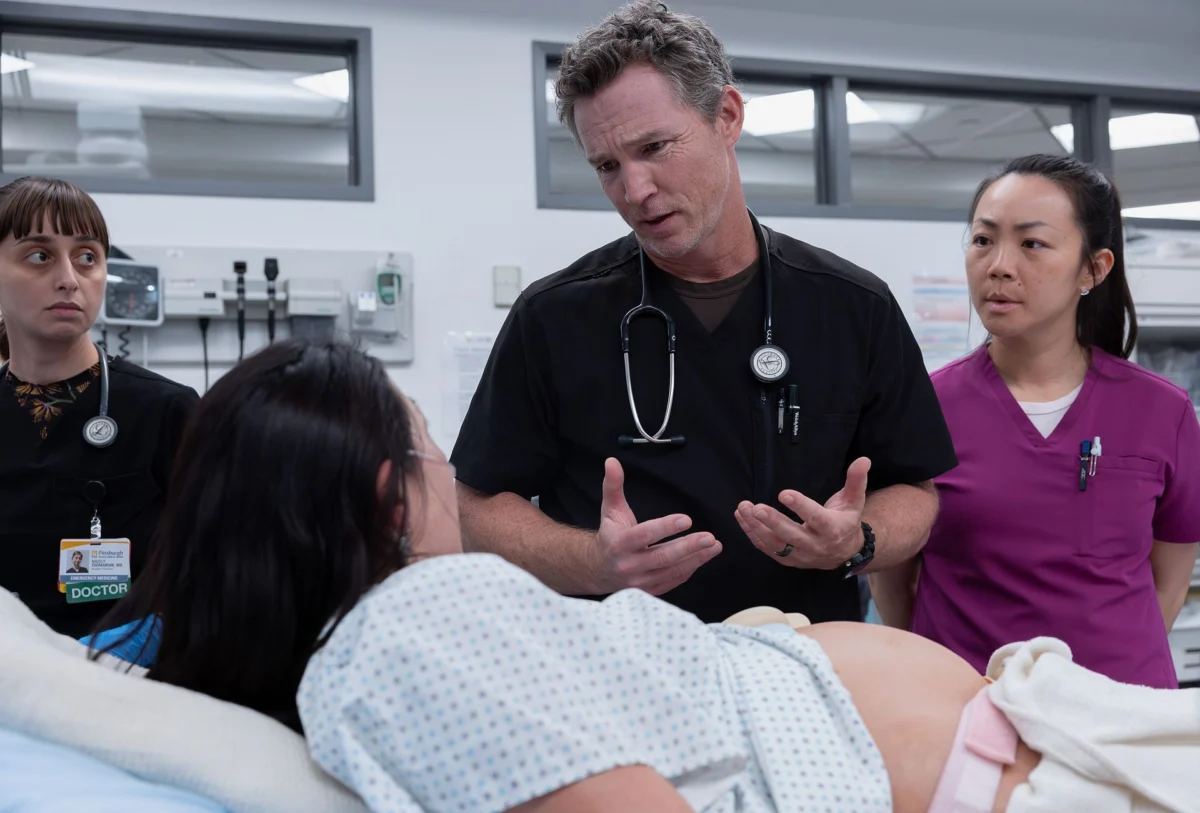
The second season of John Wells’ high-octane medical drama, The Pitt, has concluded with a finale that managed to be both viscerally intense and profoundly intimate. Titled “9:00 PM,” the episode served as a culmination of the simmering tensions that have defined the sophomore season, particularly the deteriorating mental state of Dr. Robby (Noah Wyle) and the stoic resilience of Dr. Jack Abbot (Shawn Hatosy). While the series has always thrived on the kinetic energy of a metropolitan emergency department, the finale pivoted toward a character-driven exploration of trauma, brotherhood, and the high cost of healing.
Dr. Jack Abbot’s journey through the Fourth of July holiday was a microcosm of the show’s relentless pace. Despite being technically off-duty, Abbot’s day was a gauntlet of violence and heroism: he was shot at in his capacity as a SWAT medic, trended on social media for his rugged competence, and ultimately performed life-saving surgery on a pregnant woman. However, the true climax of his arc—and perhaps the season—was not a medical miracle, but a vulnerable heart-to-heart with Robby, a man who has spent the season drifting toward a self-destructive precipice.
Shawn Hatosy’s portrayal of Abbot has become the emotional bedrock of the series. The 50-year-old actor, whose collaboration with producer John Wells spans two decades and five different television series, has crafted a character that resonates deeply with audiences. Abbot, a war veteran with a prosthetic leg and a history of profound loss, represents the “working-class hero” of the medical world. His popularity is such that Hatosy, who won an Emmy for his guest turn in Season 1, is now a frontrunner to make history as the first person to win back-to-back Emmys in the Outstanding Guest Actor in a Drama Series category for the same role. The fervor surrounding the character has even sparked widespread fan demands for a "Night Shift" spinoff, centered entirely on Abbot’s crew of "misfits."
The narrative structure of Season 2 was a gamble that paid off, keeping Abbot off-screen until the seventh episode. When he finally reappeared, rushing into the ER with an injured officer in tow, it was revealed that the night shift attending spends his daylight hours as a SWAT team medic. This revelation added a layer of complexity to Abbot’s psyche; while his therapist suggested he find a "hobby" like golf to manage his PTSD, Abbot chose to lean further into the chaos of high-stakes trauma. This duality—seeking peace through the very violence that wounded him—is a recurring theme in Wells’ work, echoing the gritty realism of Southland and the familial dysfunction of Animal Kingdom.
In the Wells-directed finale, the professional and personal collided when Abbot and Robby were forced to perform a resuscitative hysterotomy—a "Hail Mary" procedure intended to save a baby when the mother is in cardiac arrest. The procedure was a success, but the aftermath left Robby more hollowed out than ever. Abbot, sensing his friend’s withdrawal, cornered him in a private moment to deliver a speech that served as the season’s thesis statement.
"Want to know why I’ve never killed myself, after what I saw, lived through, losing my leg, losing my wife? Because it comes for all of us," Abbot told a visibly shaken Robby. "We can’t let ourselves succumb to it. Yes, life can suck, it can be unbearable and brutal and ugly and heartbreaking, but it’s also beautiful and hilarious. That woman and her baby would both be in the morgue if you hadn’t been here. That’s what we’re here for."
The exchange highlighted the stark difference between the two men. While Abbot has done the "work" of therapy and self-reflection, Robby is still in the "leeching" phase of burnout, feeling as though the constant exposure to death is eroding his soul. Abbot’s advice—to find someone to "help you dance through the darkness"—was both a plea for Robby’s survival and a reminder that the ER needs its best doctors as much as the doctors need the purpose the ER provides.
In an interview following the finale, Hatosy reflected on the shift in Abbot’s demeanor during this confrontation. He noted that while Abbot usually appears to have everything under control, the sight of his best friend on a self-destructive path—symbolized by Robby’s reckless motorcycle riding without a helmet—started to "fray his nerves." Hatosy suggested that Abbot’s own mental health might be more precarious than it appears, hinting that his "hobby" of being shot at as a SWAT medic is just another form of the same darkness Robby is fighting.
The chemistry between Hatosy and Wyle is bolstered by their real-life history and the guiding hand of John Wells. Hatosy’s career has been inextricably linked to Wells for 20 years, starting with a guest role on ER and continuing through Southland, Animal Kingdom, and Rescue: HI-Surf. This shorthand allows for a level of trust on set that translates into the deeply lived-in performances seen in The Pitt. Hatosy recalled the "glimmer" in Wells’ eye during the show’s Emmy win, noting that after years of critical success with various projects, there is something uniquely special about the resonance The Pitt has found with both critics and the general public.
However, the finale was not without its bittersweet notes. Off-screen, the news that Supriya Ganesh, who plays Dr. Mohan, will not return as a series regular for Season 3 has left fans of the "Mohabbot" ship reeling. The chemistry between Abbot and Mohan was a highlight of the season, particularly in the moments where Mohan caught Abbot attempting to stitch his own wounds. Hatosy expressed his own disappointment regarding Ganesh’s departure, praising her for creating a character the world fell in love with and acknowledging that Abbot was "her biggest fan." While the door remains open for future appearances, the loss of that romantic tension will undoubtedly change the dynamic of the night shift.
Looking ahead to Season 3, Hatosy is eager to explore new character pairings. He specifically mentioned an interest in sharing more screen time with Taylor Dearden’s Dr. Mel, suggesting that the two could find common ground in unexpected places, perhaps even "Civil War reenactments." This desire for character expansion is part of why the idea of a night shift spinoff remains so enticing. Hatosy views the night shift as a group of "misfits" whose stories are only beginning to be told. He acknowledged the "soft launch" feel of the final Season 2 episodes, which focused heavily on the night crew’s chemistry.
The success of The Pitt also speaks to the current state of the television industry. Hatosy pointed out that in an era where there are fewer opportunities for the "working-class actor," a show like The Pitt—which shoots in Los Angeles and utilizes a rotating cast of high-caliber guest stars—is a vital resource. The show’s ability to attract top-tier talent who are themselves fans of the series has created an environment of immediate chemistry and mutual respect.
As the finale drew to a close, the heavy emotional weight of the episode was punctured by Abbot’s signature dark humor. After their intense talk was interrupted by a patient with "half of his face blown off," Abbot cracked, "How can you not love this place?" It was a moment that encapsulated the show’s DNA: the juxtaposition of horrific tragedy and the gallows humor required to survive it. As Robby prepared for a trip to clear his head, Abbot reminded him that he was his emergency contact—but added the caveat that he "didn’t want to be contacted."
This blend of loyalty and boundary-setting defines the relationship between these two senior doctors. As The Pitt heads into its third season, the questions remain: Can Robby find his way back from the brink? Will Abbot’s own "hobbies" eventually catch up with him? And will the night shift finally get the standalone spotlight the fans are clamoring for? Regardless of the direction the writers take, Shawn Hatosy has solidified his place as the soul of the show, proving that even in the darkest shifts of the night, there is a way to dance through the darkness.
