
 By admin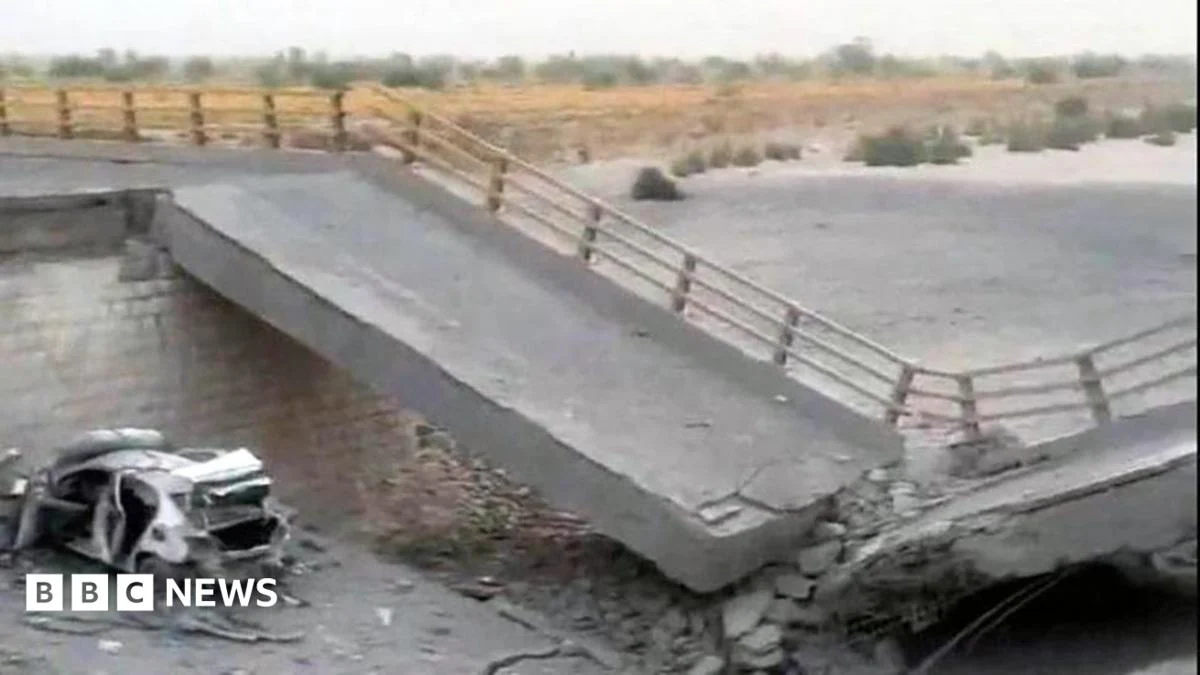
In a dramatic escalation of hostilities, Iran has vehemently accused the United States of targeting civilian infrastructure amidst a relentless wave of air strikes that have intensified since the collapse of peace talks. State media and provincial authorities in Iran have reported significant damage to vital civilian assets, including bridges, a crucial train station, and an airport. BBC Verify has independently corroborated at least one of these claims, confirming an attack on a bridge in the southern province of Hormozgan. In stark contrast, a White House spokesperson has asserted to the BBC that US operations have been exclusively directed at "military targets, including military logistics infrastructure," a claim that stands in direct opposition to Iranian assertions.
The current aerial bombardment marks the sixth consecutive night of US air strikes against what it describes as Iranian targets. President Donald Trump has openly declared his intention to strike Iranian bridges and power stations, a tactic he has framed as a means to compel Tehran back to the negotiating table to end a conflict that commenced on February 28th. This war, according to Iranian narratives, began with US-Israeli attacks, which in turn prompted retaliatory actions from Iran against Israel, US interests, and allied nations across the Gulf region.
Iranian state media and local officials detailed the alleged destruction on Thursday night, identifying Iranshahr Airport in southeastern Iran, a vital railway station, and six bridges in the strategically important Hormozgan province as direct hits. The human toll of these strikes has also been significant, with provincial authorities in Hormozgan reporting seven fatalities. BBC Verify, in conjunction with BBC Persian, has rigorously examined and verified video footage depicting the devastation of the Gariveh Bridge. Nighttime recordings captured a spectacular fireball engulfing the structure, while subsequent daylight imagery revealed a collapsed section of roadway, surrounded by a chaotic landscape of rubble and debris, painting a grim picture of the bridge’s complete destruction.
While the US Central Command (Centcom) has refrained from releasing a comprehensive list of targeted locations, they have stated that the objective of these strikes is to "further degrade Iranian military capabilities." This strategic objective, however, is increasingly being called into question by the reported impact on civilian infrastructure. The international community has previously voiced grave concerns regarding the potential for such actions to constitute war crimes. In April, UN Human Rights Chief Volker Türk issued a stark warning, stating that "deliberately attacking civilians and civilian infrastructure is a war crime," a statement that carries particular weight given the current accusations leveled against the US.
In a tit-for-tat response to the latest US air strikes, Iran’s Revolutionary Guard Corps (IRGC) has announced its own retaliatory operations. According to IRGC statements, they have successfully struck US maritime surveillance radar sites located in Oman, alongside other targets in Kuwait and Bahrain. Furthermore, Iran claims to have launched an attack against a US special operations command center in al-Tanf, Syria. As of this report, neither Syrian nor US officials have offered any comment on these specific claims.
However, Kuwaiti authorities have confirmed that Iranian strikes did impact their nation, specifically hitting power generation and water desalination stations. The Kuwaiti army has reported that several personnel sustained injuries as a direct consequence of Iranian drones targeting facilities and camps on Friday morning. In response to these actions, a White House spokesperson reiterated to the BBC that the Iranian regime has "intentionally targeted civilian vessels in the Strait of Hormuz and lashed out against its neighbors who have no role in this conflict." This statement highlights a broader pattern of Iranian aggression in the region, according to US officials.
The escalating conflict has had a profound and disruptive impact on global trade and energy security. The Strait of Hormuz, a critical maritime chokepoint through which a significant portion of the world’s oil and liquefied natural gas transits, has remained effectively blocked by Iran throughout the duration of the war. This closure poses a severe threat to global energy supplies. Fatih Birol, the head of the International Energy Agency, expressed his deep concern on Thursday night, stating, "We should be worried, and I am worried, if the situation does not improve in the next few weeks." His words underscore the potentially catastrophic economic ramifications if the current trajectory of conflict continues unabated.
The roots of this escalating conflict can be traced back to the breakdown of diplomatic efforts aimed at de-escalating tensions in the region. The initial peace talks, which had offered a glimmer of hope for a cessation of hostilities, faltered without yielding any tangible progress. The collapse of these negotiations appears to have paved the way for a more aggressive military posture from both sides, leading to the current cycle of air strikes and retaliatory actions. The geopolitical landscape in the Middle East has been particularly volatile in recent months, with a complex web of alliances, rivalries, and proxy conflicts contributing to the pervasive instability.
The involvement of Israel in the initial US-led attacks, as alleged by Iran, adds another layer of complexity to the conflict. Iran’s historical animosity towards Israel, coupled with its perception of being targeted by a US-Israeli coalition, fuels its retaliatory actions. The designation of certain targets as "military logistics infrastructure" by the US, while contested by Iran as civilian, points to a potential disconnect in intelligence gathering and interpretation, or perhaps a deliberate strategic ambiguity in targeting. The international community’s reliance on verified information from entities like BBC Verify becomes crucial in navigating these competing narratives and assessing the true impact of the military actions.
The implications of attacking civilian infrastructure, even under the guise of military necessity, are far-reaching. Beyond the immediate human cost in terms of casualties and displacement, such actions can lead to long-term economic devastation, disrupt essential services, and create widespread humanitarian crises. The deliberate targeting of bridges, railway stations, and airports not only impedes military movements but also cripples civilian transportation, exacerbates food and medical supply shortages, and hinders any potential recovery efforts. This is precisely why international humanitarian law, as articulated by the UN Human Rights Chief, draws a clear line against such practices.
The response from Iran, particularly the IRGC’s claims of striking radar sites and command centers, suggests a strategic effort to disrupt US intelligence-gathering capabilities and project Iranian power beyond its immediate borders. The targeting of facilities in Oman, Kuwait, and Bahrain, if substantiated, would represent a significant expansion of the conflict’s geographical scope and could draw neighboring countries further into the fray. The reported casualties in Kuwait highlight the immediate dangers faced by nations perceived as aligned with the US or caught in the crossfire.
The closure of the Strait of Hormuz is not merely a regional issue; it has global ramifications. As a vital artery for global energy transport, its continued inaccessibility threatens to drive up oil prices, disrupt supply chains, and potentially trigger economic downturns worldwide. The concerns voiced by the head of the International Energy Agency underscore the gravity of the situation, emphasizing that a prolonged closure could have dire consequences for global energy security. This underscores the urgent need for de-escalation and a return to diplomatic channels to resolve the underlying issues fueling the conflict.
The current phase of the conflict, characterized by a sustained aerial bombardment and retaliatory strikes, suggests a breakdown in communication and a hardening of positions. The "peace talks" mentioned in the initial report appear to have failed to bridge the fundamental disagreements between the involved parties. The threat of further escalation, with President Trump explicitly mentioning the targeting of civilian infrastructure, raises the specter of an even more devastating conflict, with potentially irreversible consequences for the region and the global order.
The role of international diplomacy in this volatile scenario is paramount. While the US and Iran remain locked in a cycle of military action and counter-action, third-party mediators and international organizations have a critical role to play in facilitating dialogue, de-escalating tensions, and preventing further loss of life and destruction. The United Nations, in particular, has a mandate to promote peace and security, and its efforts to bring the parties to the negotiating table and ensure adherence to international humanitarian law are more crucial now than ever.
Furthermore, the narrative surrounding the conflict is as important as the military actions themselves. Both sides are engaged in information warfare, seeking to shape public opinion and international perception. Iran’s accusations of US targeting of civilian infrastructure, if proven, would significantly damage the US’s international standing and potentially galvanize opposition to its military actions. Conversely, the US narrative of targeting military assets aims to justify its operations and portray Iran as the aggressor. Verifying claims through independent sources like BBC Verify becomes indispensable in cutting through propaganda and establishing a factual basis for understanding the conflict.
The long-term implications of this conflict extend beyond the immediate military engagements. The destruction of infrastructure can set back development for years, if not decades. The human cost, measured not only in lives lost but also in injuries, displacement, and psychological trauma, will leave a lasting scar on the affected populations. The erosion of trust and the deepening of animosities will make future reconciliation and cooperation even more challenging.
In conclusion, the news of Iran accusing the US of hitting civilian infrastructure amidst a renewed wave of air strikes paints a grim picture of a conflict spiraling out of control. The diverging accounts from Tehran and Washington, coupled with the verified destruction of a key bridge, highlight the critical need for transparency, accountability, and a renewed commitment to diplomatic solutions. The potential for wider regional conflagration and the severe impact on global energy markets underscore the urgency of finding a pathway back from the brink, before the consequences become irreversible and the human and economic toll becomes unbearable. The world watches with bated breath, hoping for a de-escalation that seems increasingly elusive in the face of escalating hostilities.
