
 By admin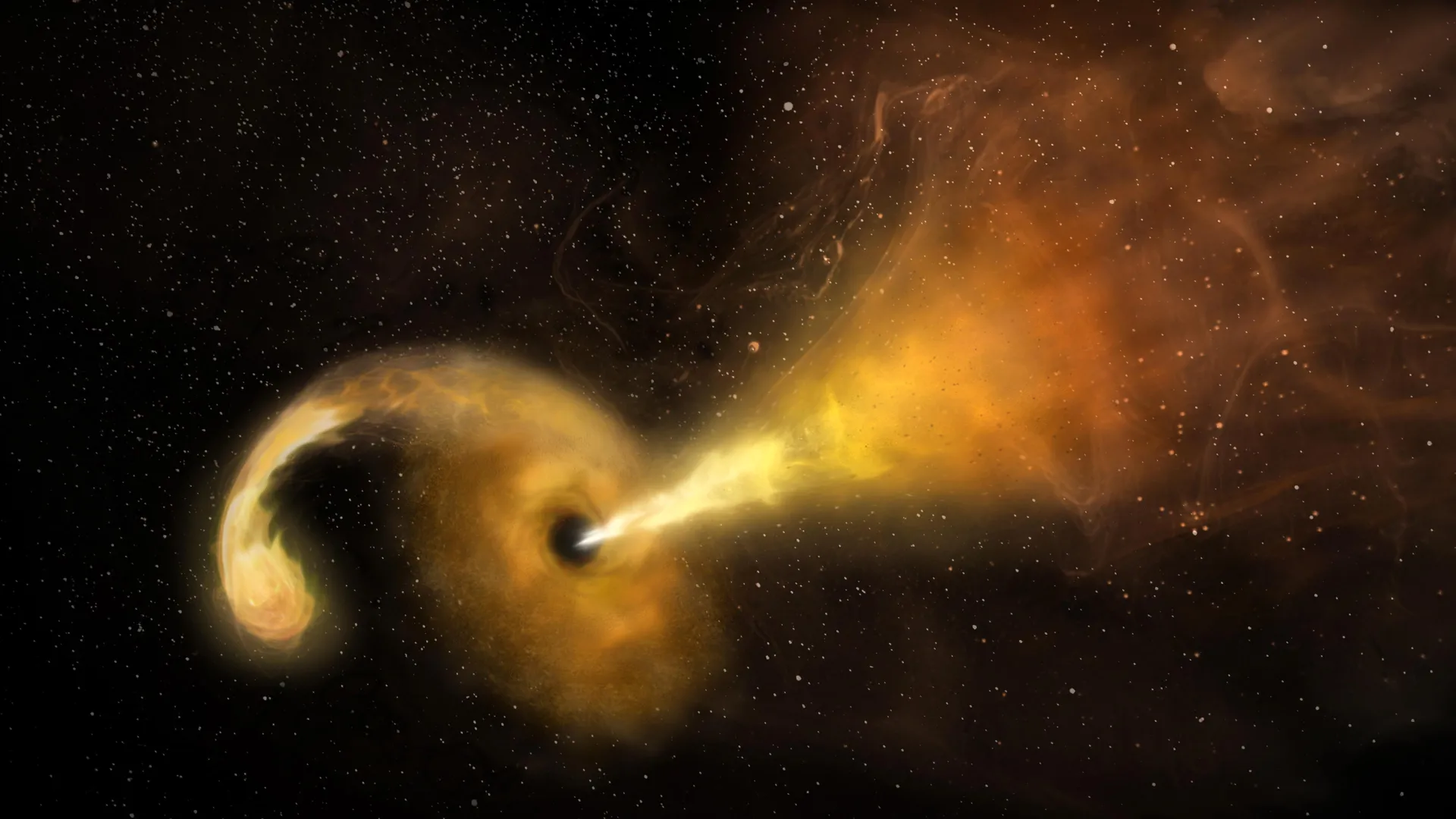
The detection validates a novel observational strategy designed to hunt for these elusive, wandering black holes. "We were actively searching for these star-shredding events as a powerful means to uncover otherwise invisible supermassive black holes that have strayed far from the dense galactic cores where they typically reside," explained Robert Stein, a research fellow at The University of Maryland, College Park and NASA’s Goddard Space Flight Center in Greenbelt, Maryland. "With this groundbreaking discovery, which is one of only a handful confirmed so far, we have not only validated a new and incredibly promising technique but also established a clear path to use it systematically to hunt for many more." The findings, led by Stein, were meticulously detailed in a paper published on July 27 in The Astrophysical Journal Letters, a leading peer-reviewed journal for astronomical research.
The cosmic drama unfolded with an exceptionally bright flare of light, a signature of a tidal disruption event. These cataclysmic occurrences happen when a star, venturing too close to the gravitational maw of a massive black hole, is subjected to immense tidal forces. These forces, far exceeding the star’s own self-gravity, stretch and tear the star apart in a process vividly described as "spaghettification," before its material is consumed by the black hole. The black hole at the center of this particular event is estimated to possess a mass roughly 1 million times that of our Sun, classifying it firmly within the supermassive category.
The initial hint of this extraordinary event surfaced in November 2025, when the Zwicky Transient Facility (ZTF), a wide-field sky survey operated by the Palomar Observatory in Southern California, detected an unusual burst of light emanating from a galaxy located approximately 750 million light-years from Earth. ZTF is a powerhouse in time-domain astronomy, continuously scanning vast swathes of the night sky for transient phenomena—objects that change in brightness or appear and disappear over short timescales. Its advanced capabilities, coupled with sophisticated data analysis, are crucial for identifying rare cosmic events amidst a deluge of data.
"Out of the half-million flashes and transient signals ZTF detects every single night, our new artificial intelligence algorithm proved its worth by automatically recognizing a flare that bore all the characteristic hallmarks of a tidal disruption event," Stein elaborated. "What made this particular detection truly remarkable and challenging was its highly unusual location in the extreme outskirts of a galaxy, a place we previously wouldn’t have typically targeted for such an event." For several months following its initial detection, the flare blazed with astonishing intensity, particularly in ultraviolet light, temporarily outshining the entire galaxy surrounding it. At its absolute peak, this cosmic beacon radiated with the brilliance of approximately 10 billion Suns, a testament to the immense energy released during the star’s demise.
Confirming the extreme nature and origin of this cosmic flare required a multi-observatory effort, leveraging the complementary strengths of both ground-based and space-based telescopes. After the initial ZTF detection, astronomers quickly directed additional observatories toward the source. The Southern Astrophysical Research (SOAR) telescope in Chile played a crucial role, studying the flare’s spectrum—a breakdown of its light into different wavelengths. The spectral analysis revealed distinct features entirely consistent with the violent processes of a tidal disruption event, further strengthening the hypothesis.
The definitive confirmation, however, came from NASA’s Neil Gehrels Swift Observatory. Swift, a space-based observatory renowned for its rapid response and multi-wavelength capabilities, is uniquely positioned to examine wavelengths, particularly X-ray and ultraviolet, that are largely absorbed by Earth’s atmosphere and thus inaccessible to ground-based telescopes. Swift’s Ultraviolet/Optical Telescope (UVOT), for instance, precisely measured the flare’s temperature, pegging it at an astonishing 54,000 degrees Fahrenheit (30,000 degrees Celsius). This high temperature is characteristic of the superheated accretion disk of stellar material forming around a black hole after a TDE.
"The synergistic combination of all this diverse observational data—from ZTF’s initial wide-field detection to SOAR’s spectral analysis and Swift’s precise multi-wavelength measurements—was absolutely instrumental in helping us systematically rule out other potential explanations," stated Jonathan Carney, a doctoral student at the University of North Carolina at Chapel Hill, who obtained the critical first spectra that supported the flare’s interpretation as a tidal disruption event. "This comprehensive approach allowed us to confidently assert that we were indeed witnessing a tidal disruption event, despite its truly bizarre and unexpected location."
The discovery of this "orphan" black hole forces a re-evaluation of our understanding of black hole demographics and galaxy evolution. It has been a cornerstone of modern astrophysics that nearly every galaxy in the universe harbors a supermassive black hole at its very center, often millions or even billions of times the mass of the Sun. These central black holes are intimately linked to the growth and evolution of their host galaxies. While TDEs are dramatic, they are also incredibly rare events within any individual galaxy, estimated to occur only once every 100,000 years or so. Yet, because astronomers monitor millions of galaxies across the cosmos, current sky surveys typically detect approximately 30 tidal disruption events throughout the observable universe each year.
Prior to 2024, every single confirmed example of a TDE had been found squarely within the dense, star-filled cores of galaxies. This was partly due to an observational bias: astronomers naturally concentrated their search efforts in these central regions, as all known supermassive black holes had, until then, been located at galactic centers. Furthermore, a TDE requires a black hole of substantial mass; the gravitational pull of less massive black holes simply isn’t strong enough to tear apart an entire star so dramatically. That long-held assumption began to shift in 2024, when scientists detected compelling signs of a star being destroyed a significant 2,600 light-years from the center of its host galaxy. That discovery, while still relatively close by cosmic standards, served as a powerful impetus for astronomers to broaden their search horizons beyond the immediate vicinity of galactic nuclei. The newly identified event, however, is far more extreme, occurring an astounding distance of more than 30,000 light-years from the perceived center of its galaxy, deep within its halo or outskirts.
The black hole’s highly unusual location naturally raises profound questions about its origin and past journey. "It is highly improbable that this black hole formed in situ at such a remote location," Stein posited. "Instead, it must have originated in the center of a galaxy, but clearly not the one it currently finds itself in the distant outskirts of. Our leading hypothesis suggests that while the host galaxy’s primary supermassive black hole likely remains anchored at its core, the black hole responsible for consuming this star could have initially started its life in the center of a much smaller dwarf galaxy that subsequently merged with the larger galaxy we observe today."
Researchers have put forth two primary scenarios to explain how this rogue black hole could have ended up so far from a galactic center. In one intricate scenario, three or more galaxies may have undergone a complex, multi-stage merger. During such a chaotic gravitational dance, their respective central supermassive black holes could have become locked in a violent, three-body gravitational struggle. This dynamic interaction could have eventually resulted in the lightest of these black holes being gravitationally slingshotted with immense velocity, launching it towards the distant edge of the newly combined, larger galaxy. A second, perhaps simpler, possibility suggests that a smaller dwarf galaxy, complete with its own central supermassive black hole, is still in the protracted process of merging with the larger system. As stars from the dwarf galaxy entered the larger galaxy’s gravitational sphere, one of them may have simply passed too close to the dwarf galaxy’s still-active supermassive black hole, resulting in the observed TDE. "Further discoveries of similar wandering black holes will be crucial in helping us to definitively reveal the true origin story of this apparent ‘orphan’ black hole," Stein emphasized. "The key scientific question we are striving to answer now is: just how common are these wandering black holes across the universe?"
Astronomers are optimistic that they will soon be able to answer that fundamental question by identifying many more displaced black holes. A critical tool in this ongoing quest, the Swift Observatory, is currently undergoing a temporary suspension of its pointed science observations with its UVOT and X-Ray Telescope (XRT) instruments. This pause is in anticipation of a planned orbit boost, scheduled for this summer. "Swift’s primary mission, though initially slated for a shorter duration from 2004 to 2006, has remarkably continued to operate and observe the ever-changing universe for over two decades," noted co-author S. Bradley Cenko, Swift’s principal investigator at NASA Goddard. Atmospheric drag is an ongoing challenge for low-Earth orbit satellites, gradually pulling Swift closer to Earth. Raising Swift into a higher, more stable orbit could significantly extend its operational lifespan for many more years. "Once it successfully resumes its normal scientific operations, Swift will once again be a powerful asset, continuing its vital search for additional examples of these intriguing, out-of-place black holes," Cenko affirmed.
Looking further into the future, astronomers are already planning to apply this validated detection method to the next generation of observatories, which promise to revolutionize our understanding of the transient sky. The newly operational Vera C. Rubin Observatory, jointly funded by the U.S. Department of Energy and National Science Foundation in Chile, with its unprecedented wide-field survey capabilities, will be a game-changer. Similarly, NASA’s upcoming Nancy Grace Roman Space Telescope, designed for deep-space observations, will offer a complementary perspective.
"Rubin’s incredibly wide and deep surveys, with their rapid cadence and vast data volume, are poised to reveal a much larger and more diverse sample of tidal disruption events than current observatories are capable of collecting, including a significant number of these tantalizing off-center events," Carney highlighted. "And Roman’s unparalleled space-based surveys, with its wide-field infrared vision, will extend the current search zone by seeing fainter, more distant TDEs, effectively allowing us to look back through an astonishing 9 billion years of cosmic history." The synergy of combining data from Rubin, Roman, the enduring Swift, and various ground-based observatories will empower scientists to identify a multitude of additional wandering black holes. Together, these forthcoming discoveries are expected to eventually help astronomers build the most comprehensive and accurate census yet of the universe’s enormous black holes, shedding new light on their distribution, evolution, and profound impact on galaxy formation.
