
 By admin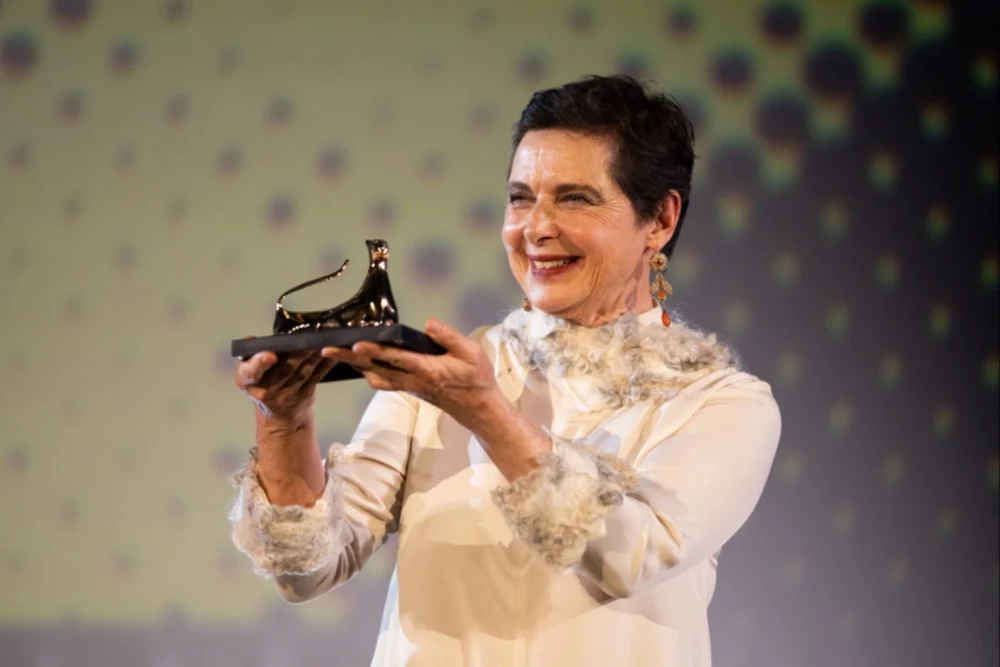
The prestigious Locarno Film Festival has recognized the illustrious career of Isabella Rossellini with its esteemed Excellence Award. The acclaimed actress, known for her captivating performances and multifaceted life, accepted the award during the festival’s opening ceremony, expressing profound emotion and a deep connection to her family’s cinematic heritage. "The prize I’m receiving tonight is for excellence, which is something I haven’t heard very often," Rossellini remarked, her voice resonating with a blend of humility and pride. "I’m very proud of it and, above all, so moved because my father received this back in 1948 for his film ‘Germany, Year Zero.’ And then, four years ago, my brother Renzo [Rossellini], who was a great producer of Fellini and Scola. Being on par with my father and my brother fills me with so much emotion."
This familial resonance is particularly poignant. Roberto Rossellini, Isabella’s father, was a pioneering figure of Italian neorealism, his work often exploring the human condition in the aftermath of war. "Germany, Year Zero," released in 1948, remains a stark and powerful depiction of a post-war society from a child’s perspective, a film that significantly shaped the landscape of cinematic realism. Renzo Rossellini, her brother, continued the family’s artistic legacy as a respected film producer, collaborating with legendary directors like Federico Fellini and Ettore Scola, whose contributions to cinema are equally monumental. To stand in their distinguished company, as recognized by Locarno, is clearly a moment of deep personal significance for Isabella.
Beyond the accolades, Rossellini’s presence at Locarno also provided a platform for her intellectual curiosity and unconventional artistic endeavors. During a masterclass that captivated attendees, she delved into her unique web series, "Green Porno" and "Seduce Me." These series, which explore the fascinating and often surprising world of animal mating rituals, are a testament to her enduring passion for the natural world. Rossellini, who holds a master’s degree in Animal Behavior and Conservation, approaches these subjects with a blend of scientific rigor and artistic flair.
Her approach to filmmaking for these series is as distinctive as their subject matter. "I know nothing about computers. I don’t speak that language, so I made these films the way I knew how: super low-tech," she explained. This self-imposed limitation has fostered a creative freedom, drawing inspiration from early cinema pioneers. "I watched a lot of [Georges] Méliès. It was a no-tech technique. Animals, to me, they fascinate me. I have a farm and when I decided to make films myself, they became my muses." This "no-tech" philosophy, ironically, has allowed her to create visually engaging and thought-provoking content that stands out in an increasingly saturated digital landscape. She revealed that in her upcoming projects, she intends to continue playing all the roles herself, but her ambition is to shift her focus more towards directing in the future.
Rossellini’s fascination with biology extends beyond the intimate world of animal reproduction. She sees the natural world as a profound source of inspiration, often challenging societal norms and preconceived notions. "I am just fascinated by biology and diversity. When someone says: ‘It’s against nature to be gay or trans’ – it’s not!" she asserted. Her discoveries in nature have consistently surprised and informed her, leading to a worldview that embraces the inherent diversity of life. "I don’t sit down to write something political or poetic, but I discover that some worms are hermaphrodites. I am just always so surprised. That’s my inspiration – not politics." This perspective highlights a deep-seated belief in the inherent wonder and complexity of the natural world, suggesting that its lessons are far more inclusive and accepting than many human constructs.
While her artistic and scientific pursuits often take center stage, Rossellini acknowledged the unavoidable impact of the current political climate, particularly in the United States, where she has resided. When asked about her future plans, she expressed a sentiment of hopeful anticipation for positive change. "We are thinking of going back, but I have sheep, I have land. Should I abandon everything? I just hope things will improve." This statement reveals a deep connection to her rural life and the responsibilities she feels towards her animals and property, underscoring a desire for stability and a return to normalcy.
Her lifelong affinity for animals has been a guiding force throughout her life. "My first passion was animals. Even when I was a kid, I would take stray dogs and take them home," she reminisced, painting a vivid picture of her early empathy and connection to the animal kingdom. This early passion, however, did not immediately translate into a career in animal studies. Instead, her journey into the arts was more circuitous, beginning with her involvement in her father’s films as a costume designer.
A pivotal moment arrived when her mother, the legendary Ingrid Bergman, was offered a role in the film "A Matter of Time," which was being shot in Rome. Isabella Rossellini seized the opportunity to join her mother on set, not with aspirations of an acting career, but simply to spend time together. "Just to spend some time with my mum! I didn’t think I would become an actress," she confessed. This seemingly casual foray into acting, however, marked the beginning of a significant chapter in her life.
Despite the familial connection to filmmaking, Rossellini faced initial discouragement from critics. This led her to explore other avenues, including a successful career in modeling and journalism. Her experiences in the fashion industry, working with iconic photographers like Richard Avedon, provided a crucial form of validation. "When you are criticized publicly, as it happened with ‘The Meadow,’ it’s really hard. Being successful in the fashion world really reassured me," she stated. Avedon’s insightful observation, "Models are like silent movie stars. You have no lines, but I shoot the emotion," resonated deeply with her, highlighting the power of visual expression beyond dialogue. It was through this newfound confidence that she began to reconsider acting. "I was asked to be in films, maybe because I was Ingrid Bergman’s daughter, and I said: ‘Why not?’"
Her role in David Lynch’s groundbreaking 1986 film, "Blue Velvet," remains a defining moment in her acting career. Rossellini recounted the initial meeting with Lynch with vivid detail. "I met David at a restaurant. We were both there with members of the De Laurentis family, and we joined the tables. He said: ‘You look like Ingrid Bergman.’ They said: ‘You idiot, she is her daughter!’" This amusing encounter set the stage for her unforgettable portrayal of Dorothy Vallens. Upon receiving the script, she was intrigued by the controversial nature of the character and the film. "When I got the script, there was a note: ‘Why don’t you read it and tell me if you want to play this character. I loved it, but it was so controversial." Her dedication to understanding the character led her to request a rehearsal, ensuring her interpretation aligned with Lynch’s vision. "I asked him if I could rehearse the scenes to see if my interpretation matches his [vision]. He said: ‘You got it right.’" "Blue Velvet" plunged audiences into Lynch’s signature surreal and unsettling world, with Rossellini’s performance becoming a central element of its enduring impact. "David was not so famous back then, and he really showed his mysterious world there. The plot was not so important. Some hated it and some loved it," she observed. The film’s distinctive soundscape, crafted by composer Angelo Badalamenti, also played a crucial role in its atmosphere. Rossellini playfully noted, "It sounds like I sing very well, but that’s movie magic," referencing her vocal performance in the film.
Following her breakthrough in "Blue Velvet," Rossellini’s career continued to flourish with collaborations with a diverse range of acclaimed directors, including Robert Zemeckis, David O. Russell, Taylor Hackford, and James Gray. Her role in James Gray’s "Two Lovers" brought her into contact with the director, who is also being celebrated at Locarno this year. Reflecting on that experience, she offered a humorous anecdote: "He was very nice. Joaquin Phoenix was more difficult, because he followed method acting back then," she quipped, referencing the intense dedication of her co-star.
More recently, Rossellini has garnered critical acclaim for her work with director Alice Rohrwacher in "La Chimera," a film that has been lauded for its artistic vision and compelling narrative. Her performance in Edward Berger’s "Conclave" earned her an Academy Award nomination for Best Supporting Actress, further solidifying her status as a formidable talent in contemporary cinema. Despite these numerous accolades and diverse roles, Rossellini maintains a grounded perspective on her craft. "I never think about someone’s ‘style.’ I think about what I want to say," she stated, emphasizing her focus on conveying meaning and emotion rather than adhering to any particular aesthetic.
Looking back on her career trajectory, Rossellini expressed a sense of retrospective curiosity about her own pace of development. "The thing is, I did everything late. I became a director in my 50s. I would have liked to start everything earlier, because I am always 10 years too late!" she admitted with a smile. This sentiment, however, belies the richness and breadth of her accomplishments. From her early explorations in filmmaking to her groundbreaking work in animal advocacy and her continued presence as a captivating actress, Isabella Rossellini embodies a unique blend of artistic passion, intellectual curiosity, and a profound connection to the natural world, making her a truly deserving recipient of the Locarno Excellence Award. Her journey serves as an inspiration, demonstrating that a life dedicated to diverse passions can yield a legacy of extraordinary impact.
