
 By Lina Irawan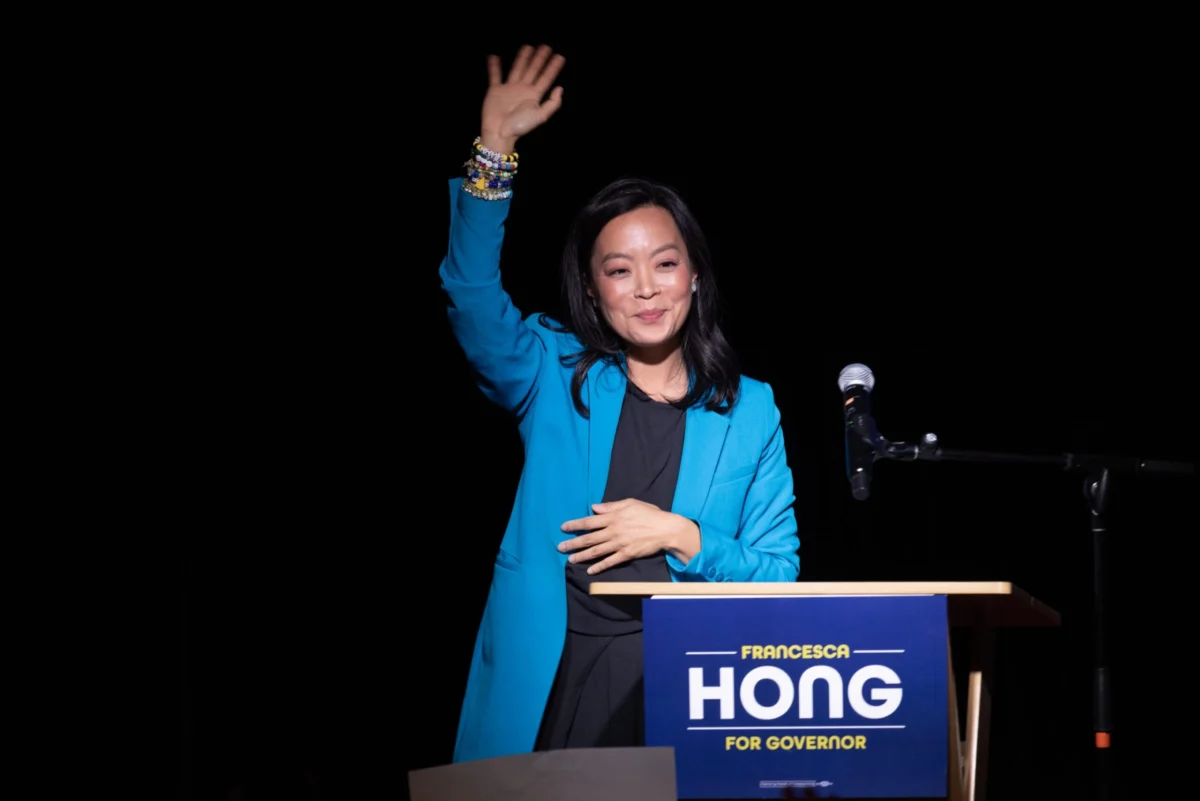
The Wisconsin primary was more than just a local contest; it was seen as a bellwether for the progressive movement’s enduring strength and organizational capacity in a key swing state. Francesca Hong, a charismatic state representative known for her staunch progressive stances on economic justice, healthcare, and environmental policy, had built a formidable grassroots operation. Her campaign enjoyed significant momentum, fueled by enthusiastic volunteers and a narrative of challenging establishment norms. David Crowley, the Milwaukee County Executive, presented himself as a more pragmatic, coalition-building Democrat, appealing to a broader moderate base and emphasizing his executive experience. Traditional polling firms, tracking the race diligently in the weeks leading up to Election Day, consistently showed Hong with a comfortable lead, often ranging between 8 to 12 percentage points. This consensus among pollsters was mirrored, and indeed amplified, by the prediction markets.
Polymarket and Kalshi, leveraging their unique model of aggregating the "wisdom of crowds" through real-money betting, had assigned an overwhelming probability to Hong’s victory. Their event contracts on the outcome of the Wisconsin governor’s primary aligned almost perfectly with the sentiments of traditional polling firms. Both platforms gave Francesca Hong roughly a 95% chance of winning, with some individual markets even nudging her probability as high as 96%. This level of certainty, typically reserved for incumbent landslides or non-contested races, underscored the perceived inevitability of her triumph. Market participants, driven by financial incentives to accurately predict outcomes, poured capital into contracts favoring Hong, pushing her probability higher and higher in the final days of the campaign.
However, when the votes were counted, the narrative spectacularly unraveled. Crowley prevailed by less than half a percentage point, a mere few hundred votes separating the candidates in a statewide contest that had drawn significant turnout. The shock was palpable, not only for Hong’s campaign and progressive activists but also for the prediction market community. The surprise loss led Polymarket to quietly delete one of its more boastful posts on X (formerly Twitter), which had confidently declared Hong had a 96% chance of winning the primary. This swift removal, captured by vigilant observers like Christopher Hale, served as an immediate visual testament to the platform’s embarrassment and the sudden fragility of its carefully cultivated reputation. The deleted tweet had also conspicuously downplayed Hong’s lack of endorsements from prominent national Democratic socialists such as Bernie Sanders and Alexandria Ocasio-Cortez, suggesting that the market’s internal dynamics superseded traditional political endorsements – a claim that now looked profoundly misguided.
In the wake of the criticism, Kalshi’s founders moved quickly to manage the fallout. Kalshi CEO Tarek Mansour and co-founder Luana Lopes Lara took to social media to defend the platform’s methodology. Their core argument was a statistical one: the outcome did not, on its own, invalidate the forecast. Mansour emphasized that the 95% probability assigned to Hong still implied that the underdog, Crowley, had roughly a one-in-20 chance of winning—a low-probability outcome, but one the market had explicitly allowed for. "5% is not 0%," Lopes Lara succinctly wrote, attempting to reframe the event as a rare but plausible occurrence within the probabilistic framework. They argued that even a highly probable event has a small chance of not happening, and this was simply that 5% scenario playing out.
This defense, while mathematically sound, clashed with the popular perception of prediction markets as infallible oracles. For many users and observers, a 95% chance implied a near-certainty, and the dramatic miss felt like a betrayal of that trust. "When you’re dealing with public perception, especially in political forecasting, 95% is often interpreted as a guarantee by the layperson," noted Dr. Evelyn Reed, a data scientist specializing in probabilistic modeling. "While technically correct that 5% allows for an upset, the public often conflates high probability with absolute certainty, particularly when platforms are marketed with claims of superior accuracy." The deletion of Polymarket’s tweet, in particular, suggested an acknowledgment of an overreach in confidence, rather than just a statistically permissible outlier.
The misstep comes at a critical juncture for prediction markets, which have seen their credibility surge dramatically in recent years. Traditionally viewed as niche platforms for sophisticated bettors, they had begun to be seen as a legitimate complement, if not a superior alternative, to traditional polls and surveys for forecasting elections and other real-world events. Their reputation received a significant boost in the final stretch of the 2024 presidential campaign and in the aftermath of Election Day. During that contentious period, many conventional polls portrayed the presidential race as a toss-up or even gave a slight edge to the challenger, while Polymarket and Kalshi were widely credited with consistently giving Donald Trump a discernible edge, ultimately proving more accurate in their final assessments. This triumph against traditional polling’s perceived inaccuracies solidified their standing as a valuable, real-time indicator of public sentiment and likely outcomes.
Their influence had since extended to mainstream media, signifying a paradigm shift in how forecasting information is consumed. CNN had named Kalshi its official prediction-markets partner, integrating their probabilities into on-air election coverage and online analyses. Similarly, Dow Jones, the parent company of prestigious financial news outlets, was planning to incorporate Polymarket data across The Wall Street Journal, Barron’s, and MarketWatch, signaling a broader acceptance of these platforms as authoritative sources of real-world intelligence. This integration was partly driven by the theory of the "wisdom of crowds," which posits that the aggregated knowledge and incentives of a large group of diverse individuals, especially when money is on the line, can produce more accurate forecasts than individual experts or traditional polling methods.
However, Crowley’s victory this week was not the first time prediction markets had mispriced an election, though the probabilities in those cases often left more room for an upset, making the "5% is not 0%" argument feel less strained. Just a few months prior, in June, both Kalshi and Polymarket had given reality-TV personality Spencer Pratt about a 75% chance of advancing from Los Angeles’s nonpartisan mayoral primary to the general election. Despite the market’s confidence, Pratt instead finished a distant third, failing to secure a spot. The month before, Kalshi had assigned Rep. Thomas Massie a similar 75% chance of winning the Republican primary in Kentucky’s 4th Congressional District. Massie, a libertarian-leaning conservative, unexpectedly lost to Trump-backed challenger Ed Gallrein, a result that surprised many political observers, but again, left a 25% window for error. These earlier misfires, while notable, had not generated the same level of scrutiny or embarrassment as the Wisconsin upset, largely because a 75% probability inherently carries a higher chance of a "miss" than a 95% one. The Wisconsin primary’s near-certainty prediction, however, made its failure far more glaring.
For some, this week’s result served as a stark reminder that prediction markets, for all their innovative appeal and recent successes, are not foolproof substitutes for polls or infallible crystal balls. They are forecasting tools, highly sophisticated ones, but tools nonetheless, susceptible to the inherent uncertainties of human behavior and political dynamics. Statistician and political forecaster Nate Silver, founder of FiveThirtyEight and a long-time skeptic of treating prediction markets as ultimate arbiters, reiterated this point in a recent social media post. “I think prediction markets are cool. But people should stop treating them as magic, and I don’t think they’re a good substitute for polls, or belong in models,” he stated. Silver’s critique often centers on the idea that while prediction markets reflect aggregate betting behavior, they might not always capture the underlying demographic realities or nuanced shifts in public opinion that traditional polling aims to measure. They can be influenced by narrative, media cycles, and even herd mentality among traders, rather than solely by objective data.
Furthermore, the regulatory landscape surrounding these platforms adds another layer of complexity. Kalshi, for instance, operates under the Commodity Futures Trading Commission (CFTC) as a designated contract market, allowing it to offer event contracts on a wide range of topics, including political outcomes, provided they are structured as binary "yes/no" questions. Polymarket, on the other hand, often operates in a more decentralized, blockchain-based environment, navigating different regulatory frameworks. This distinction can influence market liquidity, participation, and ultimately, the reliability of their aggregated predictions. The Wisconsin outcome forces a re-evaluation of whether their regulatory status or operational models inherently lend themselves to greater accuracy.
The implications of the Wisconsin upset extend beyond the platforms themselves. For the progressive movement, it’s a sobering moment that necessitates introspection into their campaign strategies, messaging, and ability to turn enthusiastic support into decisive votes, especially in lower-turnout primaries. For the broader public and media, it’s a critical lesson in media literacy and statistical interpretation: high probability does not equate to absolute certainty. The incident will undoubtedly prompt renewed discussions about the optimal role of prediction markets in political forecasting, urging a more nuanced understanding of their strengths and limitations. While they offer valuable real-time insights and a unique perspective on collective belief, their recent stumble underscores that in the unpredictable realm of politics, even the most sophisticated algorithms and the aggregated wisdom of crowds are ultimately just making educated guesses, not divining destiny. The "near-infallible" reputation, built on the back of past successes, has now been tempered by a potent reminder of political reality’s persistent capacity for surprise.
