
 By admin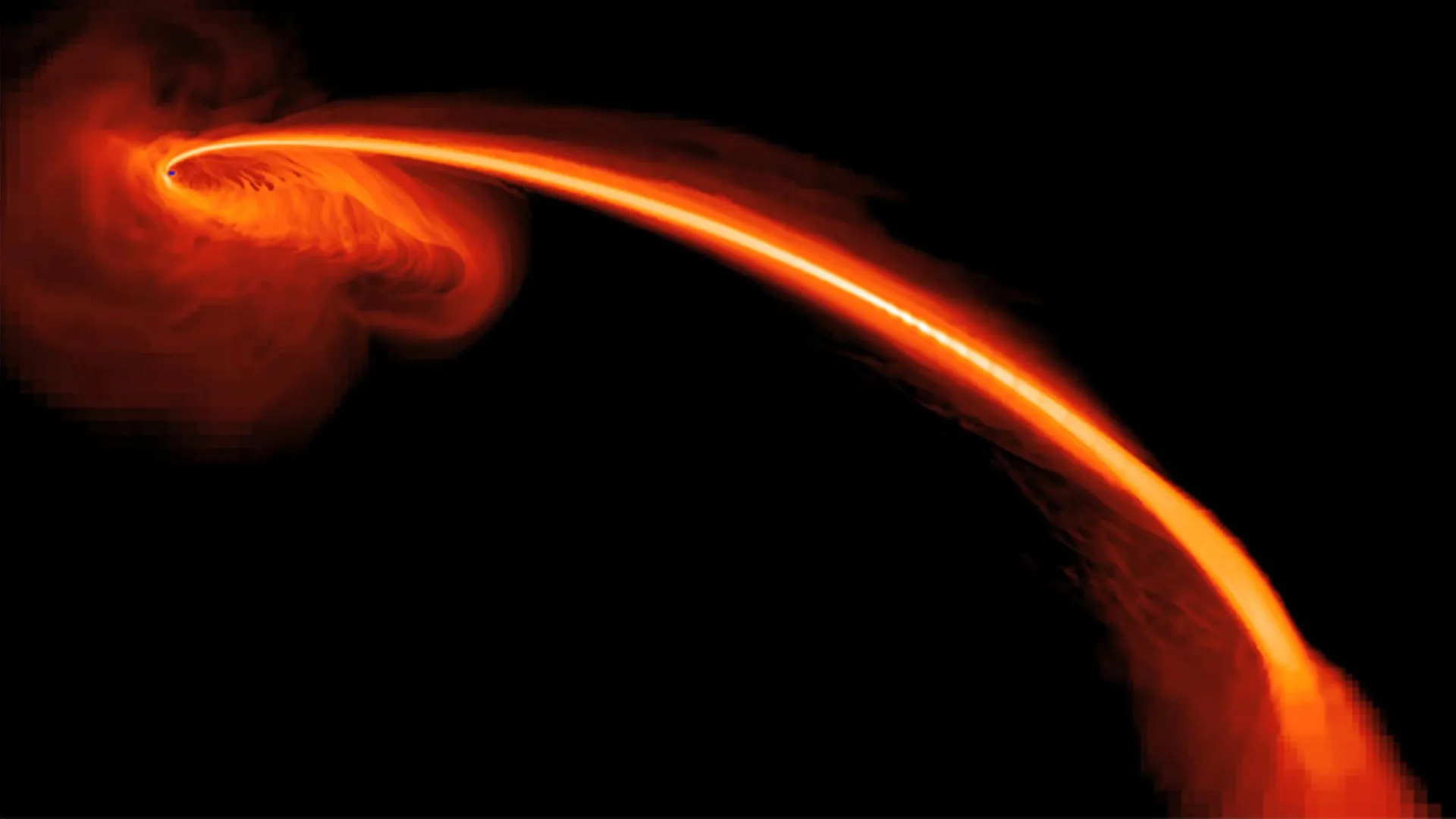
Most galaxies are thought to harbor a supermassive black hole (SMBH) at their center, colossal entities whose gravitational dominion shapes their host galaxies. These enigmatic objects, ranging from millions to billions of times the mass of our Sun, represent some of the most extreme gravitational environments known in the universe. While inherently invisible, their presence is betrayed by their profound influence on surrounding matter, particularly when they interact dramatically with stars.
When a star ventures too close to the crushing gravitational field of one of these cosmic behemoths, it faces an existential threat. The differential gravitational pull across the star – stronger on the side closer to the black hole than on the farther side – can stretch and tear it apart in a process colloquially known as "spaghettification." This phenomenon, termed a Tidal Disruption Event (TDE), provides astronomers with a fleeting, yet spectacular, glimpse into the dark heart of a galaxy. The resulting stellar debris forms an incandescent accretion disk around the black hole, emitting brilliant flares of light across the electromagnetic spectrum, from X-rays to visible light, for days to months.
However, not all such encounters result in the star’s complete demise. In a fascinating subset of these interactions, a star may pass dangerously close to a black hole without crossing the critical "tidal radius" for total disruption. Instead, it experiences a partial TDE, losing only a fraction of its mass. Crucially, the surviving stellar core remains intact, albeit battered, and continues its orbital journey around the black hole. These survivors are destined for repeated close encounters, generating a fresh burst of light each time they shed more material.
These extraordinary phenomena are known as repeating partial tidal disruption events (rpTDEs). They offer an unparalleled opportunity for astronomers: to observe the same star interacting with the same black hole multiple times, effectively creating a cosmic laboratory for studying extreme gravity. The detection of these elusive events has been made possible by the advent of wide-field time-domain surveys, such as the Zwicky Transient Facility (ZTF), the All-Sky Automated Survey for Supernovae (ASAS-SN), and the upcoming Vera C. Rubin Observatory’s Legacy Survey of Space and Time (LSST). These powerful telescopes repeatedly scan vast swathes of the night sky, meticulously tracking objects whose brightness changes over time, thus capturing the ephemeral flares of rpTDEs.
Yet, despite the wealth of data these surveys provide, some rpTDE systems have presented astronomers with a persistent enigma. Instead of producing flares of comparable brightness with each return, these systems exhibit a puzzling trend: they become steadily fainter over successive passes. For years, theoretical models and hydrodynamical simulations struggled to reproduce this observed behavior, leaving a significant gap in our understanding of these violent stellar-black hole interactions.
New groundbreaking research from astrophysicists at Syracuse University now suggests a compelling solution to this mystery. Their study posits that a previously underappreciated property of the star—specifically, how rapidly it was spinning before its initial close encounter with the black hole—could provide the answer. This crucial insight has opened a new avenue for understanding the complex dynamics at play in these extreme environments.
The study, published in The Astrophysical Journal, was spearheaded by doctoral student Ananya Bandopadhyay, working in close collaboration with postdoctoral researcher Benjamin Amend and associate professor Eric Coughlin, all members of the Department of Physics at Syracuse University. Their team also included valuable contributions from collaborators at other institutions, bringing together diverse expertise to tackle this complex astrophysical problem.
The Mechanics of Stellar Disruption and Light Emission
To fully appreciate the Syracuse team’s discovery, it’s essential to delve deeper into the mechanics of how black holes tear apart stars and how these events generate light. In a standard, full tidal disruption event, the immense gravitational gradient from a supermassive black hole creates tidal forces so powerful that they overcome the star’s own self-gravity. The star is ripped apart into a stream of gas, which then begins to fall inward, or "accrete," onto the black hole.
As this stellar debris spirals toward the black hole, it loses gravitational potential energy. This energy is converted into heat, causing the material to glow intensely across various wavelengths. The luminous emission from these accretion disks provides astronomers with an indirect but powerful means to investigate supermassive black holes, which, by definition, do not emit light themselves. The characteristics of this light – its intensity, duration, and spectral signature – offer vital clues about the black hole’s mass, spin, and the nature of the disrupted star.
In contrast, a partial TDE occurs when a star’s trajectory brings it close to the black hole, but not quite within the critical tidal radius for complete destruction. Instead, the outer layers of the star are stripped away, forming a smaller stream of debris that accretes onto the black hole, while the star’s denser core remains gravitationally bound. In the case of rpTDEs, this surviving core is not ejected but continues on an elliptical orbit, returning to the black hole’s vicinity for subsequent close passes. Each time it returns, more material is gravitationally peeled off, generating a fresh, albeit typically less luminous, flare. These recurring passages can happen anywhere from a few months to several years apart, providing a unique observational window into the long-term evolution of these interactions.
Unraveling the Mystery of Fading Flares
The amount of material stripped from a star during repeated encounters is intricately linked to the star’s internal structure. As Bandopadhyay aptly describes, a low-mass star, such as a red dwarf, might be likened to a "fluffy meringue." Its diffuse structure makes it more uniformly susceptible to the black hole’s tidal forces, meaning it could lose a significant portion of its mass in each pass, potentially becoming more susceptible over time as its outer layers are stripped.
However, a higher-mass star, like our Sun or a more massive main-sequence star, possesses a denser, more concentrated core, akin to an "onion-like internal structure." Such stars tend to lose primarily their outer, less dense layers during partial disruptions, while their robust core remains comparatively unchanged. This differential stripping could lead to a decrease in the amount of mass lost during successive encounters, intuitively suggesting that subsequent flares should become fainter.
Yet, this intuitive explanation proved insufficient to resolve the mystery of the fading flares. Of the approximately 10 repeating partial TDE systems identified so far, four have consistently shown flares that progressively diminish in brightness. While it might seem straightforward that less stripped material would simply produce weaker flares, previous sophisticated hydrodynamical simulations presented a significant complication. Even when these models accounted for the star losing less material with each pass, they paradoxically predicted flares with approximately the same peak brightness.
"We were puzzled by this for two years," Bandopadhyay revealed, underscoring the depth of the challenge. The reason for this unexpected theoretical outcome lay in another crucial consequence of the black hole’s tidal forces. Besides gravitationally pulling material away from the star, these forces also exert a powerful torque on the star itself, causing it to spin faster after each close encounter. This increased rotation, in turn, changes the dynamics of how quickly the stripped material returns toward the black hole. Even though less material was being lost in later passes, the accelerated spin meant that the rate at which this smaller amount of material fell back onto the black hole remained high. This more concentrated flow helped maintain a similar peak fallback rate, and therefore, roughly the same predicted flare brightness, in direct contradiction to observations.
The "New Ingredient": A Rapidly Spinning Star
To reconcile the theoretical models with the fading flares actually observed by astronomers, the Syracuse researchers realized they needed what Bandopadhyay termed "a new ingredient": a star that was already rotating rapidly before its very first encounter with the supermassive black hole.
The new simulations, incorporating this critical initial condition, yielded a breakthrough. They demonstrated that a star already spinning quickly could not be spun up nearly as much during subsequent close passages by the black hole’s tidal torques. Without a substantial increase in its rotation rate after each encounter, the time required for the progressively smaller amounts of stripped material to fall back toward the black hole would remain relatively steady.
This subtle but profound change in dynamics alters the outcome dramatically. As progressively less material is stripped from the star with each encounter, and without the compensatory effect of increased stellar spin to accelerate its fallback, the peak fallback rate also decreases significantly. Consequently, the predicted flare can then become fainter with each successive encounter, precisely matching the perplexing observations made by astronomers. This elegant solution not only resolves a long-standing theoretical puzzle but also highlights the complex interplay of forces governing these extreme cosmic events.
The Origin of a Rapidly Spinning Star: The Hills Mechanism
The finding that a star must be rapidly spinning prior to its first interaction with the black hole naturally raises another profound question: Why would a star approaching a supermassive black hole already be rotating so quickly? Furthermore, as Professor Coughlin points out, "It is also extremely difficult to ‘bind’ a star to a supermassive black hole so tightly that it orbits the black hole in a matter of months, and yet they seem to do so in rpTDEs." The orbits of rpTDE stars are unusually compact, making their capture by the black hole a rare and challenging event to explain through standard stellar dynamics.
A well-established astrophysical process known as the Hills mechanism may provide an elegant explanation for both the rapid rotation and the star’s unusually tight orbit. First proposed by Jack G. Hills in 1988, this mechanism describes a scenario involving a binary star system—two stars orbiting closely around each other—that ventures too close to a supermassive black hole. The black hole’s immense gravity acts as a disruptive force, tearing the binary system apart. In this violent interaction, one star is typically ejected away at an incredibly high velocity, becoming a "hypervelocity star" destined to escape the galaxy. Simultaneously, its binary companion is captured into a remarkably tight, highly eccentric orbit around the black hole.
The crucial link to the Syracuse team’s discovery lies in the properties of stars within very close binary systems. Such stars often become "tidally locked," a phenomenon familiar from the Earth-Moon system where the Moon always shows the same face to Earth. In a tidally locked binary, each star rotates on its axis at the same rate that the pair orbits one another. The tighter the binary system – meaning the shorter their orbital period – the faster each tidally locked star must rotate on its own axis.
Therefore, to leave one captured star on the short, compact orbit observed in rpTDEs, the original binary system from which it originated would have to be extremely compact. This same tight configuration would, by natural consequence, produce a rapidly spinning, tidally locked star before the black hole even captured it. This scenario provides a unified explanation for both the peculiar tight orbits of rpTDE stars and their necessary initial rapid rotation, a powerful example of how distinct astrophysical phenomena can be explained by a single underlying process.
"Ananya’s work demonstrates that each of these peculiarities can be explained by the same underlying phenomenon: the tidal destruction of a binary system and the capture of one of the stars," Coughlin states, highlighting the profound implications of their findings. "From a theoretical standpoint, this is a major step forward in our understanding of the physics at play in these systems."
A Possible Connection to Our Own Galactic Center
The implications of this research may extend far beyond distant repeating flare systems, potentially shedding light on the enigmatic stellar populations surrounding Sagittarius A (Sgr A), the supermassive black hole at the very center of our own Milky Way galaxy.
Coughlin notes that the Hills mechanism, which elegantly explains the rapidly spinning rpTDE stars and their tight orbits, may also be responsible for the origin of some of the peculiar stars now orbiting Sgr A. Among these are the "S-stars," a population of relatively young, massive stars found in surprisingly tight and eccentric orbits very close to Sgr A. The existence of these young stars in such a hostile environment has long been a puzzle for astronomers, as star formation is thought to be suppressed so close to a supermassive black hole. The Hills mechanism is a leading candidate for explaining how some of these stars could have been formed further out in the galactic disk within binary systems and then flung into their current orbits.
If this connection holds, the same mechanism that explains the perplexing fading flares of distant rpTDEs could also help astronomers understand some of the unusual stellar populations surrounding the supermassive black hole in what Coughlin aptly calls "our own cosmological backyard." This unified theoretical framework underscores the interconnectedness of astrophysical phenomena across vast cosmic scales and provides a compelling avenue for future observational and theoretical investigations.
The Syracuse University team’s research not only solves a specific astrophysical puzzle but also strengthens our understanding of the complex dynamics governing star-black hole interactions. As wide-field surveys continue to discover more rpTDEs, future observations, perhaps with advanced observatories like the James Webb Space Telescope or the forthcoming Nancy Grace Roman Space Telescope, will provide even more detailed data to test and refine these models, further illuminating the most extreme corners of our universe.
