
 By Rifan Muazin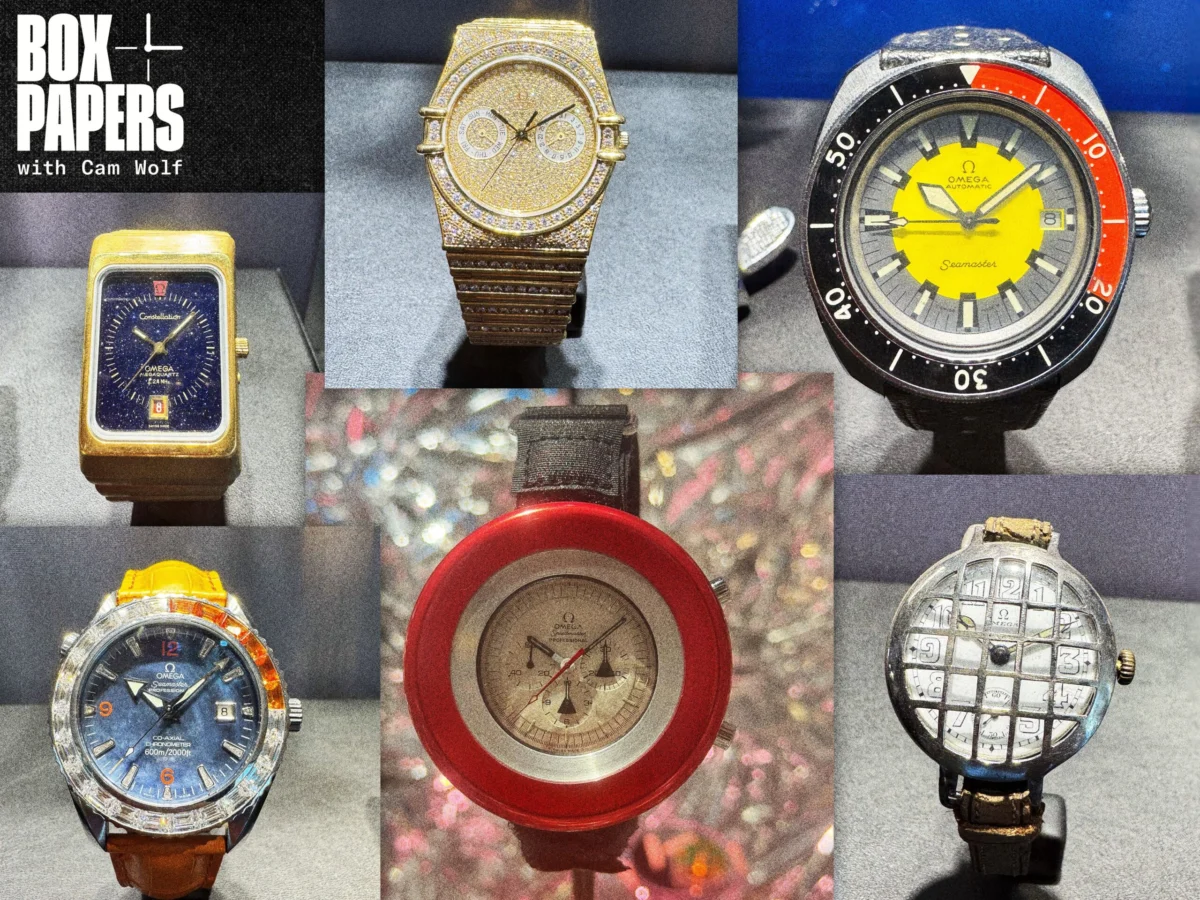
The museum itself serves as a chronological journey, but for the true enthusiast, the experience is less about checking off the "greatest hits" and more about discovering the anomalies. While the "Speedy" and the "Seamaster" are the pillars of the brand, the archive reveals a history of experimentalism that borders on the avant-garde. To walk through these halls is to realize that Omega was never just a manufacturer of tool watches; it was a laboratory for design, a participant in the highest levels of geopolitical history, and at times, a purveyor of pure, unadulterated luxury.

The journey begins in the era of the pocket watch, a time when Omega was solidifying its reputation for chronometric excellence. At the 1900 Universal Expo in Paris, the brand achieved a landmark victory, winning the Grand Prize for the accuracy of its entire collection. Among the relics of this era is a pocket watch that defies the sober aesthetics of the time, mimicking the ornate, gaudy architecture of a Greek temple. At its center sits Chronos, the god of time, depicted with a muscularity that feels more like a Renaissance sculpture than a functional dial component. This period also birthed the "roulette watch," a fascinating precursor to the digital distractions of the modern age. Long before mobile apps allowed for instant wagering, a 19th-century gentleman could use his Omega to simulate the thrill of Monte Carlo. The center hand would spin and land on a random number, proving that horology has always had a playful, occasionally devious side.

As the 20th century progressed, the focus shifted from the waistcoat to the wrist, driven largely by the brutal requirements of the First World War. The museum’s collection of "trench watches" offers a sobering look at how watchmakers adapted to the horrors of modern combat. These pieces were often jerry-rigged with protective shrapnel guards—metal lattices designed to prevent the crystal from shattering under fire. By the Second World War, this relationship with the military had matured. Omega became a primary supplier for the United Kingdom’s Royal Air Force, producing watches marked with the "Broad Arrow" or "Pheon." This symbol denoted property of the Ministry of Defence and remains one of the most coveted marks in vintage collecting. It is this military lineage that provides the narrative bridge to James Bond; although a fictional character, the literary Bond’s background as a Commander in the Royal Navy makes the choice of an Omega Seamaster a historically grounded detail rather than a mere marketing placement.

Transitioning from the utilitarian to the celestial, the Constellation line represents Omega’s mid-century pursuit of absolute precision. Launched in 1952, the Constellation was named after the emblem on its caseback: an image of an observatory under eight stars, symbolizing the eight precision records Omega set during the 20th-century observatory trials. The museum displays several "Grand Luxe" or "De Luxe" versions of these pieces, characterized by integrated gold bracelets that resemble a fine mesh of armor. These watches were the status symbols of their day, bridging the gap between a tool for telling time and a piece of high jewelry.

The historical weight of the museum is perhaps most palpable in the section dedicated to famous owners. One of the most significant pieces is the Omega "Slimline" belonging to John F. Kennedy Jr. Given to him by his friend Grant Stockdale in 1960, while JFK was still a Senator, the watch features an engraving on the back that reads: "President of the United States John F. Kennedy From His Friend Grant." It was a bold, prophetic gesture, and Kennedy famously wore the watch during his inauguration speech in January 1961. Nearby sits another icon of American culture: Elvis Presley’s Tiffany-stamped Omega. Gifted to him by RCA Victor in 1960 to commemorate the sale of 75 million records, the 33-millimeter dress watch is a masterpiece of mid-century elegance, set with diamonds. The story of this watch is as legendary as the man himself; Presley eventually swapped it with a stranger for a Hamilton. In 2018, the Omega Museum reclaimed this piece at a Phillips auction for $1.8 million, a record-breaking price that underscored the brand’s commitment to preserving its cultural footprint.

The Seamaster, arguably Omega’s most versatile line, is given extensive space to show off its various mutations. While modern enthusiasts know it as a rugged diver, the 1970s saw the line venture into strange territory. The "Soccertime" Seamasters, for instance, featured chronographs specifically designed for soccer referees to time matches. There is little logical reason for a dive watch to be a pitch-side timer, but the aesthetic results—vibrant oranges and functional scales—are undeniably cool. The museum also houses the "Ultraman" style Seamaster (ref. 145.006-66), a panda-dial beauty powered by the legendary Caliber 321 movement. This movement is the "holy grail" for many collectors, as it is the same architecture that powered the Speedmasters used by NASA astronauts.

Innovation during the "Quartz Crisis" of the 1970s and 80s is another highlight. Rather than retreating from the new technology, Omega leaned into it with pieces like the "Recife." Produced for only one year in 1984, with fewer than 1,000 units made, the Recife features a matte, titanium-like finish that prefigures the modern "stealth" aesthetic popularized by Porsche Design. For those who preferred opulence over minimalism, the museum offers the "La Magique," a gold, ultra-thin quartz watch worn by Al Pacino’s Tony Montana in Scarface. It is a watch that screams 1980s excess, much like the Megaquartz 2400, which paired an aventurine "stardust" dial with a solid gold case, proving that even in the electronic age, Omega refused to sacrifice luxury.

No visit to the museum is complete without a deep dive into the "Moonwatch" legacy. The Speedmaster’s journey from a racing chronograph to a space explorer is documented with religious fervor. The crown jewel of this collection is the Speedmaster worn by Eugene Cernan during the Apollo 17 mission in 1972—the last watch ever worn on the lunar surface. It remains in its original condition, battered and missing its bezel, a silent witness to humanity’s greatest adventure. Also on display are the prototypes from the "Alaska Project." These were experimental watches developed in the late 1960s, featuring massive red thermal shields and tubular bezels, designed to withstand the extreme temperatures of the lunar dark side. Though NASA ultimately stuck with the standard Speedmaster Professional, these prototypes represent a "what if" chapter in horological history that continues to inspire modern re-editions.

The museum also highlights the brand’s role as the Official Timekeeper of the Olympic Games, a partnership that began in 1932 in Los Angeles. This role has forced Omega to be at the absolute forefront of timing technology, from the first "touch pads" for swimmers to the high-speed cameras used to settle photo finishes. The Olympic-edition Seamasters and Speedmasters on display serve as a reminder that while these watches are beautiful, their primary purpose has always been the measurement of human achievement.

Ultimately, the Omega Museum in Biel/Bienne is more than a collection of gears and springs. it is a repository of human stories. It captures the intersection of engineering and art, of utility and vanity. Whether it is a pocket watch with a built-in roulette wheel or a Speedmaster that has felt the dust of the moon, each piece reflects a moment in time where Omega was not just recording history, but actively making it. For any visitor, the takeaway is clear: the most interesting watches aren’t always the most perfect ones; they are the ones that have lived the most interesting lives.
