
 By admin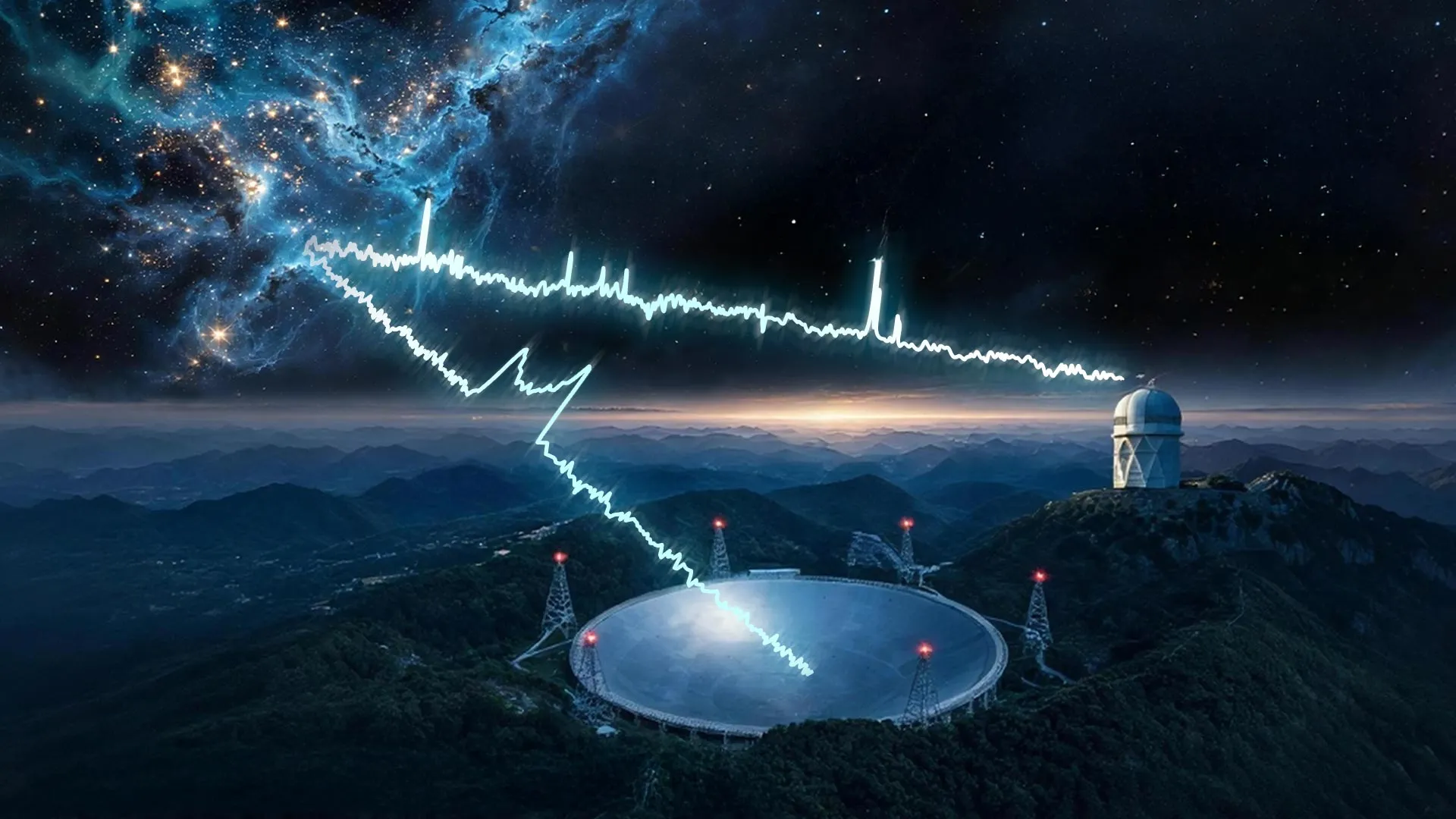
This pivotal finding emerges from the collaborative efforts of an international research team, spearheaded by scientists from the Chinese Academy of Sciences (CAS) and leveraging the immense capabilities of the Dark Energy Spectroscopic Instrument (DESI) project. Utilizing China’s Five-hundred-meter Aperture Spherical radio Telescope (FAST), the researchers meticulously measured cosmic neutral atomic hydrogen across the past 4.5 billion years, providing an unprecedented window into the universe’s gas reservoirs and their relationship to star formation.
The results, published online in the prestigious journal Nature Astronomy on September 1st, reveal a cosmic paradox: while the universe’s star-forming activity has sharply declined, the amount of neutral atomic hydrogen (HI), a crucial reservoir of gas within galaxies, has decreased only modestly. This challenges the long-held assumption that a dwindling supply of raw gas is the primary cause for the universe’s slowing stellar production line.
The Cosmic Slowdown: A Fundamental Question in Astrophysics
Understanding why star formation has become progressively less active as the universe ages stands as a major, unresolved question in the field of galaxy formation and evolution. Cosmological models suggest that the universe’s star formation rate peaked roughly 10 billion years ago, a period often referred to as "cosmic noon," and has been in a steady decline ever since. This decline is not merely an academic curiosity; it dictates the stellar content of galaxies today, the availability of elements heavier than hydrogen and helium, and ultimately, the conditions for life.
One of the most intuitive and seemingly straightforward explanations for this decline has been the gradual consumption of the cold gas needed to produce stars. Stars are born from dense clouds of gas and dust that collapse under gravity. If galaxies are simply running out of this raw material, a dramatic fall in star formation should logically be accompanied by a similarly large decline in the available gas supply. However, numerous observational campaigns over the years have struggled to definitively show such a sharp depletion in the overall gas reservoirs, leading to an ongoing debate.
This is where neutral atomic hydrogen (HI) enters the picture as a central player in this cosmic mystery. HI is not the direct fuel for star formation – that role belongs to molecular hydrogen (H2), which is much denser and colder. However, HI serves as an essential intermediary, an important cold gas reservoir inside galaxies that connects the broader cosmic supply of gas (often referred to as the circumgalactic and intergalactic medium) with the processes that eventually lead to the formation of new stars. It’s the raw material from which molecular clouds ultimately form. Astronomers primarily detect HI through its extremely faint 21-centimeter radio emission line, a signature produced by a spin-flip transition of the electron in a neutral hydrogen atom. This specific wavelength allows astronomers to trace HI across vast cosmic distances, as it is relatively immune to dust obscuration, unlike optical light.
However, detecting this faint 21-centimeter signal from distant galaxies presents immense observational challenges. The signal is inherently weak and often overwhelmed by various sources of background noise, including terrestrial interference, Galactic emission, and diffuse extragalactic radio emission. Furthermore, as galaxies recede from us due to the expansion of the universe, the 21-centimeter line is redshifted to longer wavelengths, requiring specialized radio telescopes capable of detecting these lower frequencies.
Overcoming Observational Hurdles: The Synergy of FAST and DESI
For decades, astronomers faced a significant observational dilemma when trying to map the cosmic evolution of HI. Very deep, targeted surveys could achieve the necessary sensitivity to detect individual faint HI signals, but they could only examine tiny regions of the sky, providing limited statistical power. Conversely, surveys covering much larger areas, necessary for a representative sample of the universe, generally lacked the sensitivity needed to detect such faint radio signals from individual distant galaxies. This meant that scientists have long struggled to directly and reliably determine how the universe’s total HI mass density has changed across the low- to intermediate-redshift universe (corresponding to the past few billion years, where the decline in star formation is most pronounced).
The new research ingeniously tackled this problem by combining the unparalleled radio sensitivity of FAST with the enormous optical spectroscopy data set provided by DESI. This synergy represents a paradigm shift in how such measurements can be made.
FAST: The "Eye of Heaven" for Radio Astronomy
China’s Five-hundred-meter Aperture Spherical radio Telescope (FAST), located in a natural depression in Guizhou province, is the world’s largest single-dish radio telescope. Its massive 500-meter primary mirror, composed of 4,450 triangular panels, gives it extraordinary sensitivity, making it capable of detecting extremely faint radio signals from the distant cosmos. This unparalleled sensitivity is crucial for picking up the weak 21-centimeter emission from distant HI. FAST’s unique design, which allows its feed cabin to move and illuminate different parts of the dish, enables it to observe a significant portion of the sky with its immense collecting area.
DESI: Mapping the Universe in 3D
The Dark Energy Spectroscopic Instrument (DESI) is an ambitious international collaboration designed to map the universe in 3D by measuring the redshifts of tens of millions of galaxies and quasars. Mounted on the Mayall 4-meter telescope at Kitt Peak National Observatory in Arizona, DESI uses 5,000 robotic fiber positioners to simultaneously collect light from thousands of celestial objects over a vast area of the sky. While its primary mission is to precisely measure the expansion history of the universe and constrain the nature of dark energy, the immense dataset of galaxy redshifts it produces is also invaluable for studies of galaxy evolution. These precise redshift measurements are critical because they tell astronomers the exact distance to each galaxy, and thus its look-back time in cosmic history.
The Power of Spectral Stacking
The research team studied approximately 2.5 million galaxies meticulously observed by DESI, spread across nearly one-third of the entire sky. For each of these galaxies, DESI provided a precise redshift, effectively pinpointing its location in cosmic time. Even with FAST’s incredible sensitivity, the 21-centimeter HI signal from a single distant galaxy is often too faint to be detected individually. This is where the innovative HI spectral stacking method comes into play.
The researchers used the precise redshift measurements from DESI to align the weak 21-centimeter radio signals from hundreds or even thousands of galaxies that are at similar distances. By aligning these signals (effectively shifting them back to their intrinsic 21-centimeter wavelength) and then stacking or averaging them together, the random background noise, which varies from galaxy to galaxy, tends to cancel out. The coherent HI signal, however, adds up, allowing the average HI signal to emerge clearly from the overwhelming background noise. This sophisticated statistical technique enabled the scientists to track changes in cosmic neutral hydrogen using a sample of unprecedented size and with exceptionally high statistical precision, providing a robust measurement of the average HI content of galaxies across cosmic time.
The Mismatch Unveiled: Declining Stars, Stable Hydrogen
The results of this groundbreaking study exposed a major and unexpected divergence between the evolution of the cosmic star formation rate and the supply of neutral hydrogen.
The team found that approximately 4.5 billion years ago (corresponding to a redshift of z ≈ 0.4), the cosmic star formation rate was approximately 2.5 times higher than it is today. This decline in stellar birth is well-established from other observations. However, over the same period, the cosmic neutral atomic hydrogen density was only about 1.4 times higher than its present level.
In simpler terms, the universe’s stellar production line has slowed down by 60% over the last 4.5 billion years, but its primary gaseous fuel tank, HI, has only depleted by a comparatively modest 30%. This dramatic difference highlights the core paradox: star formation dropped dramatically without a comparable disappearance of the universe’s HI reservoir. The findings therefore strongly indicate that rapidly exhausting neutral hydrogen cannot, by itself, explain why star formation has declined so strongly. This directly challenges the simplistic "fuel exhaustion" hypothesis and necessitates a more nuanced explanation.
Shifting the Cosmic Mystery: Efficiency, Not Just Supply
According to the researchers, these results fundamentally change the central question in this area of astrophysics. The focus shifts from "whether the gas is depleting" to the more complex and intriguing question: "why is it increasingly difficult to form stars despite abundant neutral hydrogen reserves?" This implies a change in the efficiency with which galaxies convert their available gas into stars.
Stars do not form directly from most neutral atomic hydrogen. As previously noted, they are mainly born inside much denser, colder clouds of molecular gas (H2). Neutral atomic hydrogen occupies an important intermediate position, acting as the raw material that must first be converted into molecular hydrogen before star formation can commence. Therefore, if the HI reservoir is relatively stable but star formation is declining, the bottleneck must lie in the processes that convert HI into H2, or subsequently, H2 into stars.
The researchers suggest that the most important changes in the more recent universe may involve how gas moves through the baryon cycle and the conditions within galaxies, rather than simply how much HI exists overall. The baryon cycle describes the continuous flow of ordinary matter (baryons) into, out of, and within galaxies, involving various phases of gas (ionized, atomic, molecular) and stars.
Several factors could contribute to a decrease in the efficiency of converting HI into star-forming molecular gas:
- Decreasing Gas Density and Pressure: As the universe expands, the average density of gas decreases. Within galaxies, the overall gas pressure might also be declining. Lower densities and pressures make it more difficult for HI to cool, condense, and self-gravitate sufficiently to form dense molecular clouds. Molecular hydrogen formation is highly sensitive to ambient pressure and density.
- Weakening Gas Inflow from the Cosmic Web: Galaxies constantly accrete fresh gas from the surrounding cosmic web. As the universe evolves, the flow of cold gas from these intergalactic filaments into galaxies may become weaker or less efficient at delivering gas that can readily cool and form stars. This could mean that even if there’s HI, it’s not being replenished or processed into the star-forming regions as effectively.
- Internal Galactic Processes and Feedback: The internal conditions within galaxies themselves might be changing. Processes like feedback from active galactic nuclei (AGN), supernovae explosions, and strong stellar winds can heat and expel gas, preventing it from settling into cold, dense star-forming molecular clouds. If such feedback mechanisms become more prevalent or efficient in disrupting gas, it could reduce the star formation efficiency even with ample HI.
- Changes in Galaxy Morphology and Structure: As galaxies evolve, their morphologies change. For instance, disk galaxies might become more stable, or the formation of bulges and bars could alter gas dynamics, potentially making it harder for gas to accumulate in dense pockets conducive to star formation.
Under this scenario, the overall HI reservoir can remain relatively stable because it’s not being consumed or converted into H2 and stars as rapidly. Meanwhile, the crucial supplies of molecular gas directly responsible for creating stars gradually decline, leading to a decrease in star formation without a corresponding dramatic drop in the total HI content.
Broader Implications and Future Directions
The implications of this research extend far beyond simply determining how much hydrogen exists in the universe. These findings offer an important new clue to why the universe’s enormous star-forming engines have been gradually slowing down. They necessitate a refinement of theoretical models and simulations of galaxy formation and evolution, compelling them to incorporate a more detailed understanding of the physical processes that govern the conversion of atomic hydrogen into molecular hydrogen and, subsequently, into stars.
The study underscores the intricate complexity of the cosmic baryon cycle and the delicate balance of physical processes that regulate star formation. It highlights that the abundance of raw material is only one piece of the puzzle; the efficiency of its processing is equally, if not more, critical in the later stages of cosmic evolution.
According to the researchers, the successful combination of observations from FAST and DESI provides a new observational benchmark for studying the cosmic gas cycle during the universe’s later evolution, the long-term decline in star formation, and the broader processes shaping galaxies. This pioneering work opens new avenues for future research, including:
- Targeted Studies of Molecular Gas: Future observations will need to focus on directly measuring molecular hydrogen (H2) in distant galaxies to confirm if its abundance is indeed declining faster than HI. This is challenging because H2 does not emit at radio wavelengths in the same way as HI, often requiring observations of tracer molecules like carbon monoxide (CO).
- Higher Redshift Measurements: Extending these HI measurements to even higher redshifts (further back in cosmic time) would provide a more complete picture of the cosmic HI density evolution, particularly during and before the peak of star formation.
- Detailed Simulations: Theoretical astrophysicists will need to develop more sophisticated galaxy formation simulations that can accurately reproduce the observed HI evolution and the declining star formation efficiency, incorporating the complex physics of gas cooling, heating, turbulence, and feedback mechanisms.
- Environmental Effects: Investigating how a galaxy’s environment (e.g., being in a dense cluster versus an isolated field) affects its HI content and star formation efficiency could provide further insights.
The research was led by scientists from the National Astronomical Observatories of China, the Shanghai Astronomical Observatory of CAS, and Shanghai Jiao Tong University, together with a broad contingent of researchers participating in DESI. Contributors hailed from numerous research institutions across Asia, North America, and Europe, demonstrating the truly international and collaborative nature of modern astronomical discovery. This successful collaboration vividly illustrates the immense scientific potential unleashed when highly sensitive radio observations are combined with enormous optical spectroscopy surveys, pushing the boundaries of what we can discern about the universe’s grand evolutionary narrative. The cosmic dance of gas and stars continues to reveal its secrets, one precise measurement at a time.
