
 By Lina Irawan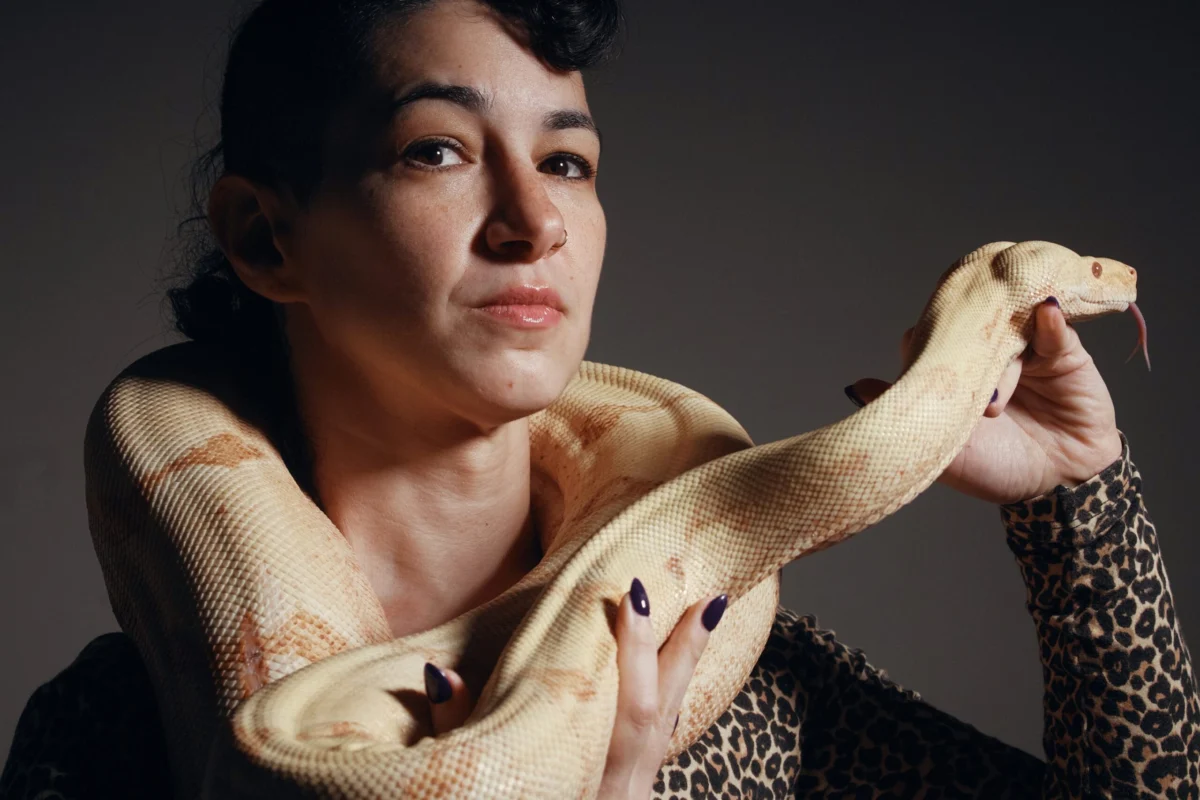
At the heart of this reptilian recruitment effort is Zoe Ziegfeld, a figure whose own journey from the vibrant, often gritty, spectacle of carnival performance to the hallowed halls of the Met is as compelling as the opera itself. Ziegfeld, cast as the snake handler in the Met’s avant-garde version of "Così fan tutte," which reimagines the classic opera against the backdrop of 1950s Coney Island, was entrusted with the critical task of selecting the perfect serpentine co-star. Her deep-seated understanding of snakes, honed over years in the carnival circuit, made her the ideal arbiter for this peculiar audition.
The audition process for these non-traditional performers was meticulous, requiring a unique blend of animal husbandry, intuition, and theatrical foresight. Ziegfeld approached each candidate with a calm professionalism that belied the unusual nature of the task. She would carefully take each snake, allowing it to slither and wrap around her, observing its temperament and responsiveness. Then, in a critical test of comfort and stage presence, she would hoist the animal over her head, rehearsing the very movements they would execute under the bright, unforgiving lights of center stage for each performance. This intimate interaction allowed Ziegfeld to look each snake directly in the eye, almost face-to-face, as she evaluated their demeanor, seeking not just a docile creature, but one that possessed a certain performative quality.
"I need to know that the animal is comfortable with people and with what we are doing," Ziegfeld articulated, emphasizing the paramount importance of animal welfare and natural inclination over mere obedience. Her criteria extended beyond physical attributes; it delved into the psychological comfort of the creature, ensuring that the demanding environment of an opera stage would not unduly stress the animal. This ethical consideration is a cornerstone of using live animals in performance, a practice that demands profound respect for the creatures involved.
Princess Slithers into Her Big Role
From a pool of hopefuls, a clear winner emerged in this cold-blooded competition: a majestic boa constrictor named Princess. Her victory was not merely a matter of chance but a testament to her inherent suitability for the spotlight. Princess, a larger snake, commanded an undeniable visual presence that would translate powerfully on stage. Her striking appearance, a "sun-glow boa constrictor who is yellow-peach," promised to be a vibrant focal point within the colorful Coney Island setting. Her size, while aesthetically pleasing, also presented a unique physical challenge for Ziegfeld, who would be responsible for her handling throughout the demanding run of performances.
Following the auditions, Ziegfeld conveyed her decision with a blend of enthusiasm and pragmatic assessment. "We will be moving forward with Princess (the big sun-glow boa constrictor who is yellow-peach) in rehearsals on a trial basis! She is a wonderful snake, and the trial is not about her, but rather about me and my strength," Ziegfeld wrote in an email. This candid admission underscores the significant physical demands of manipulating a large boa constrictor for an extended period under stage lights, requiring not just skill but considerable stamina from the handler. A full-grown boa constrictor can weigh anywhere from 30 to 60 pounds, and managing such a weight gracefully while acting and moving on stage requires exceptional strength and technique.
To ensure continuity and provide a crucial backup, a slightly smaller, brown boa constrictor named Nala, from a second round of auditions, was selected as Princess’s understudy. Nala’s presence guarantees that the show can go on, regardless of unforeseen circumstances that might affect Princess. This standard theatrical practice, common for human performers, extends logically to their animal counterparts, recognizing the inherent unpredictability of working with live creatures.
A Mozart Opera Set at a 1950s Coney Island Carnival
This upcoming production marks the third time Ziegfeld has taken on the role of the snake charmer in the Met’s distinctive adaptation of Wolfgang Amadeus Mozart’s 1790 opera, "Così fan tutte, ossia La scuola degli amanti" (Thus Do They All, or The School for Lovers). Mozart’s opera, a brilliant example of opera buffa, or comic opera, is renowned for its exquisite music, intricate ensembles, and a plot that, while lighthearted on the surface, delves into complex themes of fidelity, temptation, and the nature of love. In its original form, the narrative revolves around two young Neapolitan soldiers, Ferrando and Guglielmo, who, spurred by the cynical philosopher Don Alfonso, decide to test the unwavering loyalty of their fiancées, sisters Fiordiligi and Dorabella. They feign departure for war, only to return disguised as Albanian noblemen, each attempting to seduce the other’s beloved. The opera explores the fragility of human commitment and societal expectations, often viewed through the lens of Enlightenment-era skepticism regarding idealized love.
The Met’s current interpretation boldly transports this 18th-century tale of romantic subterfuge to the vibrant, often surreal, landscape of 1950s Coney Island. This radical reimagining, first staged in 2014, injects a new layer of visual and thematic richness into Mozart’s work. The core plot, with its intertwined deceptions and emotional turmoil, remains largely intact, but the setting transforms the opera into a vivid tableau of mid-century American popular culture. The stage comes alive with "vibrant scenery" evocative of Coney Island’s golden age – its iconic Cyclone roller coaster, the Ferris wheel, the bustling boardwalk, and the myriad sideshow attractions that once captivated millions. This transposition allows for a playful exploration of illusion and reality, artifice and authenticity, mirroring the opera’s central themes within a distinctively American context. The "sideshow performers" – fortune tellers, strongmen, and, of course, snake charmers – become integral to the visual narrative, serving as living metaphors for the theatricality and manipulation inherent in the plot. The decision to set the opera here is a stroke of directorial genius, creating a dynamic visual spectacle that resonates with the opera’s core questions about human nature.
Carnival Snake Charmer Turned Opera Performer
Zoe Ziegfeld’s casting is not merely a novelty; it is a profound testament to her authentic background and unique skill set. She came to the role not as an actress learning a trade, but as a seasoned practitioner of the very art she portrays. Before gracing the Met stage, Ziegfeld spent several transformative seasons immersed in the world of Coney Island, performing as a professional snake charmer. Her daily routine involved delivering "eight snake-charming shows a day," a grueling schedule that honed her craft, deepened her understanding of serpentine behavior, and solidified her connection with these mesmerizing creatures. This intense experience provided her with an unparalleled mastery of her craft, distinguishing her from any conventional stage performer.
When Ziegfeld first auditioned for the Met role several years ago, the logistics presented an immediate challenge: live snakes were not permitted in the audition space. Undeterred, Ziegfeld ingeniously adapted, bringing video footage of her captivating snake-charming act, allowing the casting directors a glimpse into her expertise. But she didn’t stop there. To unequivocally demonstrate her carnival sideshow bona fides and her comfort with extreme performance, Ziegfeld performed the "Human Blockhead" act – a breathtaking feat where she hammered a nail into her own nasal cavity. This shocking display of physical endurance and mental fortitude served as an irrefutable declaration of her unique suitability for a production rooted in the audacious spirit of Coney Island sideshows. It was a performance that spoke volumes about her dedication, fearlessness, and the authenticity she brought to the role.
Reflecting on her extraordinary career trajectory, Ziegfeld draws insightful parallels between the seemingly disparate worlds of Coney Island and the Metropolitan Opera. "The music’s different. The money is different," she concedes, acknowledging the obvious distinctions in scale, prestige, and financial remuneration. Yet, she quickly pivots to the fundamental similarities: "It’s a pleasure to entertain. And with snakes, it’s a delight to know that there are people watching who are in awe and people who are terrified. And those things happen at the Met and at Coney – so I would say they are more alike than different, to be honest." Her words capture the essence of performance – the primal human desire to evoke strong emotions in an audience, whether it’s awe at a soprano’s soaring aria or terror at a slithering boa. Both venues, despite their differing aesthetics, share the common goal of transporting an audience, stimulating their senses, and leaving an indelible impression.
Animals Are Important Characters at Some Met Operas
The presence of Princess and Nala at the Met auditions was facilitated by Nancy Novograd and her specialized company, All Tame Animals. Novograd’s enterprise is a vital, albeit often unseen, component of the theatrical world, providing trained animals for a wide array of productions. Her foray into this niche business began serendipitously when her own horse made an appearance onstage at the Met in a production of Bizet’s "Carmen," a grand opera often featuring equestrian elements. Since then, her company has grown to supply the opera house with an astonishing menagerie, "everything from elephants to insects," demonstrating the diverse and often ambitious demands of operatic staging.
During the snake auditions, Novograd offered additional insights into the selection process. She noted that the first two snakes to audition, while amiable, were "a bit small." One, she observed, might have even "clashed with Ziegfeld’s top," a humorous but practical consideration in costume design and visual aesthetics. Ultimately, however, Novograd reiterated that the defining factor was personality. "Animals have to perform as do human talent," she explained. "Sometimes they have a set type of behaviors that they have to demonstrate. And sometimes they just have to get along with the talent." This highlights the dual requirement for animal actors: they must be trainable for specific actions, but equally important, they must possess a temperament that allows them to interact harmoniously and safely with their human co-stars.
In the specific context of the "Così fan tutte" production, Novograd articulated the multi-faceted criteria: "So in this case, they have to be the right color, size, and Zoe has to like them." This emphasizes the collaborative nature of animal casting, where the animal’s physical characteristics, innate temperament, and compatibility with its handler are all critical. All Tame Animals employs rigorous standards for animal welfare, ensuring that all creatures are handled by experienced professionals, transported comfortably, receive regular veterinary care, and are acclimated to the stage environment gradually to minimize stress. This commitment to ethical practice is crucial for both the animals’ well-being and the success of the performance.
The use of live animals in opera, while always requiring careful consideration and expert handling, is not unprecedented at the Met or other major opera houses. Horses are frequently seen in works like "Aida" and "Carmen," adding to the spectacle and historical authenticity. Dogs have made poignant appearances in productions such as "La Bohème." These animal performers bring an unparalleled sense of immediacy, unpredictability, and raw emotion to the stage that cannot be replicated by props or projections. They remind audiences of the porous boundary between the natural world and the meticulously constructed artifice of theater, adding layers of meaning and wonder.
The Metropolitan Opera’s embrace of a boa constrictor as a featured performer in "Così fan tutte" is a testament to its commitment to innovative storytelling and the audacious spirit of its creative teams. It underscores the belief that art, in its highest forms, can transcend conventional boundaries, blending the unexpected with the sublime. Through the discerning eye of Zoe Ziegfeld and the captivating presence of Princess, the Met continues to push the boundaries of operatic performance, proving that even a slithering, cold-blooded creature can find its moment of glory under the grandest lights in New York.
