
 By admin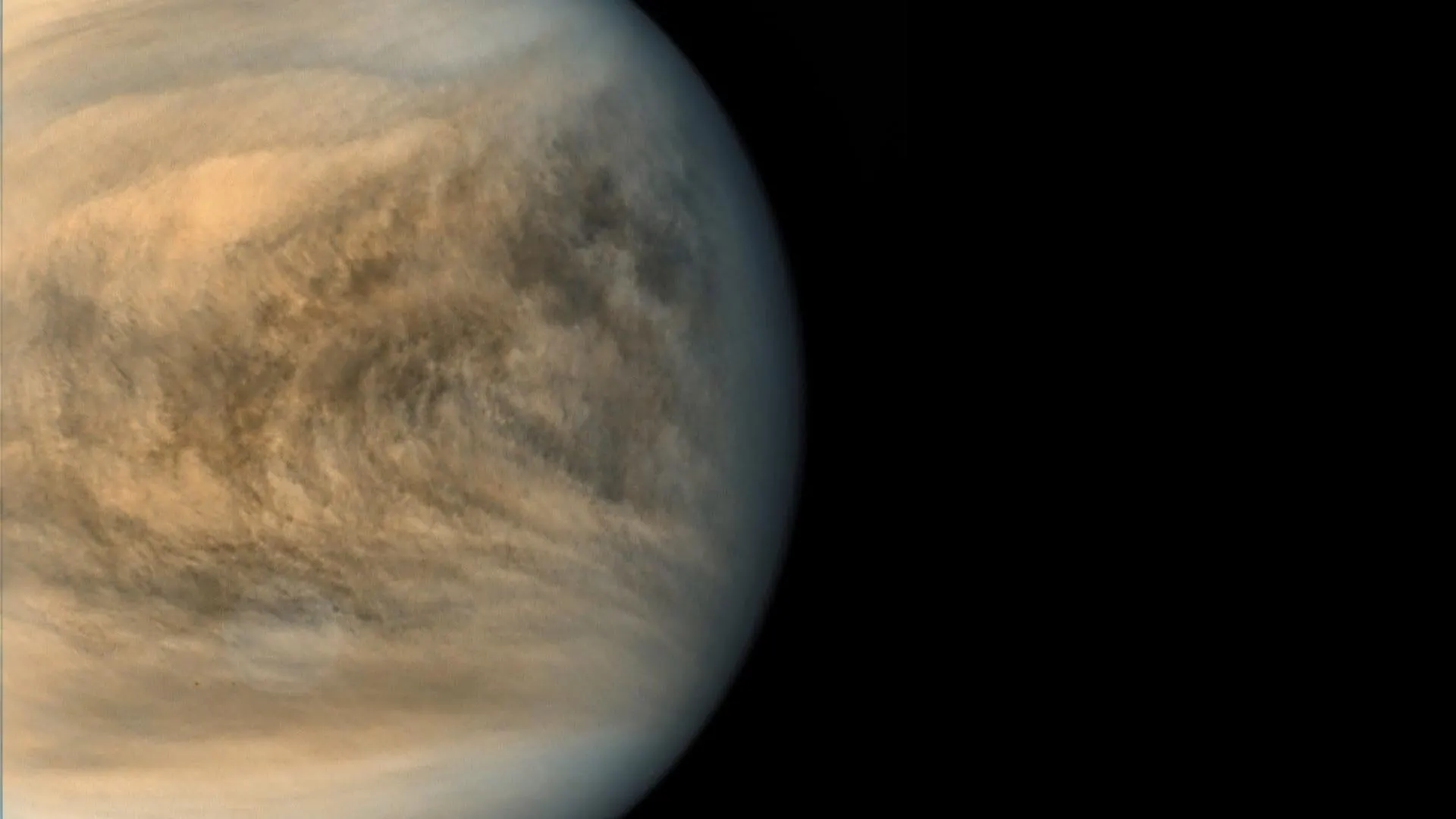
Venus, often dubbed Earth’s "sister planet," presents a dramatically different visage depending on the wavelength of light used to observe it. In ordinary visible light, its thick atmosphere renders it a pale, featureless yellow or white orb, reflecting sunlight uniformly. However, shift the observational lens to ultraviolet (UV) wavelengths, and the view transforms into a dynamic tableau of dark and bright swirling features that streak across the planet’s upper sulfuric acid clouds. These captivating patterns, first noted by astronomers nearly a century ago, are not merely aesthetic; they are indicators of an ongoing chemical process driven by an as-yet-unidentified substance within the Venusian atmosphere. This elusive material, often referred to as the "unknown absorber," has puzzled scientists for decades, remaining one of Venus’s most enduring mysteries.
For generations, researchers have grappled with the identity of this mysterious material. Early observations, beginning in the 1920s with techniques like spectrography, revealed strong absorption in the UV spectrum. Subsequent missions, including Mariner 10 in the 1970s, Pioneer Venus Orbiter, Galileo, and more recently, Japan’s Akatsuki spacecraft, have provided increasingly detailed images of these UV markings, confirming their dynamic nature and global distribution. These features are not static; they evolve over timescales of hours to days, hinting at complex atmospheric chemistry and dynamics. Understanding the unknown absorber is crucial not only for deciphering Venus’s current climate and atmospheric circulation but also for unraveling its evolutionary past and potential for habitability.
Now, an international collaboration of researchers has made a significant leap forward, not by directly identifying the substance, but by placing rigorous new numerical limits on its properties. This team, leveraging sophisticated observations of Venus combined with state-of-the-art radiative-transfer modeling, has estimated precisely how strongly the liquid components within Venus’s cloud droplets must absorb ultraviolet and blue light to account for what spacecraft and ground-based telescopes observe. This groundbreaking work fundamentally reframes the search, providing a quantitative benchmark against which any proposed candidate for the unknown absorber must be measured.
Reimagining Venus’s Clouds in the Lab: A Novel Spectroscopic Approach
The study, meticulously detailed in the journal Astrobiology, approached the problem from an unconventional yet highly insightful angle. Lead author Dr. Jan Spacek, from the Foundation for Applied Molecular Evolution in the USA, conceptualized the challenge by asking a pivotal question: what would the material comprising Venus’s clouds look like if it could be physically collected, concentrated into a spectrometric cuvette, and studied as a bulk liquid in a laboratory setting? This thought experiment, while seemingly simple, highlights a critical distinction in how we perceive celestial phenomena versus how we analyze materials in a controlled environment.
This distinction is paramount because the macroscopic appearance of a cloud can be starkly different from the intrinsic properties of the material that constitutes its individual particles. A familiar terrestrial example illustrates this principle vividly: cigarette smoke. When dispersed in the air, cigarette smoke typically appears white or grayish. This appearance is not due to the smoke particles themselves being white, but rather because their sub-micrometer size allows them to scatter light extremely efficiently across all visible wavelengths. However, if these same smoke particles are collected and concentrated within a flask, they coalesce into a dense, viscous suspension of burned tobacco – a dark, tar-like sludge that absorbs light rather than scattering it.
Venus’s dense, planet-wide cloud decks, predominantly composed of sulfuric acid droplets, are believed to behave according to a similar optical principle. The particle size distribution within Venusian clouds is comparable to that of cigarette smoke, leading to highly efficient light scattering. Consequently, while the clouds of Venus appear pale yellow and highly reflective from a distance in visible light, the liquid within those cloud droplets could, when concentrated, exhibit a surprisingly dark and light-absorbing character.
"Our model effectively asks what would happen if we could collect that cloud material into a cuvette and put it into a laboratory spectrometer," explained Dr. Spacek. "This is important, as light absorption in a bulk liquid may be correlated with the concentration of light-absorbing material in the solution." By making this conceptual leap, the researchers could bridge the gap between astronomical observations and the precise measurements typically performed in analytical chemistry, providing a more tangible target for laboratory experimentation.
Measuring How Strongly the Mystery Material Absorbs Light
To transform this conceptual framework into quantifiable data, the research team meticulously combined extensive astronomical observations of Venus with a sophisticated radiative-transfer model. This model is a computational tool that simulates how light interacts with an atmosphere, tracking its journey as it is repeatedly scattered by cloud droplets and atmospheric molecules, and absorbed by various constituents, including the unknown absorber. By iteratively refining the model’s parameters to match the observed brightness and spectral characteristics of Venus in UV and blue light, the scientists could infer the underlying absorption properties of the cloud material.
Crucially, the team then converted these astronomical measurements, which represent the overall reflectivity of the planet, into a metric commonly employed in laboratory UV-visible spectroscopy: the absorption coefficient of the liquid making up the cloud droplets. This conversion is vital because, as Dr. Yeon Joo Lee of the Planetary Atmospheres Group within the Institute for Basic Science (IBS) in S. Korea, who performed the complex radiative-transfer model calculations, elucidated: "The key is that Venus’s cloud particles scatter sunlight very efficiently, so the brightness observed from space cannot be directly compared with the absorption of a bulk liquid measured in the laboratory. By accounting for the scattering and absorption by the cloud particles and atmosphere, the model allows us to estimate how strongly the liquid of cloud droplets itself must absorb light."
The results yielded a remarkably specific and demanding requirement for the unknown absorber. Across the modeled wavelength range of 365-455 nm, which encompasses the critical ultraviolet and blue light regions where the mysterious features are most prominent, the required decadic absorption coefficient reaches an astonishing peak of approximately 1,278 cm⁻¹ at 375 nm. To put this figure into perspective, an absorption coefficient of 1,278 cm⁻¹ means that a mere 100 microns (0.01 cm) of this liquid would absorb over 99.9% of the incident light at that wavelength. This is an extraordinarily high absorption efficiency.
This stringent requirement implies that the unknown absorber must either be exceptionally effective at absorbing light at these specific wavelengths, exist at a very high concentration within the cloud droplets, or, most likely, satisfy a combination of both conditions. It sets a formidable benchmark that any proposed candidate substance must meet.
Could Carbon-Based Molecules Explain It? Exploring Organic and Inorganic Candidates
One class of substances capable of such potent light absorption is highly absorbing conjugated organic molecules. In this scientific context, "organic" simply denotes carbon-based compounds and does not inherently suggest a biological origin. Conjugated systems, characterized by alternating single and multiple bonds, possess delocalized electrons that can readily absorb photons in the UV-visible range, making them strong chromophores.
For molecules exhibiting absorption strengths comparable to highly efficient porphyrinoid pigments – a class of organic compounds that includes chlorophyll (essential for photosynthesis) and heme (in hemoglobin) – the required concentration within Venus’s cloud droplets would still be substantial, roughly 10 grams per liter. This concentration, while high, is not astronomically impossible and suggests a significant presence of the absorbing material. The researchers emphasize, however, that they are not implying chlorophyll, heme, or any specific biological pigment is responsible for Venus’s dark ultraviolet features. Instead, these compounds serve as valuable reference points precisely because they are well-understood examples of molecules that absorb light with exceptional efficiency.
The specific shape of Venus’s absorption spectrum provides another crucial clue, further constraining the possibilities for organic candidates. Simple organic compounds, when dissolved in concentrated sulfuric acid, are known to undergo complex chemical reactions, often forming dark, chemically intricate "tar-like" mixtures. These mixtures typically absorb light broadly across the entire visible spectrum, imparting a brown or black appearance. However, this behavior does not align with the pattern inferred for Venus, where the absorption profile falls sharply between 365 and 455 nm.
"If the observed light absorption is due to conjugated organic matter, the relatively sharp absorption profile is consistent with a chemically defined absorber that resists conversion into the tar-like mixture we typically observe with organics dissolved in concentrated sulfuric acid," Dr. Spacek elaborated. This suggests that if the absorber is organic, it must be a specific, resilient molecule or class of molecules rather than a generic, degraded organic sludge.
Inorganic explanations also face significant hurdles under these new constraints. Historically, various inorganic compounds have been proposed as candidates, including elemental sulfur allotropes, ferric chloride, and even various forms of iron oxides. However, as Paul B. Rimmer of the University of Cambridge, UK, noted, "The model places a demanding constraint on any proposed absorber. Many of the proposed inorganic candidates would need to be present at very high concentrations to match the required absorption." Achieving such high concentrations of specific inorganic compounds in the Venusian cloud environment, especially in the liquid phase of sulfuric acid droplets, presents considerable chemical and thermodynamic challenges. For example, while sulfur is abundant, its forms that absorb strongly in the UV are often transient or require specific conditions that may not be universally met across the cloud deck.
New Constraints Make the Venus Mystery Harder, Yet More Defined
Paradoxically, by establishing such precise quantitative constraints, the research team has not immediately identified the unknown absorber but has instead made the list of plausible candidates significantly more restrictive. "Paradoxically, by placing additional constraints on the unknown absorber, we might have made the mystery even more intriguing," remarked Janusz J. Petkowski of Wroclaw University of Science and Technology, Poland. This "intrigue" stems from the fact that the requirements are so stringent that many previously suggested candidates, both organic and inorganic, may now be effectively ruled out or require re-evaluation under more rigorous scrutiny.
It is vital to reiterate that these findings do not confirm the existence of life in Venus’s clouds, nor do they definitively establish that the mysterious absorber is organic. The study is agnostic on the origin of the material. Instead, its profound contribution lies in defining specific, quantitative requirements that any proposed material, regardless of its chemical nature or origin, must unequivocally meet. These requirements encompass not only how efficiently it absorbs light at specific wavelengths but also its necessary concentration within the cloud droplets, its spatial distribution throughout the atmosphere, and whether its presence can be realistically reconciled with the observed range of cloud-particle sizes and atmospheric chemistry.
Future Missions Could Test the Mystery Directly
This groundbreaking research provides a clear roadmap for future scientific endeavors. Scientists can now rigorously test these newly defined constraints through targeted laboratory experiments on Earth, simulating the extreme conditions of Venus’s clouds and assessing the absorption properties of various candidate substances. These laboratory efforts will be crucial for narrowing down the field of potential absorbers.
Ultimately, however, solving this long-standing mystery will require direct, in-situ measurements within Venus’s atmosphere. Fortunately, the scientific community is already responding to this call. Initiatives like the Morning Star Missions to Venus are actively developing advanced in-situ techniques specifically designed for studying the complex chemistry of Venus’s clouds. These ambitious efforts include plans for instruments capable of searching for complex organic molecules and making direct measurements that could identify the unknown absorber.
One such planned instrument, the Autofluorescence Nephelometer, is specifically engineered to examine Venus’s cloud particles for fluorescence, a phenomenon that scientists expect to be associated with certain organic molecules. This instrument is slated for deployment on a future Rocket Lab mission to Venus, signaling a new era of direct exploration.
By intricately linking remote observations from Earth and orbiting spacecraft with meticulous laboratory chemistry and the promise of future in-situ spacecraft measurements, this research offers a novel and highly promising path toward finally solving one of Venus’s most captivating and longest-standing atmospheric enigmas. The identification of the unknown absorber would not only unlock secrets about Venus’s current atmospheric processes but could also shed light on its deep past, its potential for past or present habitability, and the broader context of planetary atmospheric evolution.
