
 By Rifan Muazin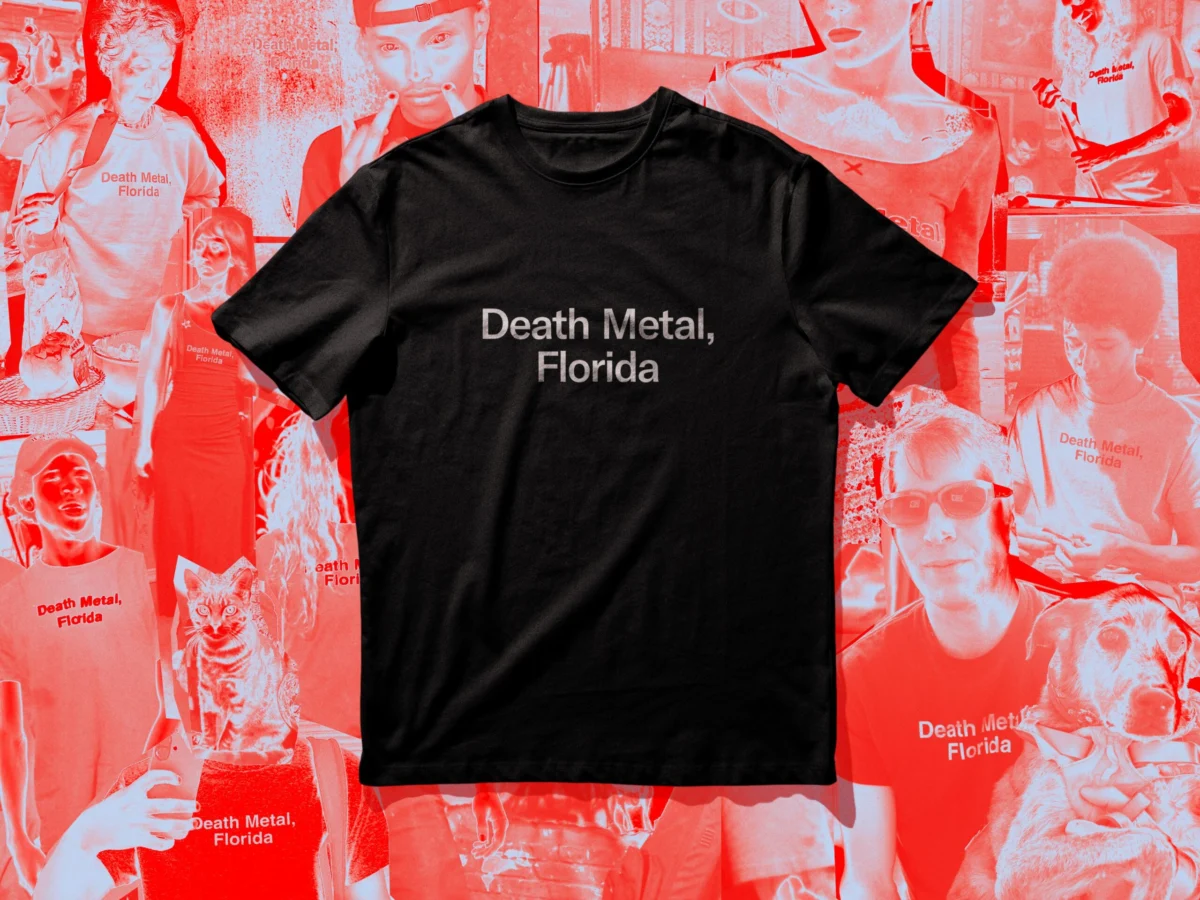
Death Metal, Florida, is not a real place, yet its name has become a ubiquitous sigil among the creative class of Lower Manhattan, appearing in stark Helvetica Bold across the chests of the city’s most discerning tastemakers. To the uninitiated, the phrase suggests a swampy, visceral wonderland tucked away in the Florida panhandle—a place where the humidity is high and the blast beats are higher. In an era defined by the "ironic graphic tee," where fashion often functions as a series of nested inside jokes, the allure of such a dirtbag utopia requires little explanation. The shirt’s resonance lies in its self-evident punkdom: it is a piece of clothing that feels like a secret handshake for a subculture that doesn’t quite exist, or perhaps, a subculture that exists only within the few square blocks of the Lower East Side known as Dimes Square.
The "Death Metal, Florida" phenomenon is as fleeting as it is influential. Most of these garments were acquired at Dimes Deli, a central hub of the micro-neighborhood that helped earn the area its nickname. The brand is the brainchild of Brandon Santana, a 29-year-old server at the deli who, despite his sudden cultural capital, claims he is "trying to get out of the shirt business." Santana’s reluctance to embrace his status as a fashion provocateur only adds to the mystique of the label. His mission, as he describes it while sitting on a mosquito-infested bench in Seward Park, is "to confuse people as much as possible."
To understand the rise of Death Metal, Florida, one must first understand the specific brand of "ultra-insider, somewhat solipsistic" humor that Santana champions. The concept took root years ago when a college friend created a T-shirt featuring a map of Mount Vernon, Washington, that bore no resemblance to the actual geography of the town. This act of intentional misinformation unlocked a dormant sensibility in Santana. It wasn’t just about the shirt; it was about the way it messed with onlookers, creating a friction between the wearer and the observer. By the time November 2022 arrived, Santana found himself immersed in the sonic landscapes of Florida’s legendary extreme metal scene.
While Florida is often associated with retirees and theme parks, it is also the undisputed birthplace of American death metal. In the late 1980s and early 1990s, the "Tampa Sound" emerged from Morrisound Recording, where producer Scott Burns helped define the genre with bands like Death, Morbid Angel, Deicide, and Obituary. These groups hailed largely from Northern and Central Florida, a fact that Santana—who was raised in the southern part of the state—found increasingly fascinating. "It just all came together one day when I was lying in bed," he recalls. "And I was like, I want to put it on a shirt."

The initial production run was as DIY as the music that inspired it. Santana began screen-printing the slogan onto used, inside-out Gildan tees in a friend’s basement studio. These shirts were initially distributed among his immediate social circle—a group of artists, writers, and "downtown scenesters" who naturally served as the brand’s first ambassadors. As these individuals wore the shirts to Chinatown gallery openings, parties, and interviews for independent magazines, the slogan began to generate a localized fever. The "Death Metal, Florida" shirt became a staple of "Indie Sleaze" 2.0, a revival of mid-aughts grit filtered through a modern lens of irony and high-low fashion mixing.
Today, the following has transcended the borders of the Lower East Side. Santana reports that inquiries for the shirts now arrive from all over the world, including high-profile requests from figures like designer Willy Chavarria and renowned photographer Ryan McGinley. Even Hollywood has taken notice; Santana mentions a message from an ex-roommate claiming that Zoë Kravitz had seen and admired the design. This trajectory—from basement-printed rags to celebrity-coveted "grails"—is a hallmark of modern street fashion, yet Santana remains tethered to his idiosyncratic roots.
Death Metal, Florida has evolved beyond mere apparel; it now functions as a multifaceted creative umbrella. It serves as a music label managing German Suplex, a band that, in keeping with Santana’s desire to confuse, plays noise rock rather than death metal. The brand also maintains a presence in the physical retail space through an exclusive collection for Retail Pharmacy, an independent fashion boutique located in NYC’s Chinatown. This expansion suggests a growing empire, yet Santana’s design practice remains deeply esoteric and personal, drawing from a "mish-mash" of niche references that defy easy categorization.
His inspirations are a catalog of the obscure: the tattoos of the unhoused, specific pages from Nan Goldin’s seminal 1986 photography book The Ballad of Sexual Dependency, and the aesthetics of Criterion Collection classics. One particular shirt features an image of a girl taking a selfie, titled "ex-girlfriend doppelgänger." The backstory of the image is as convoluted as the design itself, involving a subject Santana scouted and photographed, subsequently dated, broke up with, and eventually reconciled with. "I think we’re together," he muses, reflecting the "it’s complicated" nature that defines both his personal life and his creative output.
This commitment to the experimental is evident in Santana’s current wardrobe. During his interview, he wore a "draft" of a tee he screen-printed in his Bed-Stuy bathtub, an exercise in layering prints and colors that he describes as a "complete fuck-up." The design was inspired by Larisa, a 1980 documentary by Soviet-Russian filmmaker Elem Klimov. While writing a review of the film on the social media platform Letterboxd, Santana recalled a line from David Lynch’s character in the fourth season of Twin Peaks: "Fix their hearts or die." He paraphrased this into "Live for your wife or die" and emblazoned it on a shirt alongside a heart inscribed with "Larisa" in Ukrainian Cyrillic script.

The irony of Santana’s success is that he seems genuinely unnerved by it. He describes the experience of strangers offering to buy the clothes off his back as "a little embarrassing," largely because he considers many of his designs to be unreproducible mistakes. The fear of "blowing up" has led him to pivot toward non-apparel items, such as a screen-printed tablecloth featuring an image of his girlfriend sleeping. "The reason I chose the tablecloth is because it’s so far from clothing," he explains.
This resistance to traditional brand-building is what makes Death Metal, Florida a quintessential product of the current cultural moment. In a world of hyper-accessible, algorithm-driven fashion, there is a profound hunger for the authentic, the weird, and the gatekept. Santana’s work resonates because it feels like a genuine expression of a specific time and place—the intersection of Florida’s brutal musical history and Manhattan’s restless creative energy. Whether he likes it or not, Brandon Santana has created a symbol that captures the contradictions of modern identity: a place that doesn’t exist, a genre that isn’t played, and a brand that doesn’t want to be one.
As the mosquitoes swarm in Seward Park, Santana remains a figure of quiet contradiction—a server who has inadvertently become a fashion disruptor, a Floridian who has redefined a piece of his home state for the New York elite, and an artist who is most comfortable when he is confusing the very people who want to buy his work. Death Metal, Florida may not be on any map, but as long as Santana keeps printing, it will continue to be the most important destination in the downtown scene. The brand’s future is uncertain, perhaps by design, but its impact on the visual language of the 2020s is already indelibly etched in Helvetica Bold.
