
 By Rifan Muazin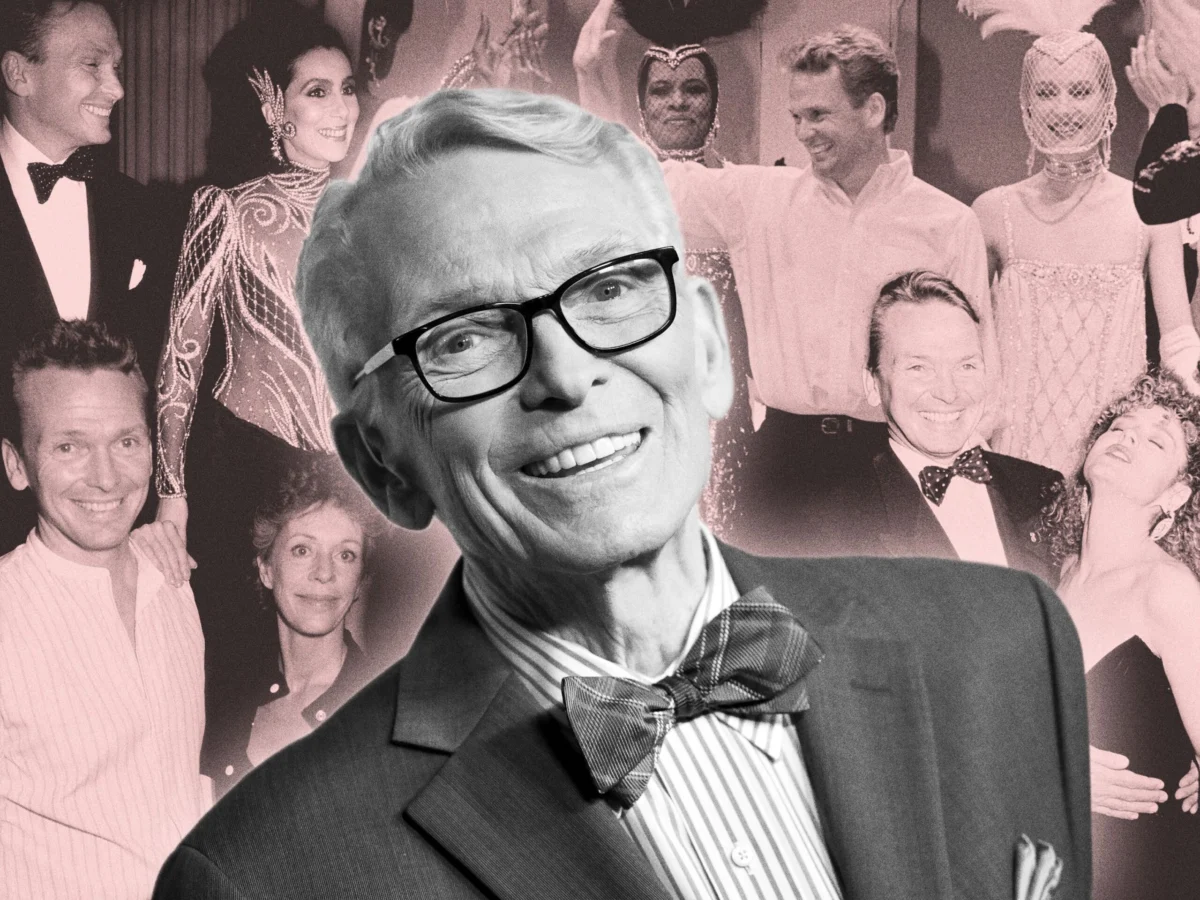
The worlds of fashion, music, entertainment, and pop culture are mourning the loss of fashion designer and Academy Award-nominated costumer Bob Mackie, who passed away Monday morning at the age of 87. Robert “Bob” Gordon Mackie was born in the spring of 1939, thrust into a world on the cusp of disaster as the shadows of World War II lengthened across the globe. It makes sense, then, that he proceeded to spend the next eight decades covering that world with crystals, glitter, and rows of meticulously hand-sewn rhinestones. He would eventually come to be known as the “Sultan of Sequins,” a maestro of camp, a high-priest of glamour, and a foundational architect of the modern celebrity image.
Chances are you’ve seen a Bob Mackie original even if you didn’t know it; his designs are so deeply embedded in the pop culture lexicon that, at a certain point, his work and the culture became indistinguishable. His influence spans the transition from the golden age of Hollywood cinema to the experimental frontiers of television and the high-octane arenas of global pop tours. There’s The Carol Burnett Show, whose campy, comedic brilliance was bolstered by Mackie’s exuberant costuming. Perhaps his most famous contribution to the show was the "curtain rod" dress—a velvet gown made from window dressings, complete with the brass rod across the shoulders—worn by Burnett in the 1976 Gone with the Wind parody, "Went with the Wind!" This single garment, now housed in the Smithsonian National Museum of American History, serves as a testament to Mackie’s ability to fuse high fashion with narrative wit.

Mackie’s reach extended far beyond the small screen. He even made a poignant appearance in the final season of the critically acclaimed series Hacks, helping Jean Smart’s character, Deborah Vance, track down an iconic jumpsuit he had originally designed for Burnett. This meta-moment underscored the reverence with which the industry held him—a living legend who bridged the gap between the mid-century studio system and the contemporary streaming era.
His impact on the music industry was equally transformative. There is Elton John’s tailored and sequined baseball ensemble, worn throughout a legendary, sold-out run of shows at Dodgers Stadium in October 1975. At a time when rock stars were beginning to embrace theatricality, Mackie provided the visual vocabulary for that evolution, turning a sports uniform into a sparkling armor of superstardom. And, of course, there is the definitive 1986 Oscars look for Cher: a towering black mohawk headdress, a jewel-encrusted bralette, and a low-rise, side-slit skirt. This outfit was more than a fashion choice; it was an act of defiance against an Academy that had snubbed her for her performance in Mask. Mackie occupied the unique space where costume and fashion met, understanding that for a certain kind of star, there was little distinction between their public persona and their private self.
They often say the mark of a true trailblazer is to be cited, referenced, sampled, and duplicated ad infinitum. That much is true of Mackie’s work, which has enjoyed a perpetual afterlife through the stars who followed in the footsteps of his original muses. Consider the way he continues to inspire generations of pop culture blondes. It was Mackie who, in 1962, sketched the initial design for Marilyn Monroe’s “Happy Birthday, Mr. President” dress while working as an assistant to Jean Louis. That sheer, figure-hugging rhinestone number, which Monroe had to be literally sewn into, created a lore and controversy that only accrues with time. More than 20 years later, Madonna called Mackie to replicate that very aesthetic for the 63rd Academy Awards, channeling Monroe in a white fur stole and glittering Mackie gown. Repeating the cycle for a new generation, pop sensation Sabrina Carpenter sourced a vintage 1991 Mackie piece for the 2024 MTV Video Music Awards, proving that Mackie’s vision of femininity remains the gold standard for "the moment."

Mackie was meant for a life in the “pictures,” as they used to say in a Transatlantic drawl. He came of age at a time when illustrators were pivotal players in the fashion ecosystem, before digital rendering replaced the fluid stroke of a pen. He got his start as a sketch artist, a role that required a deep understanding of human anatomy, movement, and the way light interacts with fabric. Working alongside costume designer Jean Louis at 20th Century-Fox, he helped sketch designs for Monroe’s final, unfinished film, Something’s Got to Give. Later, he honed his craft under the revolutionary Academy Award-winning designer Edith Head at Paramount Pictures. Under Head’s tutelage, he helped dress Natalie Wood for films like A New Kind of Love and Love with the Proper Stranger, learning the subtle art of using clothing to deepen a character’s emotional arc.
Over his 60-year career, Mackie’s trophy case became as crowded as his studio. He won nine Emmy Awards out of a staggering 31 nominations, a Tony Award for his work on The Cher Show on Broadway, and was nominated for three Best Costume Design Oscars. His Academy Award nods came for his work on Lady Sings the Blues (1972), where he helped his muse Diana Ross transform into Billie Holiday; Funny Lady (1975), starring Barbra Streisand; and 1981’s Pennies from Heaven, featuring Bernadette Peters. Each of these films required a different historical lens—the 1930s, the 1940s—but Mackie always infused them with a contemporary 1970s or 80s "zing" that made the period pieces feel vibrant and alive.
But Mackie’s work has so transcended Hollywood that every drag queen has indirectly paid homage to him. One need only watch any given episode of RuPaul’s Drag Race or head to a local gay bar on a Friday night to see the "Mackie aesthetic" in action: the sheer mesh, the strategically placed beads, the feathers, and the unapologetic celebration of the female form. He dressed the pantheon of divas: Judy Garland, Bette Midler, Liza Minnelli, Carol Channing, Whitney Houston, and the recently deceased Dolly Parton. For Parton, Mackie’s glittery, figure-hugging silhouettes became an essential part of her "backwoods Barbie" brand, a visual shorthand for a woman who was as smart as she was sparkly.

There was a profound psychological understanding between Mackie and his muses. He didn’t merely dress them in designs that shimmered; he seemed, more potently, to embellish their inner selves, highlight their features, and imbue them with a sartorial confidence that acted as a shield. The clothes could be extravagant, but the relationships between designer and muse were intimate and protective. When Tina Turner left Ike Turner in 1976 with nothing but her name and a few cents in her pocket, she turned to Mackie to craft the wardrobe for her first solo shows. This was a pivotal moment of reinvention. The "Flame Dress" Turner wore so effortlessly in the late 1970s—a tattered, fiery explosion of orange and yellow beads—didn’t create her power, but rather set it ablaze, signaling to the world that she had risen from the ashes as a rock-and-roll phoenix.
Before film studios and record executives ever fully harnessed fashion as a tool for global promotion—decades before the rise of "image architects" like Law Roach for Zendaya or Andrew Mukamal for Margot Robbie—Mackie was laying the groundwork. He was arguably the first true image architect, helping several icons craft their signature aesthetics from the ground up. Long before celebrity styling became a multi-billion-dollar industry unto itself, Mackie knew that clothing could do more than simply dress a star. It could establish the terms by which they would be seen, respected, and mythologized.
His decades-long creative partnership with Cher is particularly the stuff of legend. It began when she was a guest on The Carol Burnett Show and blossomed into a collaboration that redefined television. Her variety show, The Sonny & Cher Comedy Hour, premiered on August 1st, 1971, with Mackie as its primary costume designer. In it, Cher cycled through dozens of different outfits in a single hour, coordinating elaborate frocks with guests and suggestively revealing her now-definitive “naked” dresses. Mackie pioneered the use of illusion netting and flesh-toned mesh to create garments that appeared to be held together by nothing but prayer and crystals. These looks were revolutionary, challenging the broadcast standards of the time and cementing Cher as a fashion icon for the ages.

In all of this, Mackie’s genuine love for the women he dressed shone through every stitch. He understood that the most memorable fashions don’t impose an identity from the outside so much as reveal a hidden truth from within. He was a designer who celebrated the "diva" not as a pejorative, but as a title of hard-won excellence and theatrical bravery. His passing marks the end of an era—a time when the "Sultan of Sequins" could turn a simple sketch into a cultural phenomenon. Yet, his work will live forever: on the screen and stage, on carpets magic and red, and in the hearts of anyone who has ever found strength in a bit of glitter and the courage to stand in the spotlight. Bob Mackie didn’t just design clothes; he designed the way we dream of stardom.
