
 By admin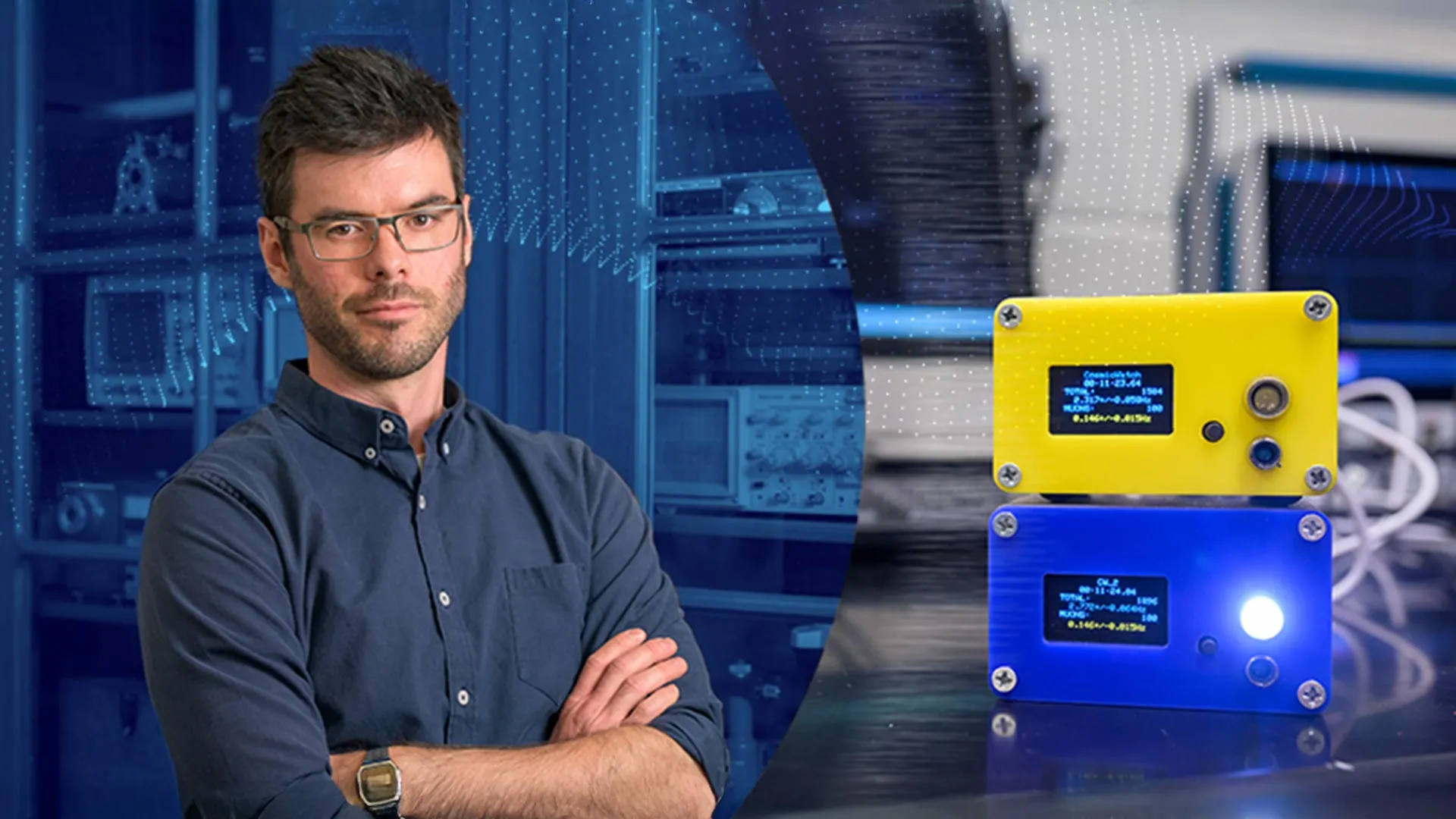
When these incredibly energetic primary cosmic rays collide with atoms in Earth’s upper atmosphere, they initiate a spectacular cascade of interactions, producing what physicists call "extensive air showers." These showers involve a rapid succession of collisions and decays, creating a multitude of secondary particles. Among these secondary particles are muons, which are often described as "heavy electrons." Muons possess a remarkable ability to penetrate deep into the atmosphere, through solid ground, and even into rock and water, making them a unique probe of both astrophysical phenomena and terrestrial structures. Unlike most of the other secondary particles, muons have a relatively long lifetime (about 2.2 microseconds in their rest frame), which, when combined with relativistic time dilation, allows a significant fraction of them to reach Earth’s surface and even travel kilometers underground.
Despite their constant presence, detecting these subatomic travelers has historically been a complex and expensive endeavor, often relegated to specialized laboratories and large research facilities. However, University of Delaware physics professor Spencer Axani has revolutionized this field with the development of a groundbreaking device called CosmicWatch. This innovative detector significantly simplifies the process of identifying these otherwise invisible particles, making sophisticated particle physics accessible to a much broader audience, from high school students to seasoned professional researchers.
CosmicWatch: A Gateway to Invisible Cosmic Particles
CosmicWatch is a testament to the power of accessible technology. Roughly the size of a small box of animal crackers, this compact detector is constructed from readily available electronic components, with a total material cost hovering around an astonishingly low $100. When a muon passes through the device, it triggers a tiny flash of light, which is then recorded, providing a precise count of detected particles. The collected information is stored internally, allowing users to download and analyze the data at their convenience. This design ethos dramatically lowers the barrier to entry for particle physics experiments.
Axani’s initial vision for CosmicWatch was to create an inexpensive and user-friendly tool to introduce students to the fundamental principles of particle physics. However, its utility quickly expanded beyond educational outreach, finding a significant role in international astrophysics research. As Axani aptly states, "CosmicWatch detectors allow us to do far more physics at a dramatically lower cost, in a compact and portable form, opening the door to many new kinds of experiments and outreach opportunities." This portability and affordability have unlocked unprecedented opportunities for distributed experiments and real-world data collection in diverse environments.
Unveiling the Universe: What Muons Reveal
Scientists meticulously study muons because they serve as invaluable clues about some of the most powerful and enigmatic events in the cosmos. By analyzing the properties of muons detected on Earth, researchers can infer critical characteristics of the original primary cosmic rays that initiated their cascade. These properties include the cosmic ray’s energy, mass, and the direction from which it originated. Such data is crucial for understanding the sources of these high-energy particles, which include supernovae, gamma-ray bursts, and blazars – active galactic nuclei with relativistic jets pointed towards Earth. Understanding the cosmic ray energy spectrum and composition is vital for addressing long-standing mysteries in astrophysics, such as the GZK paradox (the theoretical cutoff in the energy of cosmic rays due to interactions with the cosmic microwave background) and the search for dark matter. Muons also play an indirect role in neutrino astronomy, as their interactions can mimic neutrino signals, requiring careful discrimination.
Beyond their direct relevance to cosmic ray research, muon flux played a pivotal role in the history of physics, providing one of the earliest and most compelling experimental confirmations of Albert Einstein’s theory of special relativity in the early 1940s. Muons are unstable particles, decaying into electrons and neutrinos with a characteristic half-life of about 2.2 microseconds when at rest. However, when muons are produced high in the atmosphere by cosmic ray interactions, they travel at relativistic speeds (a significant fraction of the speed of light). Due to time dilation, a key prediction of special relativity, their perceived lifetime from an Earth-bound observer’s perspective is significantly extended. Without this relativistic effect, very few muons would survive long enough to reach the ground. Early experiments measuring muon flux at different altitudes clearly demonstrated that far more muons reached the Earth’s surface than predicted by classical physics, perfectly aligning with Einstein’s relativistic predictions. This experiment provided profound evidence for the fundamental warping of space and time at high velocities.
The utility of muons extends beyond astrophysics, proving invaluable for studying objects here on Earth. Because muons are weakly interacting particles, they can effortlessly traverse solid materials such as walls, rock, and even human tissue without causing any damage. As they pass through matter, they leave behind a detectable energy trail, which scientists can exploit to create images of structures hidden behind vast amounts of material. This technique, known as muography or muon tomography, works by measuring the attenuation of muon flux as it passes through different densities of material. Denser materials absorb or scatter more muons, creating "shadows" that can be mapped. A striking example of this application occurred in 2016, when muon technology famously uncovered an unknown, 30-meter-long void or corridor within the Great Pyramid of Giza, a discovery that captivated archaeologists and the public alike. Muography has also been used to image active volcanoes, helping scientists monitor magma chambers and predict eruptions, and to inspect nuclear waste containers and even cargo for illicit materials.
The significant challenge, prior to CosmicWatch, was that conventional muon detectors were typically bulky, requiring specialized infrastructure, and prohibitively expensive. This limited both the scope and scale of experiments researchers could conduct and severely restricted the number of educational institutions that could provide students with invaluable hands-on access to this cutting-edge technology. As Axani points out, "A typical undergraduate physics lab course uses a rack of electronics about the size of a small bookshelf to measure muons," highlighting the dramatic reduction in size and complexity achieved by CosmicWatch.
The Genesis and Evolution of CosmicWatch
Spencer Axani first conceived and developed CosmicWatch in 2017 while he was a graduate student at MIT. His initial objective was highly specific: to design a compact, energy-efficient muon detector for deployment at the IceCube Neutrino Observatory in Antarctica. IceCube is a colossal scientific instrument, buried deep within the pristine ice of the South Pole, designed to detect high-energy neutrinos – another type of elusive subatomic particle that carries information from the most extreme environments in the universe. In neutrino observatories like IceCube, muons are a significant background signal; they are far more numerous than neutrinos and can mimic neutrino interactions. Therefore, a reliable muon detector is crucial for helping researchers distinguish the desired neutrino signals from the pervasive muon background, effectively acting as a "muon veto" and aiding in detector calibration.
As the CosmicWatch project progressed, Axani recognized that the same underlying technology, with careful refinement, could be made portable and inexpensive enough for widespread educational use. This realization marked a pivotal moment, transforming CosmicWatch from a specialized research tool into a powerful outreach instrument for teaching fundamental particle physics concepts to a global audience.
After joining the faculty at the University of Delaware in 2022, Axani continued to meticulously refine the design of CosmicWatch. He recently unveiled the third version of the detector, which incorporates significant improvements detailed in an October article published in the prestigious Journal of Instrumentation. These enhancements allow the new detector to monitor its ambient surroundings (e.g., temperature, pressure), tolerate high radiation levels, and gather data at an accelerated rate, making it even more versatile for demanding research environments. Masooma Sarfraz, a doctoral student in Axani’s lab and the primary author of the journal article, reflected on her experience: "Even though I had studied cosmic rays, I didn’t fully appreciate the rich physics behind the working of these detectors to actually ‘see’ the world and atmospheric particle production. For a student like me who has been working on theoretical ideas, this was a perfect opportunity to dive into the experimental side. It also connects beautifully to my current broader research work with particle physics." This sentiment underscores the transformative potential of CosmicWatch in bridging theoretical understanding with practical experimental experience.
From Dark Matter Research to Spaceflight and Beyond
The latest iteration of the CosmicWatch design is particularly well-suited for calibrating large-scale particle detectors. It is currently being deployed in the NuDot experiment at the University of Delaware and at the Coherent CAPTAIN-Mills (CCM) dark matter detector located in Los Alamos, New Mexico. In these sophisticated research facilities, precise calibration of detector response is paramount, and CosmicWatch provides an agile and cost-effective solution for monitoring background muon flux and ensuring accurate data collection.
Researchers are also actively developing another specialized version of CosmicWatch engineered to measure primary cosmic rays aboard rockets and spacecraft. Such a device would provide invaluable data on the space radiation environment, which is critical for designing radiation-hardened electronics for satellites and for ensuring the safety of astronauts on long-duration space missions. Understanding the flux and composition of primary cosmic rays in situ is vital for characterizing the hazardous radiation belts and solar particle events that can impact space infrastructure and human exploration.
Despite its expanding role in cutting-edge research, education remains a core tenet of the CosmicWatch philosophy. At the University of Delaware, Axani integrates the detectors into his particle, nuclear, and astrophysics courses. Students gain invaluable hands-on experience by assembling the devices themselves, learning about high-speed electronics, data acquisition, and circuit design. They then proceed to use their self-built detectors to design and execute their own experiments, fostering a deep understanding of the scientific process.
Musarate Shams, a doctoral student in the quantum science and engineering program, exemplifies this educational impact. He ingeniously modified his CosmicWatch by integrating temperature and pressure sensors, driven by a desire to study cosmic rays in Earth’s upper atmosphere. In a remarkable achievement, his modified detector embarked on a high-altitude balloon flight in May, ascending to an astonishing 100,000 feet – near the very edge of space. By meticulously analyzing the collected measurements, Shams was able to quantitatively demonstrate how the flux of cosmic rays from space changes significantly with increasing altitude, providing tangible data on atmospheric shielding and particle production. "It’s a very cool thing to build something in the lab in a couple of days that’s able to detect these cool particles from hundreds of light-years away," Shams remarked, encapsulating the profound wonder and accessibility of the project.
Giving Students a Taste of Real Particle Physics
The influence of CosmicWatch extends far beyond the University of Delaware. Natasha Holmes, the Ann S. Bowers Associate Professor of Physics at Cornell University, has embraced the technology in her introductory physics courses. Her students actively build these detectors and then design and conduct experiments with them, providing an unparalleled experiential learning opportunity.
Holmes emphasizes that this direct engagement with the technology offers students an experience that closely mirrors the work of professional experimental physicists. "The students seem really excited about doing this thing that is more like what particle physicists and experimental physicists actually do," she explains. "They get to learn some coding with it, and sometimes they break the devices, and then we have to talk to them about being careful with your equipment. It’s very different from a typical physics lab. We’ve had students say they’re doing ‘real science’ after using it." This hands-on, problem-solving approach instills critical thinking, technical skills, and a genuine appreciation for the challenges and rewards of scientific discovery, moving beyond rote exercises to foster authentic scientific inquiry.
A Possible Global Network of Cosmic Ray Detectors
Axani estimates that thousands of CosmicWatch detectors have been constructed and deployed worldwide since the first version emerged eight years ago. He harbors an ambitious vision for the future: that this number could expand exponentially through a global "citizen science" initiative. Under this captivating concept, individuals and groups in diverse geographical locations could measure local muon rates using their CosmicWatch detectors and contribute their observations to a centralized online database. Collectively, these distributed measurements would form an unprecedented, dynamic, and much broader picture of particle activity across the entire planet. Such a network could offer invaluable insights into atmospheric physics, space weather phenomena, and even seismic activity, as muon flux can be influenced by changes in atmospheric density and composition.
Axani is also developing a related, sophisticated detector system designed to enhance the intelligence and responsiveness of satellite constellations. This advanced technology could enable groups of satellites to communicate autonomously about real-time conditions in space. For instance, if a solar flare—a powerful burst of radiation from the Sun—were detected by one satellite, the system could immediately alert nearby satellites, allowing them to power down or reconfigure their systems to mitigate potential damage from the surge of radiation. Such a system would be crucial for protecting vital space infrastructure, from communication satellites to GPS networks, which are increasingly vulnerable to the unpredictable nature of space weather.
What began as an innovative, inexpensive educational project has remarkably blossomed and proliferated into several diverse and advanced areas of physics research and technological development, a trajectory Axani admits he did not originally anticipate. "Although it started as an educational program, it’s found a use in a lot of different areas of physics," Axani reflects with a sense of wonder. "It’s pretty cool." This journey of CosmicWatch exemplifies how accessible technology can democratize scientific exploration, inspire new generations of researchers, and lead to unforeseen breakthroughs, bridging the gap between fundamental cosmic phenomena and tangible applications that benefit humanity.
