
 By admin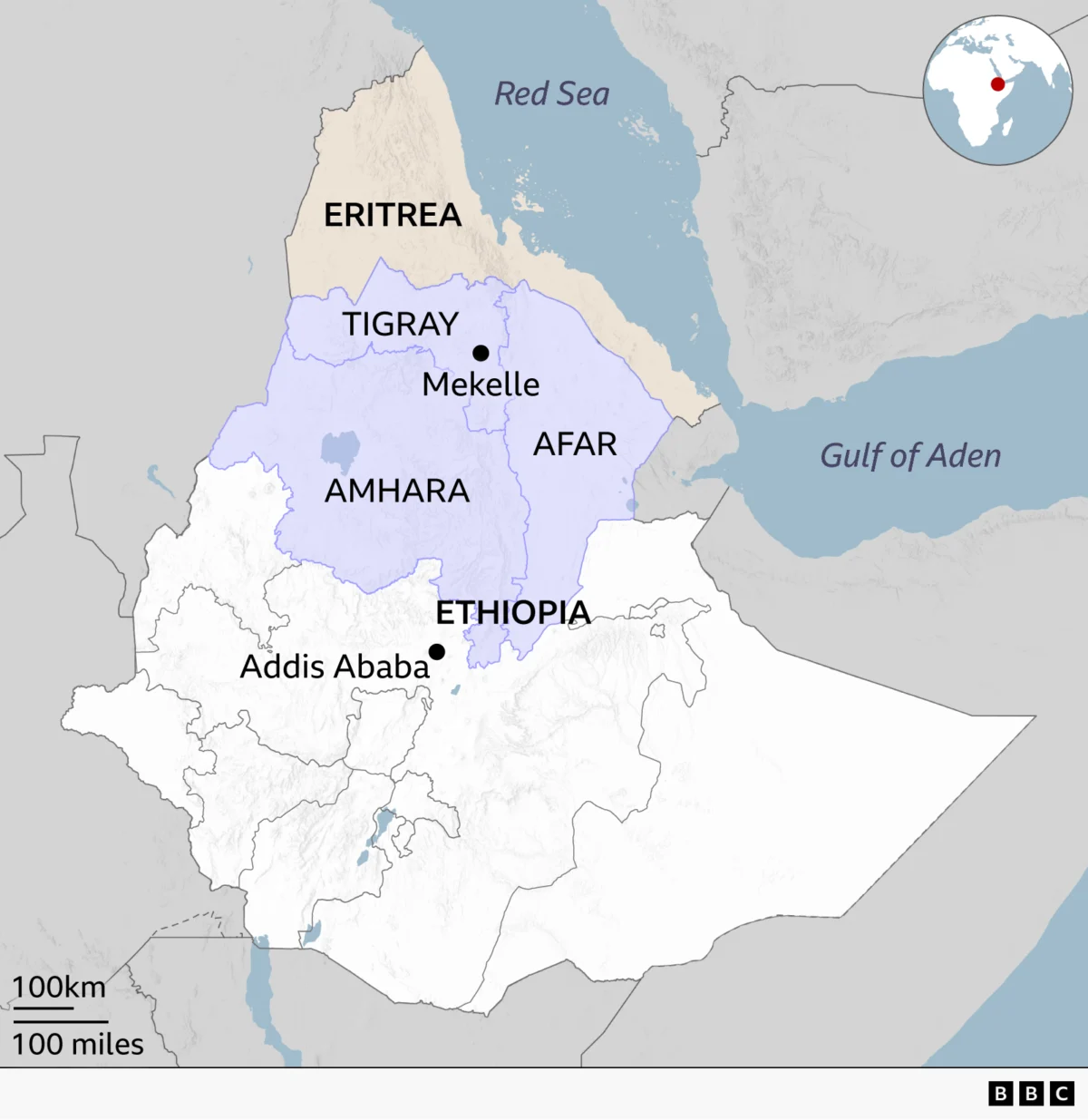
Fighting has reignited in Ethiopia’s northern Tigray region, igniting fears among its residents of a return to the devastating two-year conflict that officially concluded in 2022. The resurgence of hostilities between regional forces and the national army has plunged the already fragile province back into a state of panic, with reports of widespread panic buying and a critical disruption of internet and telephone services. This communication blackout is particularly severe in a society that has largely transitioned to a cashless economy, with ATMs having ceased functioning months prior, leaving many unable to access their funds via digital applications.
The current outbreak of violence follows a protracted period of escalating tensions, spanning over six months, between the federal government and the Tigray People’s Liberation Front (TPLF), the dominant political entity in Tigray. While the African Union (AU) successfully brokered a peace accord, known as the Pretoria Agreement, which brought an end to the war nearly four years ago, a number of critical issues have remained unresolved, fueling the current animosity. Both sides have been engaged in a war of accusations, punctuated by troop mobilizations and sporadic clashes. This past week, significant fighting erupted in Tigray and rapidly spilled over into the adjacent Afar and Amhara regions. The precise trigger for this latest escalation is a point of contention, with the TPLF asserting that they were reacting to a federal offensive, including drone strikes. Conversely, the Ethiopian government contends that Tigrayan forces initiated the hostilities by seizing control of airports within Tigray.

For a substantial portion of Ethiopia’s modern political history, Tigray has been under the governance of the TPLF. This movement first emerged in the 1970s as an armed force challenging the military junta that then ruled the country. The TPLF played a pivotal role in the overthrow of the Marxist regime in 1991 and subsequently became the most influential component of the Ethiopian People’s Revolutionary Democratic Front (EPRDF), the ruling coalition that presided over the ethnically diverse nation for nearly three decades. This period of TPLF dominance was not without its controversies, as some segments of the population felt that the TPLF wielded disproportionate influence, despite Tigrayans constituting only about 6% of Ethiopia’s total population.
The political landscape shifted dramatically in 2018 when Abiy Ahmed assumed the position of Prime Minister. He initiated a significant restructuring of the political system, replacing the EPRDF with the Prosperity Party, which effectively diminished the TPLF’s political power. This move precipitated a rapid deterioration in relations between Addis Ababa and the TPLF, culminating in the outbreak of war in November 2020, a conflict that has been described as one of the deadliest of the 21st century. Estimates from AU mediators suggest that approximately 600,000 lives were lost during the war, which also led to Tigray’s complete isolation from the outside world and pushed the region to the brink of widespread famine. An uneasy ceasefire was eventually agreed upon in November 2022.
The fragility of the current peace is largely attributed to the failure to resolve several key issues embedded within the Pretoria Agreement. Foremost among these are disputes concerning the fertile western Tigray region. This territory fell under the control of the Amhara region during the initial phase of the civil war, with Amhara fighters aligning themselves with the Ethiopian national army. Many within the Amhara region hold the conviction that western Tigray should not have been incorporated into Tigray when administrative boundaries were redrawn following the ousting of the military regime in 1991. The seizure of this territory by Amhara forces during the recent conflict resulted in the displacement of hundreds of thousands of ethnic Tigrayans, who are now residing in displacement camps within Tigray and the capital, Addis Ababa. The TPLF is demanding the return of western Tigray and the repatriation of its displaced inhabitants, while the federal government proposes that the future of the territory be determined by a referendum.

Beyond territorial disputes, the disarmament process has been a significant point of contention. The federal government alleges that the TPLF has only surrendered outdated weaponry to the AU, while retaining its more modern arms. Furthermore, disagreements persist regarding the governance of Tigray. Under the terms of the peace deal, an interim administration was appointed by Prime Minister Abiy Ahmed. However, attempts by the federal government to exert influence over Tigrayan affairs led to internal divisions within the TPLF. In a move that underscored the lingering tensions, just prior to the general election in May – an election that did not take place in Tigray due to the prevailing security situation – the TPLF reinstated its pre-war administration, effectively disbanding the interim government established by Abiy. This action has had tangible consequences, including the cessation of salary payments to civil servants and the disruption of other essential services, exacerbating the region’s already dire economic conditions.
A significant development in the evolving conflict dynamic has been the TPLF’s strategic outreach and the formation of new alliances. Once politically isolated within Ethiopia, the TPLF has managed to forge connections with several key opposition groups. In early September, the TPLF joined forces with six other armed movements to establish what is known as the Alliance for Survival. This coalition includes groups actively engaged in armed struggle against the federal government, such as the Amhara’s Fano militia and the Oromo Liberation Army. While the constituent members of this new alliance harbor diverse grievances, they share a common overarching objective: the removal of Abiy Ahmed’s government from power. This strategic alignment represents a notable shift in the TPLF’s geopolitical positioning, moving from isolation to a potentially formidable coalition.
The formation of this alliance, however, is not without its complexities. Notably, the TPLF and the Fano militia were on opposing sides during the civil war, and their differing perspectives on the future of western Tigray remain a point of contention. Despite these underlying disagreements, they have temporarily set aside their differences in pursuit of a shared goal. TPLF officials have publicly stated their desire to avoid a repeat of the 2020 scenario, where they felt strategically outmaneuvered and isolated. Analysts, however, caution that the sustainability of this alliance may be challenged by the divergent interests of its members, potentially creating fissures in their united front.

The federal government, in response to the escalating situation, has not only accused the TPLF of initiating the recent hostilities but has also strongly criticized the newly formed alliance, characterizing it as an effort to destabilize the nation. Furthermore, Addis Ababa has leveled accusations against Eritrea, alleging its support for armed groups operating within Ethiopia – allegations that Asmara has consistently denied. During the recent civil war, Eritrean forces fought alongside Ethiopian troops. However, the relationship between these two neighbors, historically marked by volatility, has once again soured. Their recent disagreements appear to be rooted in competing interests concerning the Red Sea and its ports. Ethiopia, the most populous landlocked nation globally, lost direct access to maritime trade routes when Eritrea gained independence in 1993. Prime Minister Abiy has recently intensified his pursuit of access to Eritrea’s southern port of Assab, located approximately 60 kilometers from the border, and has alluded to the possibility of acquiring it through force.
Regarding the recent bombing incidents in Tigray, reports indicate that federal forces have been employing drones and conducting other military operations against Tigrayan forces. The government’s official justification for these actions is that they are in direct response to attacks and are aimed at defending federal positions and territories. However, the precise circumstances surrounding individual strikes are difficult to independently verify, given the ongoing conflict and restricted access to the region. Residents of a town recently targeted by drone strikes have reported to the BBC that two schools were hit. Local officials claim these educational institutions had been repurposed by Ethiopian troops as military bases during the civil war. This suggests that Addis Ababa may believe these locations are again being utilized for military purposes, this time by Tigrayan forces. These attacks have occurred amidst reports that the TPLF has been engaged in the forced recruitment of young men to bolster its ranks.
The international community is actively engaged in efforts to de-escalate the conflict and prevent a further descent into widespread violence. The primary diplomatic initiative is being spearheaded by the African Union, which has issued an urgent call for an immediate cessation of hostilities and a return to direct negotiations. The AU has tasked its special envoy for the Horn of Africa, former Nigerian President Olusegun Obasanjo, with engaging the parties involved in urgent dialogue. The United Nations has echoed these sentiments, issuing a stark warning against the potential for a wider and more devastating conflict. The Intergovernmental Authority on Development (IGAD), a regional bloc, has also appealed for a halt to the fighting and the resumption of dialogue. However, the effectiveness of these diplomatic efforts is significantly hampered by the profound lack of trust between Addis Ababa and Tigray, compounded by the recent formation of the new armed alliance, which has introduced further complexity to an already precarious situation.

The risk of the fighting spreading beyond Tigray is substantial. Hostilities have already extended into areas bordering Tigray, and the federal government is simultaneously contending with armed conflicts in other regions, most notably in Amhara and Oromia. The newly formed alliance has the potential to politically and militarily connect several of these disparate conflicts, creating a more unified front against the central government. There is also a palpable concern that Eritrea could be drawn back into the conflict, this time potentially against the Ethiopian federal forces. The primary belligerents in Sudan’s ongoing civil war also appear to have aligned themselves with opposing factions in the Tigray conflict, adding another layer of geopolitical complexity to the region. The AU has issued a pointed appeal to all neighboring countries, urging them to refrain from any actions that could further exacerbate the crisis. The current situation underscores the deep-seated political and ethnic tensions that continue to plague Ethiopia, with the prospect of renewed large-scale violence casting a dark shadow over the nation’s future.
