
 By admin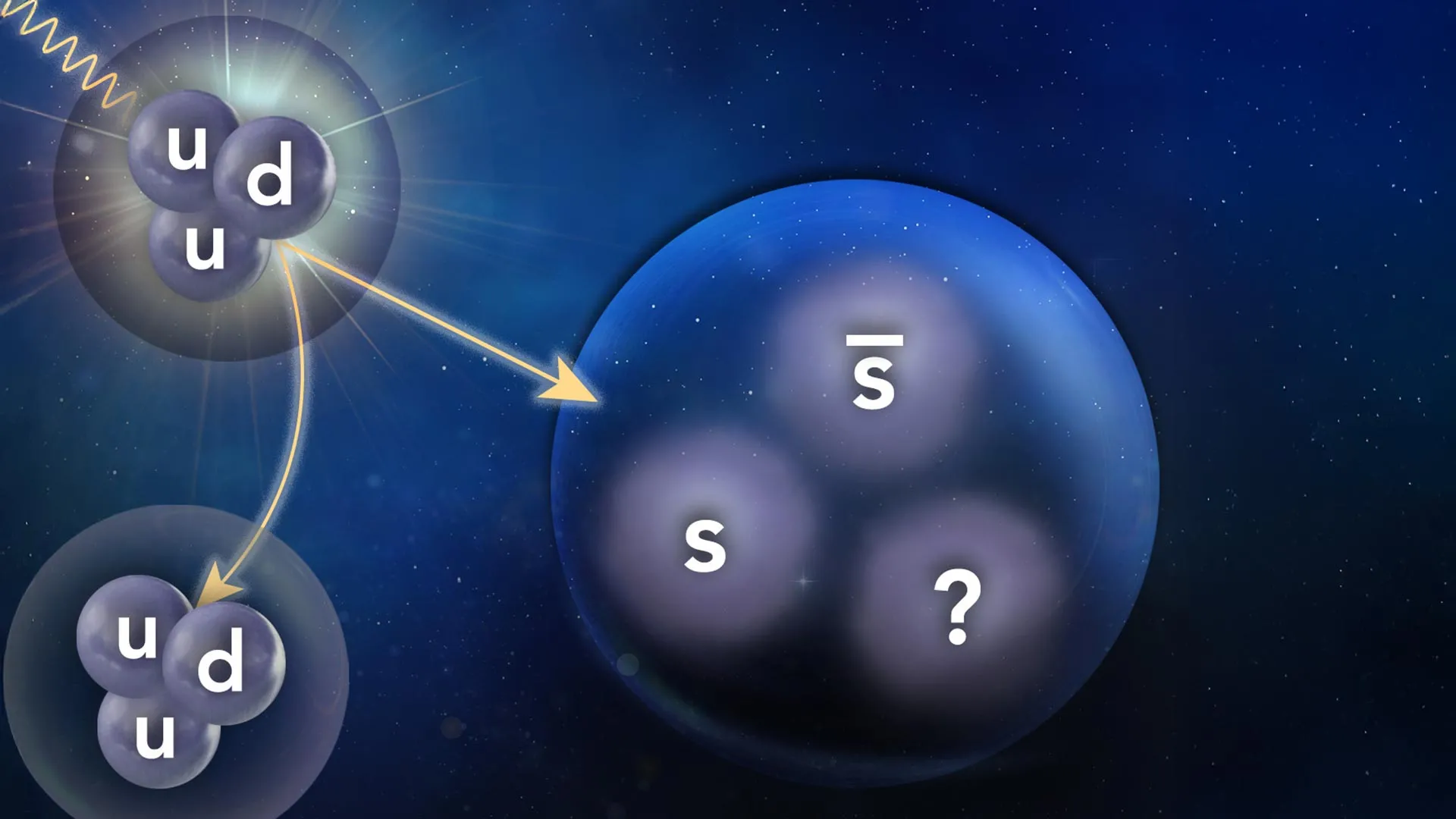
The quest to understand the fundamental building blocks of matter has led physicists through a bewildering "particle zoo," a teeming menagerie of subatomic particles whose properties and interactions define the very fabric of our universe. For decades, the Standard Model of particle physics has served as the triumphant framework for categorizing these particles and their interactions, primarily through three of the four fundamental forces: the electromagnetic, weak, and strong nuclear forces. However, the strong force, which binds quarks into protons, neutrons, and other hadrons, has consistently presented formidable challenges, giving rise to a spectrum of particles that sometimes defy conventional classification. Now, groundbreaking research at the U.S. Department of Energy’s (DOE) Thomas Jefferson National Accelerator Facility (Jefferson Lab) has unveiled evidence for two novel subatomic structures, offering tantalizing clues that could illuminate a particularly enigmatic corner of this particle landscape: the "XYZ states."
These newly observed signals, detected for the first time through the interaction of a high-energy photon beam with a proton target, promise to shed crucial light on the mysterious XYZ states. Unlike familiar particles composed of simple quark-antiquark pairs or three-quark combinations, XYZ states possess unusual quantum properties that do not align with the established "quark model." Their existence suggests more complex, potentially exotic, configurations of quarks and gluons – the force carriers of the strong interaction. This discovery, made by the Gluonic Excitations (GlueX) Collaboration in Jefferson Lab’s Experimental Hall D, was recently published in the prestigious journal Physical Review Letters, marking a significant advance in our understanding of how the strong nuclear force orchestrates the formation of matter.
"We went searching for a confirmed XYZ candidate with a photon beam but instead found two other structures," stated Malte Albrecht, a staff scientist at Jefferson Lab, emphasizing the serendipitous nature of the discovery. "It’s new information that could fundamentally alter our theoretical understanding of these elusive particles."
The Enduring Mystery of the Particle Zoo and the Rise of the Quark Model
The narrative of subatomic particle discovery truly exploded in the 1950s, a period often referred to as the "particle zoo" era. As increasingly powerful particle accelerators began smashing atomic nuclei together, they revealed a profusion of short-lived particles collectively known as hadrons. Prior to this, scientists were familiar with protons and neutrons, discovered much earlier in the 20th century, which form the nuclei of atoms. Hadrons, as we now understand, are composite particles held together by the strong nuclear force, the most powerful of nature’s fundamental interactions. This force is mediated by particles called gluons, which bind quarks – the true fundamental constituents of hadrons.
Among the deluge of newly discovered hadrons were mesons, ephemeral particles typically consisting of a quark paired with its antimatter counterpart, an antiquark. The sheer number of these particles, each with unique masses, spins, and decay modes, presented a formidable organizational challenge. It was in 1964 that physicists Murray Gell-Mann and George Zweig independently proposed the revolutionary quark model. This elegant framework posited that all known hadrons could be explained as combinations of a few fundamental particles: quarks. The earliest version of the quark model introduced three "flavors" of quarks: up, down, and strange. Up and down quarks, for instance, are the primary ingredients of protons (two up, one down) and neutrons (one up, two down). These three were also the lightest of the quark flavors. The quark model not only brought order to the chaotic particle zoo but also predicted the existence of new particles, many of which were subsequently discovered, solidifying its place as a cornerstone of modern physics.
The landscape of particle physics underwent another dramatic transformation in 1974 with the discovery of the much heavier charm quark. This pivotal finding, which involved a simultaneous discovery at both the Stanford Linear Accelerator Center (SLAC) and Brookhaven National Laboratory, provided crucial experimental validation for the quark model’s expansion. The model was eventually extended to include six quark flavors: up, down, strange, charm, bottom, and top. The discovery of these heavier quarks played a vital role in constructing the Standard Model, the overarching theory that describes all known elementary particles and three of the four fundamental forces. It also vastly expanded the theoretical spectrum of possible hadronic structures, pushing the boundaries of what physicists believed possible.
However, as particle accelerators continued to grow in power and detectors became exquisitely sensitive, researchers gained access to subtler physical processes and a wider range of collision energies. After the turn of the 21st century, a new wave of experimental results began revealing many hadrons with peculiar quantum properties that simply did not fit neatly into the original, elegant quark model. These anomalies hinted at structures more complex than simple two-quark mesons or three-quark baryons.
The accumulation of these enigmatic discoveries was so rapid and perplexing that physicists adopted a general, somewhat informal, label for many of these poorly understood particles: "XYZ states." This nomenclature reflects the profound uncertainty surrounding their internal composition and fundamental nature. "We are in a new era here, similar to 70-odd years ago," observed Frank Nerling, a Jefferson Lab collaborator from Germany’s GSI Helmholtz Centre for Heavy Ion Research and Goethe University Frankfurt, drawing a parallel to the initial discovery of the particle zoo. "First, a zoo of hadrons was discovered. Now, we’re facing a zoo of so-called exotic states." This new "exotic zoo" challenges the very foundations of our understanding of matter.
Delving into Exotic Structures: The Strong Force and Quantum Chromodynamics (QCD)
To truly appreciate the significance of XYZ states, one must delve deeper into Quantum Chromodynamics (QCD), the quantum field theory that describes the strong nuclear force. Unlike the electromagnetic force, which is mediated by massless photons and decreases with distance, the strong force is mediated by gluons, which themselves carry "color charge" – a property analogous to electric charge. This unique characteristic of gluons leads to "color confinement": quarks are never observed in isolation, always bound together in color-neutral combinations (hadrons). At short distances, the strong force is weak (asymptotic freedom), but it grows incredibly strong at larger distances, effectively "confining" quarks within hadrons.
The quark model, while successful, describes hadrons as simple valence quark configurations. However, QCD, in its full complexity, predicts a much richer spectrum of hadronic states. Beyond the conventional mesons (quark-antiquark) and baryons (three quarks), QCD allows for "exotic hadrons" – particles where gluons play a more direct structural role, or where quarks combine in ways not permitted by the simple quark model. These include:
- Tetraquarks: Hadrons composed of four quarks (two quarks and two antiquarks).
- Pentaquarks: Hadrons composed of five quarks (four quarks and one antiquark).
- Hybrid Mesons: Mesons where the gluon field itself is in an excited state, contributing to the particle’s quantum numbers and mass.
- Glueballs: Hypothetical particles composed entirely of gluons, with no valence quarks.
- Hadronic Molecules: Loosely bound states of two or more conventional hadrons, similar to how atoms form molecules.
The XYZ states are believed to be candidates for these exotic configurations. Their unusual masses and decay patterns defy explanation by simple quark-antiquark or three-quark models, making them prime targets for investigating the full, non-perturbative dynamics of QCD. Unraveling their true nature is crucial for a complete understanding of the strong force and its role in building matter.
The Search in the Strange Quark Sector: The Enigma of Y(2175)
The particle spectrum is often categorized by the types of heavy quarks they contain. Hadrons containing a charm quark and its antimatter partner, an anti-charm quark, populate a region with similar masses known as charmonium. Similarly, particles containing strange and anti-strange quarks populate the strangeonium region. It is within these sectors, particularly charmonium and strangeonium, that many of the puzzling XYZ states have been detected.
A significant breakthrough occurred in 2006 when researchers working on the BaBar experiment at the DOE’s SLAC National Accelerator Laboratory reported a possible strangeonium state with a mass of approximately 2.16 billion electron volts (2.16 GeV). Because its quantum properties suggested it was an XYZ candidate, the particle was designated Y(2175). BaBar generated Y(2175) through a process called electron-positron (e+e-) annihilation, where negatively charged electrons collide with their positively charged antimatter counterparts, positrons, transforming their energy into new particles.
Y(2175) displayed quantum behavior – such as its spin and parity – that proved difficult to reconcile with a conventional strange quark-antiquark pair. This immediately sparked theoretical speculation about its true composition. One compelling possibility was that it represented a hybrid state, involving two strange quarks and excited gluons that directly contribute to the particle’s structure. Scientists also proposed that it could be a tetraquark, a four-quark configuration, or even a molecule-like combination of other composite particles.
The existence of Y(2175) was later confirmed by other electron-positron collider experiments, including the Beijing Spectrometer (BES) in China and the Belle experiment in Japan. This independent verification solidified its status as a real, albeit enigmatic, particle. However, until the recent Jefferson Lab findings, Y(2175) had only been observed through e+e- annihilation. This limited production mechanism presented a challenge for fully characterizing the particle.
"The challenge is that you have many measurements around the world in very different experiments that have to find consensus about what they are seeing," explained Klaus Goetzen, another GSI physicist conducting research at Jefferson Lab. "It’s more complicated than it sounds, because there are states that are close by in mass and might or might not be the same thing." Different production mechanisms can preferentially excite different internal structures, and observing a particle through multiple channels is crucial for definitively establishing its nature.
It was precisely this challenge that the GlueX Collaboration aimed to address. They set out to search for Y(2175) using a fundamentally different production mechanism: photoproduction. In this process, a high-energy photon beam strikes protons held inside a fixed target. This method is expected to be particularly sensitive to hybrid mesons, where the gluon field plays an active role. Intriguingly, while the GlueX team diligently searched for Y(2175), the particle itself did not appear through this production mechanism. Instead, researchers detected something entirely unexpected at nearby masses.
GlueX Uncovers an Unexpected Pair with a Unique Experimental Setup
The GlueX Experiment at Jefferson Lab was purpose-built to investigate hybrid mesons, exotic particles where excited gluons are predicted by QCD to contribute directly to the internal structure. "Excited gluonic fields are what could be in these mesons where you have more than just the quark-antiquark pair," elaborated Justin Stevens, a William & Mary physics professor and the spokesperson for GlueX. "That’s one of the investigations, to try to understand whether there is a gluonic contribution to the structure we see." This pursuit is central to validating the more complex predictions of QCD beyond the simple quark model.
GlueX leverages the Continuous Electron Beam Accelerator Facility (CEBAF), a DOE Office of Science user facility that supports cutting-edge research by over 1,700 physicists globally. CEBAF is renowned for its high-quality, continuous electron beam. For the GlueX experiment, this electron beam is directed onto an ultrathin diamond wafer. This interaction converts CEBAF’s electrons into a beam of high-energy photons, critically, with their spins aligned in parallel. This polarized photon beam is then directed at protons contained within a liquid hydrogen target. Millions of these photons strike the protons every second, initiating a cascade of particle interactions. A sophisticated, large-acceptance spectrometer then meticulously records the spray of particles produced in these collisions, capturing their trajectories, energies, and identities.
The unique capabilities of Jefferson Lab’s CEBAF are paramount to GlueX’s success. "No other experiment has a facility with a photon beam of this intensity at the energy we have available," Albrecht highlighted, emphasizing the unparalleled nature of the setup. "This truly is a unique setup, allowing us to probe hadron structures in ways not possible elsewhere." The high intensity and specific polarization of the photon beam provide a sensitive probe for glu
