
 By Lina Irawan
The digital frontier of corporate leadership faced a stark reality check this week as Airbnb cofounder and CEO Brian Chesky became the apparent target of a sophisticated "AI slop" cyberattack. On Monday, Chesky’s official X (formerly Twitter) account unexpectedly disseminated a multi-post thread advocating a highly bullish stance on "real-world asset (RWA) tokenization," a complex and often speculative concept within the cryptocurrency ecosystem. The incident, first reported by Fortune‘s Rachel Ventresca based on a source with direct knowledge, immediately raised alarms within cybersecurity circles and among market observers.
The now-deleted series of posts commenced with a seemingly innocuous, yet strategically crafted, statement: "I’ve been quietly keeping an eye on real-world asset tokenization for a while now. Most of it is noise. But underneath the noise, something real is happening." This phrasing, designed to mimic genuine thought leadership, laid the groundwork for a detailed, albeit entirely fabricated, endorsement of converting traditional assets like stocks, real estate, or commodities into digital tokens on a blockchain. Such a move by a prominent tech CEO, if authentic, would signal a significant pivot or interest in the burgeoning, yet volatile, crypto space.
However, the authenticity quickly came into question. Fortune utilized the AI-detection tool Pangram to analyze the thread, which promptly flagged the content as 100% AI-generated. This "AI slop" — a term referring to low-quality, often deceptive content churned out by artificial intelligence with minimal human oversight — highlights a growing threat in the digital information landscape. Unlike simpler phishing attempts, AI slop attacks leverage advanced language models to create convincing narratives, making them harder for an unsuspecting audience to discern as fraudulent. The goal of such an attack is often to manipulate public opinion, influence markets, or sow confusion, rather than direct financial theft, though it could easily be a precursor to more malicious activity like promoting scam tokens or phishing links.
The swift identification of the hack triggered an urgent response. The compromised posts were immediately flagged to X, and the situation was escalated to their platform security teams as a "high-profile compromise," according to internal correspondence between Airbnb and X employees reviewed by Fortune. X moved to secure the account on Tuesday evening, allowing Chesky to regain access. Airbnb has, for its part, declined to comment on the incident, a common stance in ongoing cybersecurity investigations to avoid revealing vulnerabilities or aggravating the situation.
This incident serves as a potent reminder of the escalating cybersecurity risks faced by high-profile individuals and corporations in the age of generative AI. Social engineering attacks are becoming increasingly sophisticated, blending deepfakes, AI-generated text, and voice cloning to create highly believable impersonations. For executives whose public personas are intertwined with their company’s brand, a compromised social media account can have far-reaching reputational and even financial implications, undermining trust and potentially impacting stock performance. Cybersecurity experts increasingly advise rigorous multi-factor authentication, constant vigilance, and robust incident response plans to counteract these evolving threats.
THE MARKETS
Tech Stocks Lead Steep Global Sell-Off Amid Mounting Economic Concerns
Global markets experienced a sharp downturn this morning, with U.S. futures pointing significantly lower ahead of the New York open, following a significant sell-off that rippled across Asian and European bourses. The catalysts for this broad retreat were multifaceted, but primarily stemmed from disappointing earnings reports and persistent macroeconomic anxieties.
Chipmaker TSMC, a bellwether for the semiconductor industry, saw its shares decline by 2.63% today after its earnings call raised concerns about future guidance and demand, particularly in the smartphone and PC segments. Compounding the tech sector’s woes, streaming giant Netflix plummeted 9.24% overnight, as investors reacted negatively to its latest subscriber growth figures and projections for increased content spending, suggesting a challenging competitive landscape.
The fallout was particularly pronounced in Asia. Japan’s tech-heavy Nikkei 225 index took a substantial hit, mirroring broader concerns about global tech demand. South Korea’s KOSPI index, which was closed today, had already experienced dramatic swings in the preceding 24 hours. The KOSPI’s inherent volatility is magnified by its concentrated composition, with half its weight consisting of just two industrial giants: Samsung and SK Hynix. Furthermore, the country’s allowance for retail investors to engage in leveraged ETFs has amplified market movements, turning minor dips into steeper declines.
In the U.S., the pre-market trading saw major chipmakers like Intel, Micron, AMD, and Marvell all extending losses from yesterday’s close. The prevailing sentiment among investors appears to be that the artificial intelligence (AI) chip business, while still a growth area, has become "overbought" in recent months. Years of aggressive investment and speculative trading have pushed valuations to unsustainable levels, leading to a natural correction as market participants re-evaluate future growth prospects against current prices.
Adding to the market’s unease is the escalating geopolitical tension in the Middle East, particularly the expanding conflict involving Iran. The price of crude oil, a key indicator of global economic stability, remained stubbornly in the mid-$80s per barrel, fueling fears of sustained inflationary pressures. As Deutsche Bank’s Jim Reid succinctly put it to clients this morning, "And in the background, fears about rate hikes and more persistent inflation are still there." This comment underscores the lingering concern that central banks, particularly the U.S. Federal Reserve, may need to maintain higher interest rates for longer, or even implement further hikes, to tame inflation, which would inevitably slow economic growth and dampen corporate earnings.
A Looming AI Investment Mismatch Could Tip Economy into Recession, Warns Top Analyst
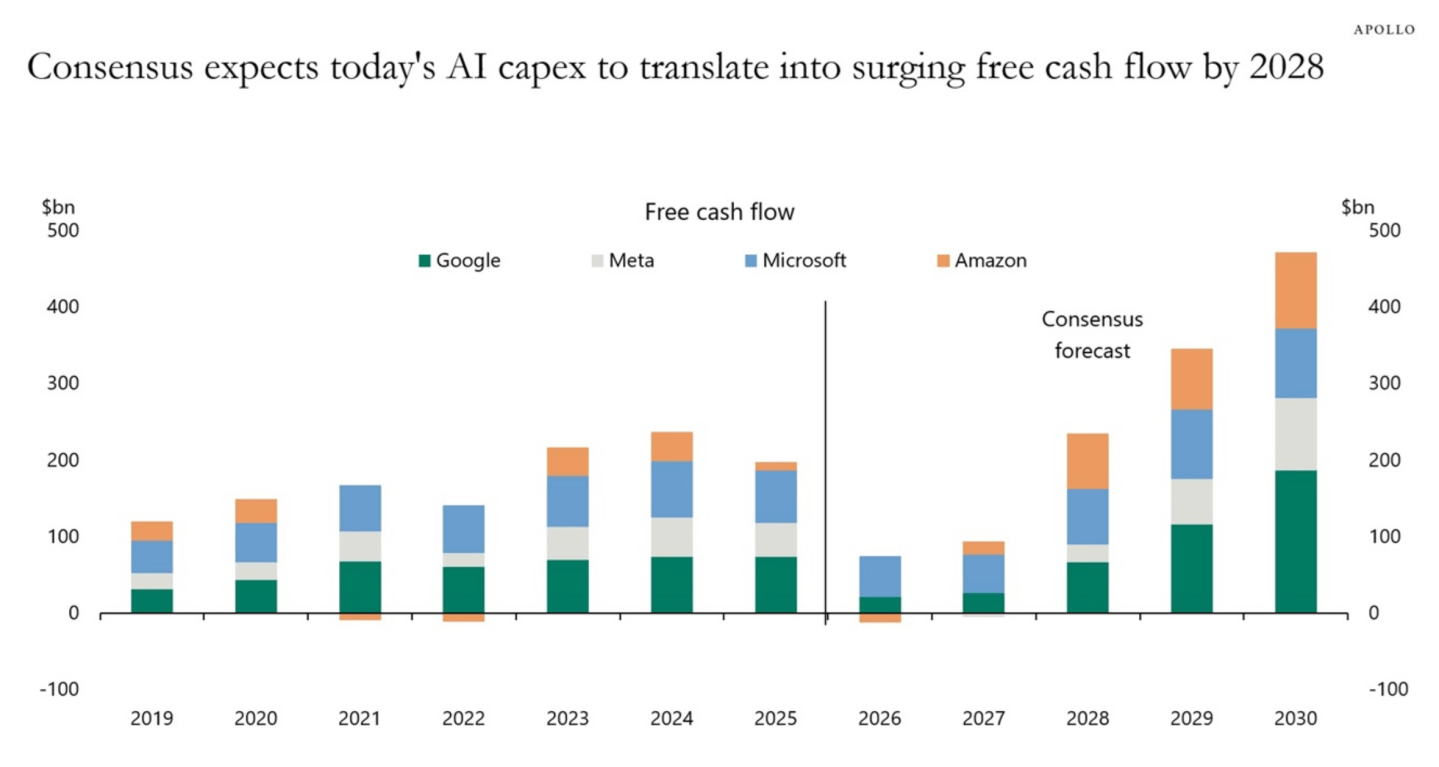
The current economic landscape, heavily buoyed by enthusiasm for artificial intelligence, faces a critical juncture, according to Torsten Sløk, Chief Economist at Apollo Global Management. Sløk is increasingly concerned about a potential "timeline mismatch" between the massive capital expenditures (capex) currently being poured into AI infrastructure by hyperscalers and the anticipated free cash flow generation from these investments.

Hyperscalers – the tech giants like Google, Amazon, Microsoft, and Meta that dominate cloud computing and AI development – are investing tens, if not hundreds, of billions of dollars annually into data centers, specialized AI chips, and advanced computing resources. The expectation is that these investments will yield substantial returns through new AI services, platforms, and increased efficiency. However, Sløk posits a significant risk: if the revenues generated by various AI models do not meet these robust expectations, perhaps due to intense price competition from emerging Chinese AI models (like Moonshot’s Kimi K3) or the proliferation of powerful open-source alternatives, then the resulting disappointing earnings could trigger a broader market downturn.
The implications extend beyond the tech sector. Sløk highlights that without the immense IT-related capital expenditure by these hyperscalers, overall corporate investment in the U.S. would currently be in negative territory. This underscores the disproportionate role AI investment plays in sustaining economic growth. If hyperscalers are forced to scale back their ambitious data center construction budgets due to slower-than-expected AI monetization, the ripple effect could be severe, potentially hobbling economic growth across multiple sectors that rely on this investment for demand.
"The bottom line is that AI has been the one thing holding up both the economy and markets," Sløk asserts in his analysis. "And with so much riding on so few names, a slower payoff wouldn’t just be a sector problem, it would risk tipping the economy into recession and the S&P 500 into a correction." This stark warning emphasizes the concentrated nature of the current market rally and the systemic risk embedded in its dependence on a handful of AI-centric companies. A correction in the S&P 500 would imply a significant decline from its current levels, potentially erasing much of the gains seen over the past year.
UBS Maintains Bullish S&P 500 Forecast, Citing Shift to Fundamentals
Despite the current market turbulence and dire warnings from some analysts, UBS Wealth Management remains optimistic about the trajectory of the S&P 500. Charlie Anderson, a Senior Vice President at UBS Wealth Management, forecasts that the benchmark index will climb to 7,900 by the end of the year, representing a substantial gain from its current levels.
Anderson’s confidence stems from a perceived shift in market dynamics. He observes that investors are increasingly prioritizing company-specific earnings results and underlying business fundamentals over volatile macroeconomic headlines and geopolitical noise. "We’ve gone from a market driven by macro headlines to one increasingly driven by micro fundamentals," Anderson explained in an email. "That’s a healthier environment for long-term investors because it rewards companies executing well rather than simply benefiting from liquidity."
This perspective suggests that while broad market sentiment might be swayed by inflation fears or geopolitical events, savvy investors are digging deeper, identifying companies with strong balance sheets, innovative products, and sustainable growth strategies. Such an environment, Anderson argues, is more resilient and offers better opportunities for value creation over the long term. However, this optimistic outlook contrasts with the more cautious stance taken by analysts like Sløk, highlighting a divergence in opinion regarding the primary drivers and risks facing the market in the latter half of the year.
MORE FROM FORTUNE
- Kevin O’Leary Targeted in Defamation Lawsuit: Shark Tank investor Kevin O’Leary and Fox News are being sued for defamation. O’Leary had publicly claimed that opposition to his proposed Utah data center project was being "fueled by Chinese money," an assertion that has now led to legal action, raising questions about accountability for public statements and the spread of unverified allegations.
- $71 Billion Tariff Refunds Offset by Inflation: U.S. companies have finally received $71 billion in tariff refunds, a significant sum intended to alleviate financial burdens. However, this windfall is largely being used to offset the rising costs of goods and operations, driven in part by persistent inflation exacerbated by the ongoing conflict in Iran.
- Netflix Leverages AI for Content Creation: Amid fierce streaming competition and a projected $20 billion in annual content spending, Netflix has successfully utilized AI to produce 17 minutes of a documentary "twice as fast and at half the cost." This marks a significant step towards integrating AI into the production pipeline, potentially revolutionizing content creation efficiency and cost-effectiveness in the entertainment industry.
- Michaels’ Growth Strategy from Rivals’ Failures: Apollo-owned Michaels craft stores have strategically capitalized on the bankruptcies of two key rivals, Party City and Joann Fabrics. This aggressive maneuver has allowed Michaels to consolidate market share and expand its footprint, demonstrating a calculated growth strategy in a challenging retail environment.
- Moonshot’s Kimi K3 Pushes Chinese AI Boundaries: Chinese AI firm Moonshot’s Kimi K3 model is making waves, pushing the capabilities of Chinese artificial intelligence into what experts describe as "Fable-level territory." This advancement signifies China’s rapid progress in the AI race, introducing new competition and potentially reshaping the global AI landscape with increasingly sophisticated models.
IRAN
U.S. Escalates Iran Bombing Campaign to Civilian Infrastructure, Retaliation Ensues
The already volatile situation in the Middle East dramatically escalated last night as the United States expanded its bombing campaign in Iran to include civilian infrastructure, a significant shift from previous targeting strategies focused solely on military and political leadership. As reported by the BBC, U.S. forces struck critical non-military targets, including bridges, a train station, a nuclear power plant, and an airport, alongside various coastal areas.
This widening of targets marks a dangerous intensification of the conflict, with potentially severe humanitarian and strategic consequences. Attacking civilian infrastructure is often viewed as a tactic designed to cripple a nation’s ability to wage war and sustain its population, but it also carries a high risk of civilian casualties and widespread condemnation.
Iran’s response was swift and retaliatory, demonstrating its capability to project power across the region. Iranian forces targeted U.S. radar sites and other strategic objectives in several allied and neighboring nations, including Oman, Kuwait, Bahrain, Syria, and Iraqi Kurdistan. This tit-for-tat escalation significantly raises the specter of a broader regional conflict, threatening critical global shipping lanes, oil supplies, and international stability. The move to target civilian assets could also lead to increased pressure from international bodies and a more concerted effort by global powers to de-escalate the situation, though the immediate outlook remains grim.
CHART OF THE DAY
Government Debt Surpasses Great Financial Crisis Levels and Continues to Grow
A stark reality confronting global economies is the unprecedented level of government debt, which today surpasses the peaks seen during the Great Financial Crisis (GFC) of 2008-2009. The accompanying chart illustrates this alarming trend, showing the combined fiscal deficits of the United States, China, and Germany reaching historic highs.
According to the Deutsche Bank Research Institute, the magnitude of these deficits has become normalized to a degree that would have been unimaginable just over a decade ago. "After years of ever-larger deficits, we’ve become conditioned to numbers that would once have seemed extraordinary," notes Deutsche Bank’s Jim Reid. "What would have been unimaginable in 2008-09 now barely raises an eyebrow, with numbers previously unseen outside major wars or big recessions."
This ballooning debt is a consequence of several factors: massive fiscal stimulus packages enacted during the COVID-19 pandemic, increased defense spending in a more fractured geopolitical landscape, and the long-term demographic pressures of aging populations requiring greater social welfare outlays. While governments took on debt during the GFC to prevent a systemic collapse, the current accumulation of debt is occurring during a period of relative economic stability, albeit with underlying inflationary pressures.
The implications of such high and growing government debt are profound. It leads to higher interest payments, which divert funds from other critical public services and investments. It can "crowd out" private investment by competing for capital. Furthermore, it raises concerns about long-term fiscal sustainability, potential sovereign debt crises, and the risk of exacerbating inflation if central banks are forced to monetize this debt. The normalization of these extraordinary debt levels poses a significant challenge for policymakers seeking to maintain economic stability and growth without resorting to austerity measures that could stifle recovery.
NUMBER OF THE DAY
$200 billion
This staggering figure represents the projected profits of Samsung in 2026. To put this into perspective, Herald van der Linde, HSBC’s head of equity strategy for Asia Pacific, notes that this amount is "roughly the same as the combined earnings of all listed companies in India." This projection underscores Samsung’s immense market dominance and its pivotal role in the global technology landscape, particularly in memory chips, smartphones, and display technologies. The anticipated profits highlight the concentrated nature of wealth creation within the tech sector and the potential for a few global giants to command outsized financial success, especially as demand for advanced electronics and AI components continues to surge.
THE FRONT PAGES TODAY
- FT: Hotel group Accor has reportedly hired a law firm to investigate the conduct of its CEO, Sébastien Bazin, signaling potential corporate governance issues at the hospitality giant.
- CNBC: The world’s largest olive oil company declares the market has "definitively" entered a new phase, driven by climate change-induced droughts in major producing regions like Spain, leading to persistent supply concerns and rising prices.
- Axios: Former President Trump alleges a "vast conspiracy" to commit and cover up election fraud, intensifying his rhetoric around election integrity and fueling ongoing political divisions.
- WSJ: The Wall Street Journal provides an exclusive "inside story" detailing IBM’s shocking profit warning, shedding light on the challenges facing the tech stalwart amidst evolving market demands and competitive pressures.
- Bloomberg: In a move that risks diplomatic retaliation, former President Trump plans to cut U.S. stays for Chinese journalists, escalating tensions between the two global powers over media access and freedom.
- NYT: In prime time, former President Trump publicly criticized major television networks for not carrying his recent speech live, raising questions about media coverage, political narratives, and the role of broadcast news.
ONE MORE THING
Congress Considers Ending Twice-Yearly Clock Change, But History Offers a Cautionary Tale
The perennial debate over daylight saving time could soon reach a legislative conclusion in the U.S. as Congress considers a bill to make daylight time permanent, effectively ending the twice-yearly ritual of "spring forward" and "fall back." Proponents argue for benefits ranging from improved public health and safety to increased economic activity due to longer daylight hours in the evening.
However, as the Associated Press reports, America has trodden this path before, with less-than-stellar results. A trial period of permanent daylight time was implemented from January 1974 to April 1975, a response to the 1973 oil crisis aimed at conserving energy. The legislation, however, was met with widespread public outcry and was ultimately repealed in October 1974, just ten months into the experiment.
The core issue then, as it would be now under the proposed bill which favors "spring forward" time, was the impact of permanently darker mornings. Kevin Birth, a professor of anthropology at Queens College who vividly remembers the 1970s trial, recounted the experience: "I had to get up for school and it was like it was midnight. It was just pitch black and it remained pitch black into the school day." This prolonged darkness in the morning raised significant concerns about children’s safety traveling to school, disrupted daily routines, and led to a palpable sense of gloom for many. While lighter evenings are appealing for leisure and commerce, the trade-off of pitch-black mornings, particularly during winter months, proved unpopular and unsustainable for the American public in the past, posing a significant challenge for current legislative efforts.
