
 By Titik Puspa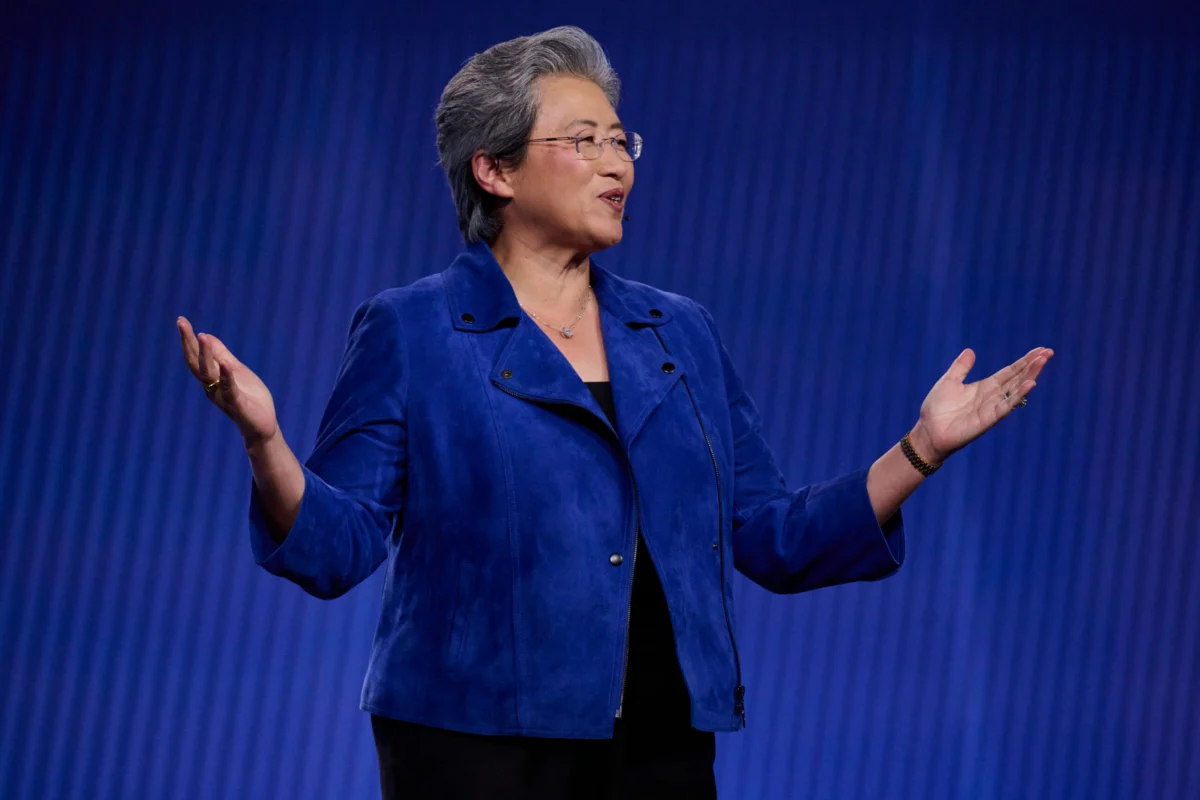
In a bold move to directly challenge industry leader Nvidia, chipmaker AMD has unveiled its formidable new hardware offering: a rack-scale system meticulously engineered to cater to the insatiable computational demands of the world’s most prominent artificial intelligence laboratories. This strategic unveiling, which took place at AMD’s highly anticipated and sold-out Advancing AI conference in San Francisco, signifies AMD’s aggressive push to capture a significant share of the rapidly expanding AI infrastructure market. Dr. Lisa Su, AMD’s Chair and CEO, took center stage to champion the new AI rack system, christened "Helios," and to announce its impressive roster of early adopters, prominently featuring tech giant Microsoft. With shipments slated for later this year, Helios, coupled with AMD’s latest generation of cutting-edge chips, is positioned to become a critical engine for the burgeoning AI industry.
Rack systems represent the pinnacle of modern data center architecture, consolidating numerous high-performance processors into a single, exceptionally powerful unit. These meticulously designed systems are the backbone of data centers, tasked with the computationally intensive processes of training and deploying sophisticated AI models, as well as handling a wide array of other demanding workloads. Dr. Su emphatically declared Helios to be the tech industry’s "highest-performance AI rack," underscoring its capacity to "train and run the most demanding frontier models in the world at massive scale." The company further elaborated that Helios will be deployed by leading AI organizations at a truly colossal "gigawatt-scale," illustrating the sheer magnitude of computing power it represents.
Historically, Nvidia has held a near-monopoly in this high-stakes market with its renowned Vera Rubin and Grace Blackwell rack-scale systems. AMD’s entry with Helios is a clear declaration of intent to disrupt this established order. Early performance benchmarks, as reported by The Register, suggest that Helios possesses the technical prowess to genuinely compete, reportedly outperforming Nvidia’s Vera Rubin across several key metrics. This competitive edge is crucial for AMD as it seeks to erode Nvidia’s market dominance and establish its own presence in the AI hardware arena.
The development and reveal of Helios have been a strategic process. While the system was initially showcased in 2025 and publicly demonstrated on stage at CES 2026, its official launch and subsequent customer announcements are now solidifying its market presence. The impressive list of early adopters, including industry powerhouses such as OpenAI, Meta, Oracle, Anthropic, and Microsoft, speaks volumes about the confidence these leading AI companies have placed in AMD’s new offering. These organizations have concrete plans to integrate Helios into their existing and future AI infrastructure.
Microsoft’s commitment to Helios is particularly noteworthy. Microsoft CEO Satya Nadella confirmed on Monday that the tech behemoth intends to significantly expand its Azure cloud computing infrastructure by deploying AMD’s Helios systems. This endorsement from one of the world’s largest cloud providers provides a powerful validation for AMD’s technology. Furthermore, a strategic partnership announced between Anthropic and AMD on Wednesday will see the deployment of up to two gigawatts of AMD Instinct MI450 series GPUs through the new Helios rack system. This substantial commitment from Anthropic underscores the growing demand for high-performance AI hardware and AMD’s capability to meet it at scale.
Beyond the Helios rack system, AMD also took the opportunity at the Advancing AI conference to introduce its new Venice-X CPU. Designed specifically for the demanding environment of data centers and engineered to excel at high-computing workloads, the Venice-X CPU is slated for a 2027 launch. This forward-looking product development further solidifies AMD’s commitment to providing a comprehensive suite of solutions for the evolving AI landscape, from processors to complete rack-scale systems.
Dr. Su’s remarks at the conference offered a compelling vision for the future of the chip industry, projecting that AI-powering chips will evolve into an overwhelmingly significant segment of the overall computing market by the year 2030. She attributed this exponential growth to a fundamental "step change in compute demand," primarily fueled by the rapid advancement and adoption of agentic AI. Agentic AI, characterized by its ability to perform complex, multi-step tasks, requires sophisticated reasoning, tool utilization, data access, and iterative problem-solving, all of which translate into a massive demand for parallel processing capabilities, largely driven by GPUs.
"When you ask the agent to do something, it actually has dozens of steps, and it has to reason, and it has to call tools, and it has to access data, and it has to keep doing it over and over until it solves the problem, and so you need lots of GPUs to do all that," Dr. Su explained, vividly illustrating the computational intensity of modern AI applications.
Projecting further into the future, Dr. Su provided a staggering forecast for the AI accelerator market. "We do expect that by 2030, the AI accelerator market is going to reach about $1.4 trillion," she stated. This figure is particularly remarkable, as she elaborated, "What that means is, by the end of the decade, the AI accelerator market is going to approach the size of the entire semiconductor market today." This projection highlights the transformative impact of AI on the semiconductor industry and the immense opportunities it presents for companies like AMD.
Dr. Su also emphasized the continued dominance of GPUs within this rapidly expanding AI accelerator market. "We do expect that GPUs are going to make up the vast majority of that market because the algorithms are still very much in their infancy, and we’re still continuing to see the workloads change, and that favors programmability in the overall silicon ecosystem," she explained. This statement underscores the inherent flexibility and programmability of GPUs, which are crucial for adapting to the constantly evolving landscape of AI algorithms and workloads. The focus on programmability suggests that as AI research progresses and new model architectures emerge, GPUs will remain the preferred hardware for their adaptability and efficiency.
The competitive landscape in AI hardware is intensifying, with AMD’s Helios emerging as a potent contender against Nvidia’s established dominance. The sheer scale of investment and development in AI infrastructure, as evidenced by the gigawatt-scale deployments and multi-trillion-dollar market projections, indicates that the demand for high-performance computing solutions will continue to soar. AMD’s strategic moves with Helios and its future CPU offerings demonstrate a clear ambition to not only participate in this growth but to lead it. The success of Helios will hinge on its ability to consistently deliver on its performance promises, its cost-effectiveness, and its integration capabilities within the complex ecosystems of major AI players. As the AI revolution accelerates, the battle for AI compute supremacy is far from over, and AMD’s Helios is poised to be a central figure in this ongoing technological arms race.
The implications of AMD’s strategic push with Helios extend beyond direct competition with Nvidia. It signals a broader trend of diversification and increased choice within the AI hardware market. For large AI labs and cloud providers, having multiple robust options for high-performance compute infrastructure is crucial for ensuring supply chain resilience, fostering innovation through diverse technological approaches, and potentially driving down costs through healthy competition. The success of Helios could pave the way for AMD to become a more significant player in the enterprise AI market, challenging Nvidia’s long-standing leadership in this critical domain. The company’s commitment to developing a full-stack compute solution, from CPUs to advanced GPUs and integrated rack systems, positions it as a comprehensive provider for the most demanding AI workloads. The future of AI compute is being shaped by these pivotal hardware developments, and AMD’s Helios represents a significant chapter in that unfolding narrative.
