
 By admin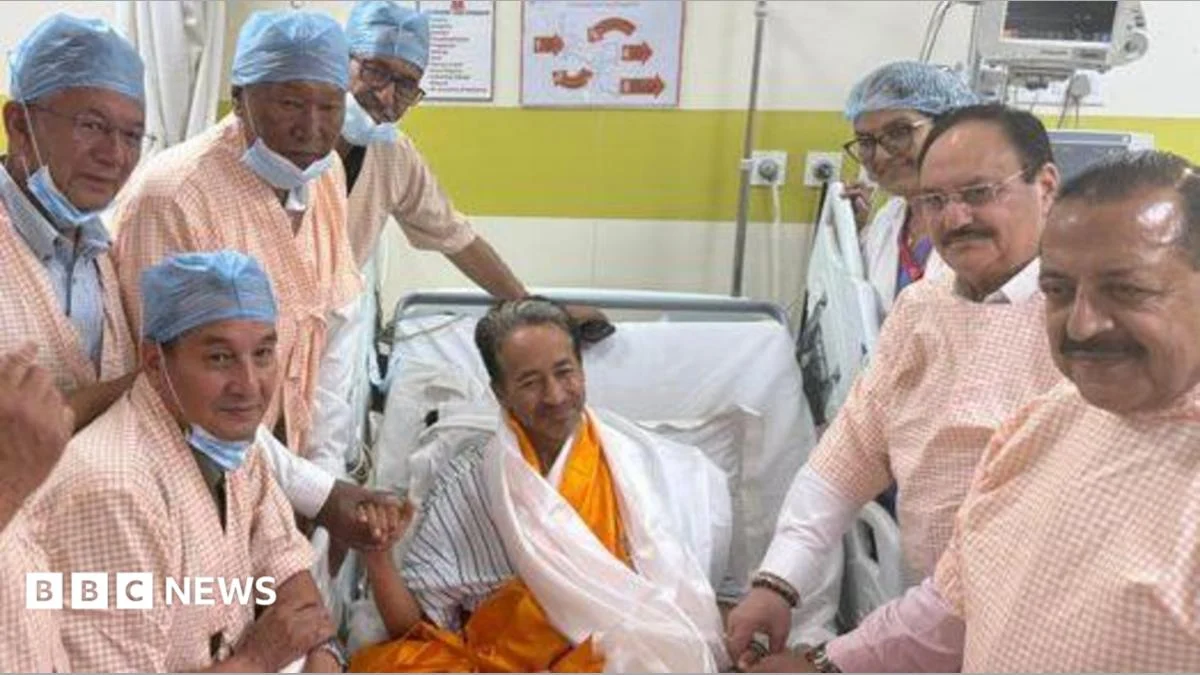
Sonam Wangchuk, a globally recognized climate activist and education reform advocate from Ladakh, has successfully concluded his arduous 26-day hunger strike after receiving firm assurances from the Indian government that no legal repercussions will befall protesters demonstrating at Jantar Mantar, New Delhi’s historic protest site. The dramatic end to Wangchuk’s fast, which had garnered significant national and international attention, was announced by NDTV, a prominent Indian news network. Wangchuk, a Ramon Magsaysay Award winner and an influential figure in environmental activism and educational innovation, had embarked on the hunger strike to protest what he and his supporters term the government’s indifference to critical environmental and educational issues.
The high-profile nature of Wangchuk’s protest was underscored by the visit of India’s state and health ministers to his hospital bedside. Their presence signaled the government’s recognition of the gravity of the situation and the potential for wider unrest if Wangchuk’s health deteriorated further or if his demands were not addressed. The government’s pledge to refrain from legal action against the Jantar Mantar protesters represents a significant concession, aimed at de-escalating the tense atmosphere that has gripped the capital.
Abhijeet Dipke, the founder of the Citizens for Justice and Peace (CJP), a prominent civil society organization, expressed profound relief and gratitude over Wangchuk’s decision to break his fast. In a post on the social media platform X (formerly Twitter), Dipke stated, "We are relieved and grateful that Sonam sir has ended his hunger strike after 26 days." However, Dipke’s statement also carried a stark warning, indicating that the protest movement, which playfully refers to itself as the "Cockroach Janta Party," would not cease its demonstrations at Jantar Mantar. He explicitly stated, "The Cockroach Janta Party’s peaceful protest at Jantar Mantar will continue until [Education Minister] Dharmendra Pradhan resigns." This declaration highlights the continued determination of the protesters to achieve their primary objective – the resignation of the Education Minister.
The backdrop to this development is a period of sustained and intensifying public dissent in the Indian capital. Mass protests have become a regular feature in New Delhi, following a forceful police crackdown on a march to Parliament on Monday. Reports from the scene indicated that scores of protesters and police personnel sustained injuries during the confrontation, underscoring the volatile nature of the ongoing demonstrations. The crackdown itself has fueled further anger and solidarity among various groups protesting against government policies.
The "Cockroach Janta Party," as the group has self-identified, has rapidly emerged as one of India’s most visible youth-led movements. Its current activism is being widely interpreted as one of the most significant public displays of dissent against the administration of Prime Minister Narendra Modi, who has been in power since 2014. The movement’s origins are relatively recent, having coalesced in May as an online satirical initiative. Initially, it was conceived as a platform to voice grievances against widespread paper leaks and other alleged irregularities plaguing India’s highly competitive top-tier examinations. The movement’s clever use of social media and its satirical approach have resonated with a vast number of young people, rapidly translating online traction into tangible on-ground mobilization.
The protesters, who have adopted the moniker "cockroaches" as a symbol of their resilience and persistence in the face of adversity, have been actively demonstrating for approximately a month. Their sustained campaign has included several members, including Sonam Wangchuk, undertaking hunger strikes to amplify their message and pressure the government. The core demand of these protesters centers on the immediate resignation of Union Education Minister Dharmendra Pradhan. This demand stems directly from the cancellation of a crucial national medical entrance examination, the National Eligibility cum Entrance Test (NEET-UG), in early May. The exam’s cancellation was a direct consequence of a significant paper leak, which raised serious questions about the integrity of the examination process and the security protocols in place.
The protesters argue that Minister Pradhan must accept moral responsibility for the systemic failures that led to the NEET-UG paper leak. They contend that as the head of the Ministry of Education, he is ultimately accountable for the integrity of the examination system under his purview. The demand for his resignation is framed not merely as a punitive measure but as a necessary step to restore public trust and signal a commitment to accountability and reform within the education sector. The persistent calls for his resignation, even with Wangchuk’s hunger strike concluded, indicate the depth of the protesters’ conviction and their unwavering commitment to this specific demand.
The broader context of the protests also touches upon the socio-economic anxieties of India’s youth. The NEET-UG exam is a gateway to medical education, a highly sought-after and competitive field, with immense career prospects and societal respect. The paper leak not only undermines the dreams of countless aspiring doctors but also raises concerns about fairness and equal opportunity. For many students from less privileged backgrounds, such leaks represent a direct impediment to their upward mobility and a perpetuation of systemic inequalities. The "Cockroach Janta Party’s" activism, therefore, taps into a deep-seated frustration with what is perceived as a compromised system.
The government’s response, while offering an olive branch in the form of a no-legal-action pledge, is likely to be closely scrutinized. The protesters will be watching to see if this assurance translates into concrete action and if there are further steps taken to address the underlying issues of examination integrity and accountability. The continued presence of protesters at Jantar Mantar, despite Wangchuk’s hunger strike ending, suggests that the movement has gained a momentum that extends beyond the personal efforts of any single individual.
Sonam Wangchuk’s hunger strike was not just about the immediate issues of exam leaks; it was also a broader call for systemic reform and a plea for the government to prioritize sustainable development and ethical governance. His background as an innovator in education and an environmental activist lends significant weight to his pronouncements. He has been a vocal advocate for the protection of the fragile Himalayan ecosystem and has championed alternative educational models that foster critical thinking and environmental consciousness. His participation in the protests against exam irregularities highlights a growing convergence of concerns among civil society, linking environmental activism with broader issues of social justice and good governance.
The "Cockroach Janta Party" has employed a multi-pronged strategy, utilizing social media virality, satirical campaigns, and symbolic acts of protest like hunger strikes to capture public imagination and exert pressure on the government. Their choice of the "cockroach" as a symbol is particularly poignant. Cockroaches are often seen as pests, yet they are also incredibly resilient and adaptable survivors. This symbolism resonates with the protesters’ self-perception as a marginalized but persistent force challenging a seemingly entrenched establishment. It speaks to their determination to survive and thrive despite what they perceive as oppressive systems.
The ongoing protests at Jantar Mantar are not an isolated incident but part of a larger trend of increased civic engagement and vocal dissent across India. The digital age has empowered citizens to organize, disseminate information, and mobilize support more effectively than ever before. The success of movements like the "Cockroach Janta Party" is a testament to this evolving landscape of activism. The government, therefore, faces the dual challenge of addressing the specific grievances raised by these movements while also navigating the broader implications of a more assertive and digitally connected citizenry.
The future trajectory of the "Cockroach Janta Party" will depend on several factors, including the government’s continued responsiveness, the sustained solidarity among its members, and its ability to maintain public support. The demand for Education Minister Dharmendra Pradhan’s resignation remains a central point of contention. The government’s willingness to engage in meaningful dialogue and implement substantive reforms will be crucial in determining whether the current wave of protests can be effectively addressed or if it will continue to simmer and potentially escalate. The assurances given to Sonam Wangchuk are a step in the right direction, but the larger battle for accountability and reform appears far from over. The nation watches closely to see how these complex issues will unfold.
