
 By Lina Irawan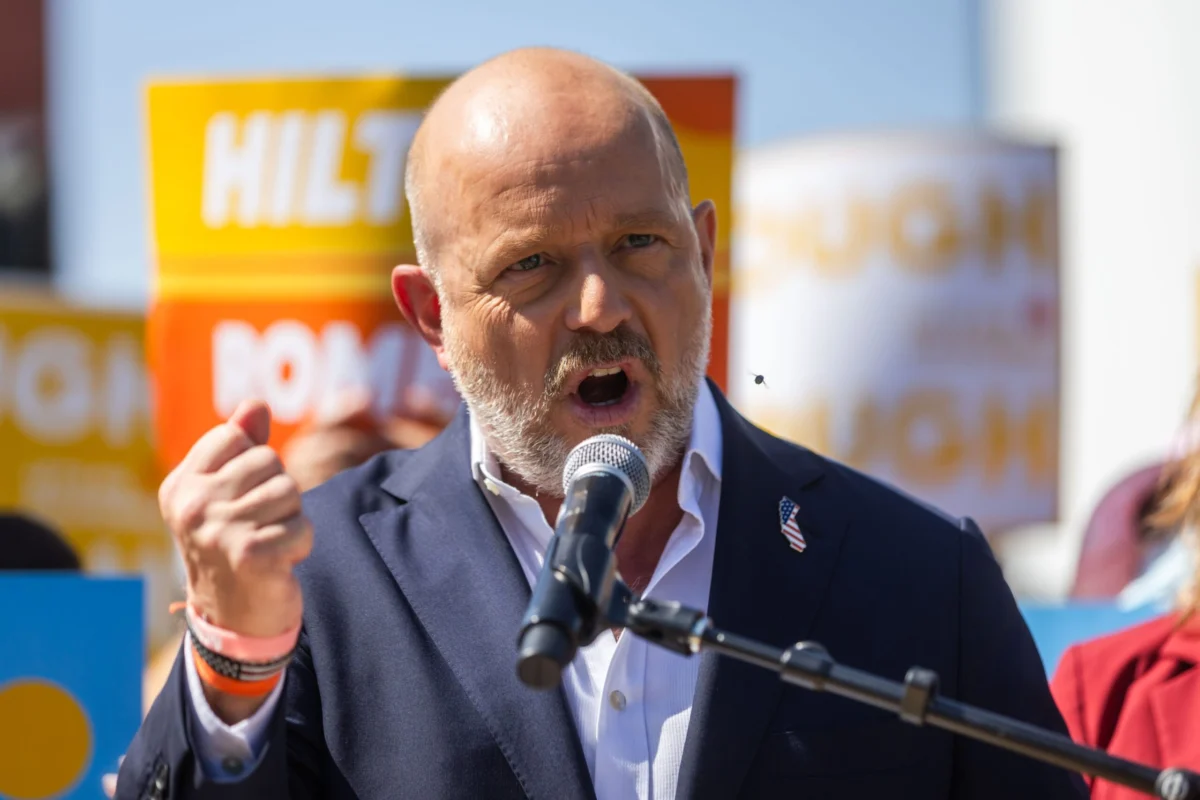
The setting for Hilton’s kickoff event was carefully chosen to underscore his central campaign theme: the perceived decline of California under Democratic leadership. Against the backdrop of a "stinking, scorched food warehouse" in Boyle Heights, a working-class Los Angeles neighborhood, Hilton painted a vivid picture of the state’s political incompetence and neglect. This charred edifice, emanating odors and attracting pests, served as a potent symbol of what Hilton described as a broader governmental failure affecting the daily lives of Californians. Residents of Boyle Heights had been vocal about the persistent stench and public health concerns following a fire at the cold storage facility the previous month, making it an ideal, if stark, metaphor for the challenges Hilton aims to address.
Hilton’s platform, rolled out before a small but enthusiastic group of supporters, directly targeted the acute financial pressures faced by California residents. He pledged a series of aggressive economic reforms designed to alleviate the state’s notoriously high cost of living. Foremost among these promises was a vow to slash the price of gasoline to $3 a gallon, roughly half the current average cost in California, which consistently ranks among the highest in the nation. This promise directly confronts the financial burden placed on commuters and businesses, who contend with not only global oil prices but also the state’s unique blend requirements, high excise taxes, cap-and-trade fees, and fewer operating refineries compared to previous decades. California’s stringent environmental regulations, while aimed at improving air quality, also contribute to higher production costs for fuel.
In a similar vein, Hilton committed to cutting residents’ utility bills in half. California’s utility rates are among the highest in the U.S., driven by factors such as massive infrastructure investments to prevent wildfires (particularly by Pacific Gas & Electric, PG&E), the high cost of integrating renewable energy sources, and various state-mandated fees. Energy policies designed to transition the state away from fossil fuels, while environmentally progressive, often come with substantial price tags passed directly to consumers. Hilton’s pledge suggests a reevaluation of these mandates and their financial impact, aiming to provide immediate relief to households and businesses grappling with escalating monthly expenses.
Perhaps his most ambitious economic promise was the elimination of state income taxes on the first $150,000 in earnings. California operates under a highly progressive income tax system, with some of the highest marginal rates in the country, particularly for high earners. While intended to fund extensive social programs and public services, this tax burden is frequently cited by critics as a disincentive for businesses and wealthy individuals, contributing to the "exodus" narrative. Hilton’s proposal, if enacted, would represent a fundamental restructuring of the state’s revenue generation and could significantly boost the disposable income of a large segment of the middle class and even some higher earners. Such a change, however, would require significant legislative cooperation and careful management of the state budget, which currently relies heavily on income tax revenue.
Hilton unequivocally laid the blame for California’s myriad problems at the feet of the Democratic Party. He castigated the state’s current political establishment, which controls every statewide office and holds supermajorities in both chambers of the Legislature, as a "rotten regime that has abandoned the working class." His critique spanned issues from widespread homelessness, despite billions in state spending, to subpar student test scores that indicate a struggling public education system. He argued that the state’s one-party rule has led to unchecked spending, bureaucratic inefficiency, and policies that exacerbate rather than alleviate the crises facing ordinary Californians. The ongoing homelessness crisis, particularly visible in major urban centers, has become a symbol of governmental failure for many residents, irrespective of political affiliation, prompting widespread frustration and calls for more effective solutions.
A central element of Hilton’s campaign launch, reiterated in his remarks and through newspaper advertisements across the state, was his nuanced approach to his relationship with former President Donald Trump. While Trump has publicly endorsed Hilton, a move that would typically be seen as a kiss of death in deeply Democratic California, Hilton sought to reframe the narrative. "This is not about who you hate in Washington. It’s about what we love about California and what we can do to make California once again the best place anywhere in the country to start and raise a family, to start and run a business," he told his supporters. "That’s what this election is about."
This maneuver reflects a shrewd, if precarious, attempt to create a sliver of distance from Trump without outright disavowing his endorsement. It’s a tacit acknowledgment of the stark political realities in California, arguably one of the most reliably Democratic states in the nation. Registered Republicans are outnumbered nearly 2-to-1 by Democratic voters, and the last time a GOP candidate won a statewide election in California was in 2006, when Arnold Schwarzenegger was re-elected governor and Steve Poizner won for Insurance Commissioner. Since then, the Republican brand has become increasingly toxic in the Golden State, largely due to its association with national figures perceived as extreme or out of touch with California’s progressive values.
Donald Trump, in particular, remains widely unpopular across broad swaths of California, extending far beyond his loyal conservative base. The electoral history underscores this sentiment: Trump lost to Democrat Hillary Clinton by a staggering 30 points in 2016, then to Joe Biden by 29 points in 2020. Even in the more recent 2024 election, he lost to Kamala Harris by 20 points, demonstrating a persistent and significant electoral deficit. California has long been regarded as a bastion of the so-called "Trump resistance," where Democrats have effectively leveraged the former president as a powerful foil in campaigns to energize and motivate their voter base. Last year, Governor Gavin Newsom famously nationalized the state’s fight over Proposition 50, a measure to redraw U.S. House districts to favor Democrats, by explicitly framing it as a direct confrontation with Trump. The measure ultimately secured a decisive 29-point victory, illustrating the potency of the anti-Trump message.
The campaign of Hilton’s Democratic opponent, former U.S. Health and Human Services Secretary Xavier Becerra, quickly scoffed at the notion of Hilton as a credible change agent or someone capable of appealing to a broad cross-section of Californian voters. "Californians already know who Steve Hilton is: Trump’s puppet in California. His campaign is a promise to run our state the way Trump runs the country and we’re not buying it," declared Jonathan Underland, Becerra’s campaign spokesman, in a sharply worded statement.
Underland further dismantled Hilton’s appeal to disaffected voters, directly linking Hilton’s economic promises to perceived failures of the Trump administration. "Steve Hilton cheers on a president whose illegal war has sent gas prices soaring and illegal tariffs have cost California families more than $2,500 this year alone. You can’t fix the affordability crisis while carrying water for the man causing it," Underland added. This attack line effectively aims to neutralize Hilton’s attempts to distance himself, by tying his economic proposals back to federal policies under Trump that Democrats argue have negatively impacted consumers and the economy. The reference to "illegal war" likely alludes to trade wars or economic policies that have created instability, rather than military conflicts, emphasizing the economic consequences.
In a state with such entrenched Democratic dominance, Hilton’s campaign is banking on the hope that his direct appeal to Democrats and independents will "give voters a permission slip" to look beyond traditional party labels. This strategy attempts to capitalize on voter frustration with the status quo and the state’s persistent problems, suggesting that a focus on pragmatic solutions to everyday economic hardships might transcend deep partisan divides. "You do have a choice if you think that this state is going in the wrong direction," Hilton asserted at the Boyle Heights event, aiming to empower voters who might feel politically homeless or disenfranchised by the current political landscape.
Adding a layer of bipartisan flavor to his campaign launch, Hilton was accompanied by Gloria Romero, a former prominent Democratic state lawmaker who made headlines in 2024 by switching to the Republican Party. Romero, now the Republican nominee for lieutenant governor, delivered her own address in both English and Spanish, resonating with the diverse audience. Supporters held "Hilton-Romero" signs in the background, symbolizing a hopeful, if challenging, cross-party appeal. Romero’s defection from the Democratic Party provides a tangible example of the type of voter Hilton hopes to attract – someone disillusioned with the Democratic Party’s direction and willing to consider alternatives.
Xavier Becerra, a seasoned politician with a distinguished career as a state lawmaker, congressman, and state attorney general, is widely favored to win the governorship. He currently holds the seat vacated by Governor Gavin Newsom, who is term-limited and widely speculated to be a future Democratic presidential candidate in 2028. Becerra’s deep roots in California politics, his extensive experience in both state and federal government, and his strong alignment with the state’s progressive values make him a formidable opponent. Both Hilton and Becerra emerged from a crowded and somewhat chaotic primary election in June, which saw more than 50 candidates vying for a spot on the general election ballot, reflecting the widespread interest and discontent in the state’s political direction.
The gubernatorial race unfolds against a backdrop of multiple, interconnected crises plaguing California. Despite billions of dollars allocated to combat homelessness, the problem remains pervasive and highly visible, particularly in major cities, prompting questions about the effectiveness of current strategies. The state also faces significant multibillion-dollar budget deficits projected into the foreseeable future, raising concerns about fiscal stability and the ability to maintain essential services. Home prices continue to soar, placing homeownership out of reach for a vast majority of residents and contributing to a deepening housing affordability crisis. The home insurance market is in disarray, with major insurers pulling out or significantly raising rates due to wildfire risks and other factors, further destabilizing the housing sector. Reports of businesses and residents fleeing the state in search of lower costs of living, fewer regulations, and better economic opportunities have become a persistent narrative. All these factors contribute to a pervasive sense of unease among Californians, who also contend with some of the highest gas prices, taxes, and utility bills in the nation.
Making good on his ambitious campaign promises will be an exceedingly difficult task for Hilton. A former adviser to ex-United Kingdom Prime Minister David Cameron, Hilton has never held elective office, which presents a significant hurdle in terms of political experience and navigating California’s complex legislative landscape. The governor, even with executive power, does not directly control the global oil markets or the independent utility companies. However, Hilton asserts he can influence these costs by eliminating state mandates, taxes, and fees that contribute to higher prices. Furthermore, any fundamental changes to the state’s income tax structure would almost certainly require the consent and cooperation of a Legislature overwhelmingly controlled by Democrats, who are unlikely to support such a drastic shift in fiscal policy. This makes his path to implementing his agenda extremely challenging, if not entirely dependent on an unprecedented political realignment.
Hilton capped his campaign kickoff with a 30-second TV ad, strategically designed to resonate with the financial struggles of many Californian families. "Life here has become impossible for anyone who isn’t already rich," he states directly to the camera, framing the election as a clear choice for economic relief. "Let’s fix California." This simple, direct message aims to cut through the political noise and connect with voters on the most fundamental level: their ability to afford a decent life in the state they call home, setting the stage for a compelling, albeit uphill, battle for the governorship.
