
 By Lina Irawan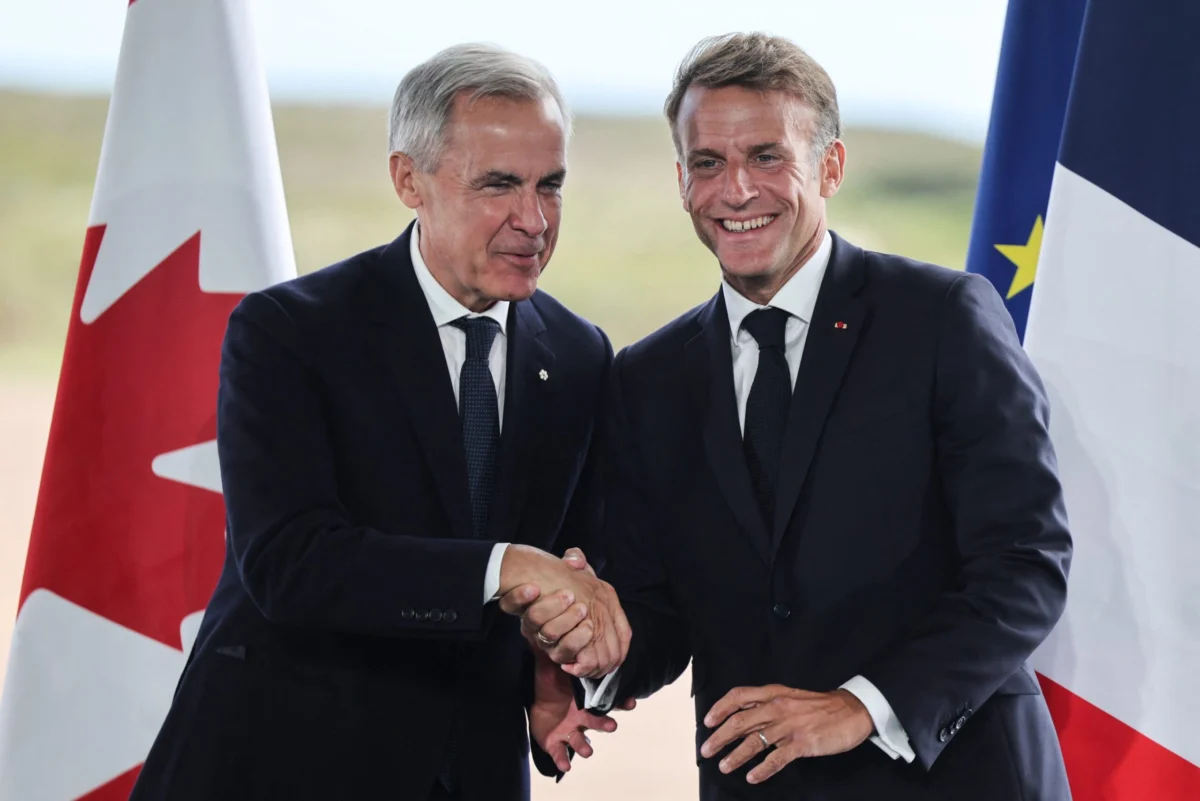
In a landmark summit held in the strategically significant French territory of Saint-Pierre-et-Miquelon, Canadian Prime Minister Mark Carney and French President Emmanuel Macron forged a comprehensive agreement to significantly enhance bilateral cooperation across crucial sectors. The accord, announced Sunday, signals a profound reorientation of Canada’s foreign policy, as it actively seeks to diversify its economic and security partnerships away from its traditional reliance on the United States. The leaders’ discussions centered on strengthening collaborative efforts in space exploration and defense, bolstering energy security, and fostering robust business and technological exchanges, underscoring a shared commitment to global stability and collective resilience.
Prime Minister Carney underscored the immediate actions following the agreement, stating that both nations would task their respective space agencies and defense ministries to collaboratively develop and share vital infrastructure. This includes innovative launch systems and advanced ground-based reception facilities, paving the way for integrated operations and shared capabilities in the burgeoning domain of space. Beyond the cosmos, the leaders committed to expanding cooperation in critical terrestrial sectors, specifically energy, telecommunications, climate resilience, and broader economic development initiatives. This multi-faceted approach aims to build a more robust, interconnected, and mutually beneficial relationship between Ottawa and Paris, rooted in shared democratic values and a vision for a diversified future.
This pivotal meeting between Canada and France arrives at a time when Canada is actively re-evaluating its long-standing geopolitical and economic alignments. Just days prior, Prime Minister Carney had openly embraced the groundbreaking prospect of Canada potentially becoming the European Union’s first associate member. This bold strategic move, articulated by Carney in a parliamentary speech, was framed as a crucial step towards making Canada less susceptible to economic coercion from any single country, implicitly referencing the recent strains in Canada-U.S. relations. "Canada and Europe will build an alliance for the future that will strengthen our collective resilience so we can live our lives as we choose based on the values that we share," Carney declared Sunday, echoing a sentiment of burgeoning transatlantic solidarity that extends beyond traditional alliances.
The impetus for Canada’s strategic pivot is deeply rooted in the recent turbulent period under the U.S. presidency of Donald Trump. The Trump administration’s "America First" doctrine led to the imposition of tariffs on Canadian steel and aluminum, persistent demands for economic concessions during the renegotiation of the North American Free Trade Agreement (NAFTA) into the USMCA, and repeated, provocative suggestions of incorporating Canada as the 51st U.S. state. These actions and rhetoric were widely perceived in Ottawa as direct challenges to Canadian sovereignty and economic autonomy, prompting a concerted effort by the Canadian government to mitigate its dependence on its southern neighbor. The diversification strategy seeks to cultivate deeper economic, security, and political relationships with European partners, leveraging existing frameworks like the Comprehensive Economic and Trade Agreement (CETA) with the European Union, which has already facilitated significant trade liberalization between Canada and the EU bloc.
President Macron’s choice of Saint-Pierre-et-Miquelon for the summit underscored the strategic importance of the French territory located off Newfoundland’s coast. Macron, welcomed by Prime Minister Carney upon his arrival Saturday, emphasized the significance of the encounter. "This is an important moment," Macron stated, noting that the talks "will allow us to strengthen our bilateral economic ties and defense relationship." The symbolic value of the meeting taking place on French soil in North America was not lost on observers, highlighting France’s enduring presence and influence in the region and providing a tangible backdrop for discussions on trans-Atlantic cooperation. The archipelago, home to approximately 5,800 people, serves as a vital outpost for French interests in the North Atlantic, offering a unique geographical nexus for bilateral discussions.
A key driver for France’s engagement, as articulated by President Macron, is the urgent need to secure reliable oil and gas supplies for Europe. Macron specifically cited the "Iran war" – a reference to heightened geopolitical instability in the Middle East and the impact of sanctions and tensions on global energy markets – as a critical factor disrupting supply chains and raising fears of higher prices for fuel and other essential commodities. This context underscores Europe’s broader push for energy independence and diversification away from traditionally volatile regions. Macron highlighted Canada’s immense potential as a strategic energy partner, stating, "Canada is a country with significant resources of critical minerals and rare earths. It is also a major oil and natural gas producer. What we want to do is conclude agreements to secure more liquefied natural gas that can be shipped to Europe’s Atlantic coast." This pursuit of Canadian LNG aligns with Europe’s long-term strategy to reduce reliance on single-source energy providers and enhance its energy security, a policy that has gained even greater urgency in the face of recent geopolitical shifts.
The leaders’ comprehensive discussions, as detailed in a statement from Prime Minister Carney’s office, encompassed a wide array of strategic sectors. Beyond conventional energy, they explored deepening the Canada-France partnership in aerospace, recognizing both nations’ significant contributions to space technology and aviation. Critical minerals were a major point of focus, acknowledging Canada’s vast reserves of materials essential for the global green energy transition and high-tech industries, which are crucial for Europe’s industrial future. Furthermore, advanced technologies such as quantum computing, satellite development, and supercomputing were identified as key areas for joint research, development, and commercialization, aiming to position both countries at the forefront of the next technological revolution. This focus on cutting-edge sectors reflects a shared vision for innovation-driven economic growth and strategic autonomy in critical technological domains.
The summit’s broader geopolitical context also included recent developments in the Arctic. The meeting between Carney and Macron followed closely on the heels of U.S. President Donald Trump’s announcement of a deal regarding Greenland. This agreement, which aimed to expand the U.S. military presence on the island while maintaining Danish sovereignty, came after months of controversial threats by Trump to purchase the semi-autonomous territory of a NATO ally. Macron welcomed the Greenland agreement Saturday, stating, "Danish sovereignty is being respected, international law is being respected. Anything that helps ease tensions is a good thing." While seemingly separate, the Greenland development highlights the escalating strategic importance of the Arctic region, where Canada, France (through its NATO membership and North Atlantic interests), and the U.S. all have stakes. The shared interest in upholding international law and stability in the Arctic provides another layer of common ground for Canada and France to collaborate, potentially counterbalancing unilateral actions and ensuring a multilateral approach to regional security.
The convergence of these factors – Canada’s strategic diversification, Europe’s energy security imperatives, and the evolving geopolitical landscape of the North Atlantic and Arctic – underscores the profound significance of the Canada-France agreement. For Canada, forging deeper ties with a major European power like France provides a vital bulwark against economic vulnerability and reinforces its commitment to a rules-based international order. For France and Europe, Canada represents a stable, democratic partner rich in natural resources and advanced technological capabilities, offering solutions to pressing energy security challenges and opportunities for collaboration in future-defining sectors. This bilateral strengthening serves as a testament to the enduring Franco-Canadian relationship, built on historical ties and shared democratic values, now recalibrated for the complex demands of the 21st century. The path forward envisions not just economic gains but also a reinforced collective resilience, positioning Canada and France as pivotal actors in shaping a more balanced and secure global future.
