
 By admin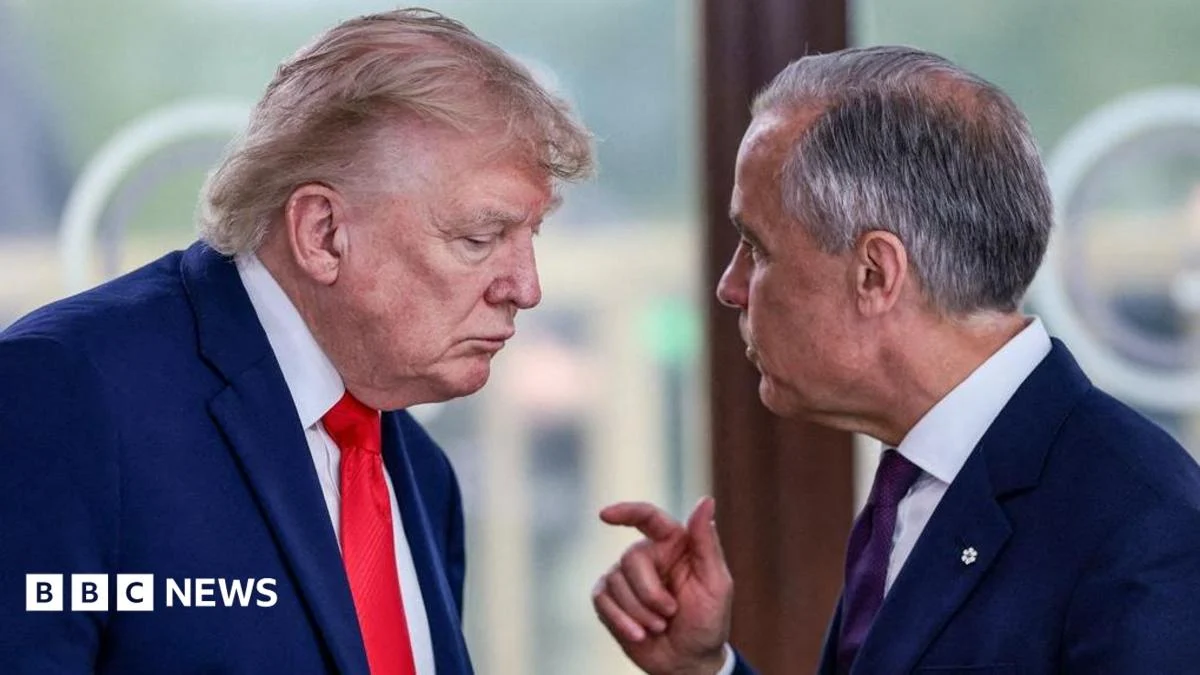
The long-standing economic partnership between the United States and Canada has plunged into uncharted territory, as a bitter trade war escalates with no apparent resolution in sight. Decades of free trade have been shattered, leaving Prime Minister Mark Carney facing a significant political test following his late-night decision to abruptly suspend negotiations with President Donald Trump and opt for retaliation over a deal that had seemed within reach. Carney’s bold move positions him as one of the first world leaders to walk away from the negotiating table with the White House, a decision whose repercussions will be scrutinized globally.
Both nations have pointed fingers for the eleventh-hour collapse of the tentative agreement. Prime Minister Carney articulated Canada’s position, stating that the U.S. “asked too much” and “offered too little.” This decision by Carney will undoubtedly challenge the appetite among Canadians for enduring economic hardship as Ottawa pushes for greater concessions from its southern neighbor. Having rejected what he characterized as President Trump’s high-pressure tactics and opting to counter new U.S. duties with retaliatory measures, Carney’s immediate task is to persuade Canadians that the short-term economic pain is a necessary sacrifice for standing firm against the Trump administration, with the ultimate goal of securing a more favorable long-term agreement.
In his remarks on Saturday, Prime Minister Carney asserted, "We take this step confident this is in the best interest of Canada," while simultaneously accusing the U.S. of a "power play" through its last-minute demands. When directly asked if the U.S. and Canada were engaged in a trade war, Carney’s response was unequivocal: "You’re at war when you’re attacked – we got attacked." Switching to French, he emphasized that the spiraling trade dispute "wasn’t our choice," and added a resolute declaration of national strength: "Canada is strong, Canada is ready, Canada is united."
The economic fallout from this trade dispute is undeniable and will be felt on both sides of the border. Businesses are bracing for increased pressure from U.S. tariffs, which will be met with Canadian counter-tariffs. Canada’s economic reliance on its southern neighbor is substantial; approximately 70% of Canadian exports are destined for the U.S. market. Conversely, Canada serves as the top trading partner for numerous U.S. states, with Michigan, Kentucky, Indiana, and Ohio being particularly vulnerable to the repercussions of this trade friction.
Prime Minister Carney’s premiership began with a call for an “elbows up” approach – an ice hockey metaphor signifying an aggressive stance – vowing to vigorously defend Canada’s interests against a Trump administration intent on prioritizing its “America First” economic agenda. Public opinion in Canada appears to support this assertive posture. A recent Abacus Data survey indicated that roughly 36% of Canadians would endorse retaliatory measures against U.S. tariffs, while a Leger poll revealed that a significant 56% of Canadians desire the federal government to adopt a hard line and cease making further concessions.
The public’s frustration with U.S. tariffs has already manifested in tangible actions. A growing number of Canadians have opted to boycott travel to the United States, resulting in an estimated loss of C$3.3 billion (approximately $2.35 billion USD or £1.75 billion GBP) in travel revenue for the U.S. last year. Furthermore, the decision by most Canadian provinces to remove U.S. alcoholic beverages from their store shelves has dealt a significant blow to that sector. U.S. government trade data highlights a dramatic 78% year-over-year decrease in U.S. wine exports to Canada, representing a loss of $357 million in export value. The Distilled Spirits Council of the United States has reported similarly dire figures, indicating that provincial bans have led to a more than 70% drop in exports of American spirits. These actions quickly became a source of considerable frustration for the Trump administration.
Prime Minister Carney now faces the considerable challenge of convincing provincial leaders, particularly those whose economies have been less directly impacted by the U.S. trade dispute thus far, that walking away from the negotiating table is a risk worth taking. He engaged in extensive briefings with provincial premiers on Saturday to apprise them of the current situation. For now, a united front appears to be holding. British Columbia Premier David Eby expressed his commitment to the "national project we are on," while Ontario Premier Doug Ford declared, "We didn’t start this fight but I can assure you, we’re going to win this fight."
For a full week leading up to the breakdown, it had seemed that a resolution between Washington and Ottawa was within grasp. The precise circumstances that led to the collapse of the talks in the final hours remain somewhat opaque, but accounts suggest it was a nail-biting conclusion. Prime Minister Carney characterized the last-minute U.S. proposals as "unfair, uneconomic, and called into question the reliability of any deal." He further elaborated on Saturday that these terms included contentious demands related to the automotive sector and imposed "unacceptable" restrictions on Canada’s ability to enter into trade agreements with other nations. In a particularly sharp critique of the Trump administration, he remarked, "We recognize sometimes its signature is written in pencil."
Conversely, U.S. Trade Representative Jamieson Greer pointed to "new demands and walk backs of other commitments by Canada." In a statement released on Friday, the Distilled Spirits Council of the United States suggested that "Canadian provinces’ continued refusal to return U.S. spirits products to store shelves has led to this outcome." Reports from Canadian media also indicated that U.S. Commerce Secretary Howard Lutnick expressed dissatisfaction with the tentative deal. The BBC has reached out to his office for comment.
As details of an interim trade agreement with the U.S. began to emerge throughout the preceding week, concerns were voiced by some provincial leaders, industry groups, and political opponents who felt the Prime Minister had not delivered on the robust defense of Canadian interests he had promised. However, Carney has denied that these criticisms influenced his decision-making. Premier Doug Ford of Ontario, typically one of the most vocal Canadian politicians regarding U.S. tariffs, had remained notably silent on the tentative deal all week. Yet, in a letter addressed to Carney, Ford articulated concerns that an agreement reached under duress would "embolden the United States to seek concession after concession." Ontario, with its substantial manufacturing and automotive sectors, has been among the regions most severely affected by this ongoing trade dispute.
Conservative opposition leader Pierre Poilievre echoed these sentiments, arguing that any agreement that included "one-sided" tariffs on Canadian industries would constitute "a bad deal." On Saturday, he publicly supported Carney’s decision to temporarily withdraw from negotiations, stating, "Canada cannot accept one-sided tariffs that will de-industrialize our country."
The collapse of this proposed agreement casts a significant shadow over the future of ongoing trade discussions, including the critical review of the existing U.S.-Mexico-Canada free trade pact (USMCA). Prime Minister Carney, and by extension Canada, now find themselves in a period of uncertainty, awaiting President Trump’s response to this dramatic turn of events. The coming days and weeks will reveal the true extent of the damage to the bilateral economic relationship and the potential for further escalation or de-escalation. The stakes are exceptionally high, impacting not only the immediate economic well-being of millions but also the long-term trajectory of North American trade and diplomacy. The resolve shown by Prime Minister Carney and the apparent unity among Canadian provinces will be put to the ultimate test as they navigate this unprecedented period of trade conflict with their most important economic partner.
