
 By admin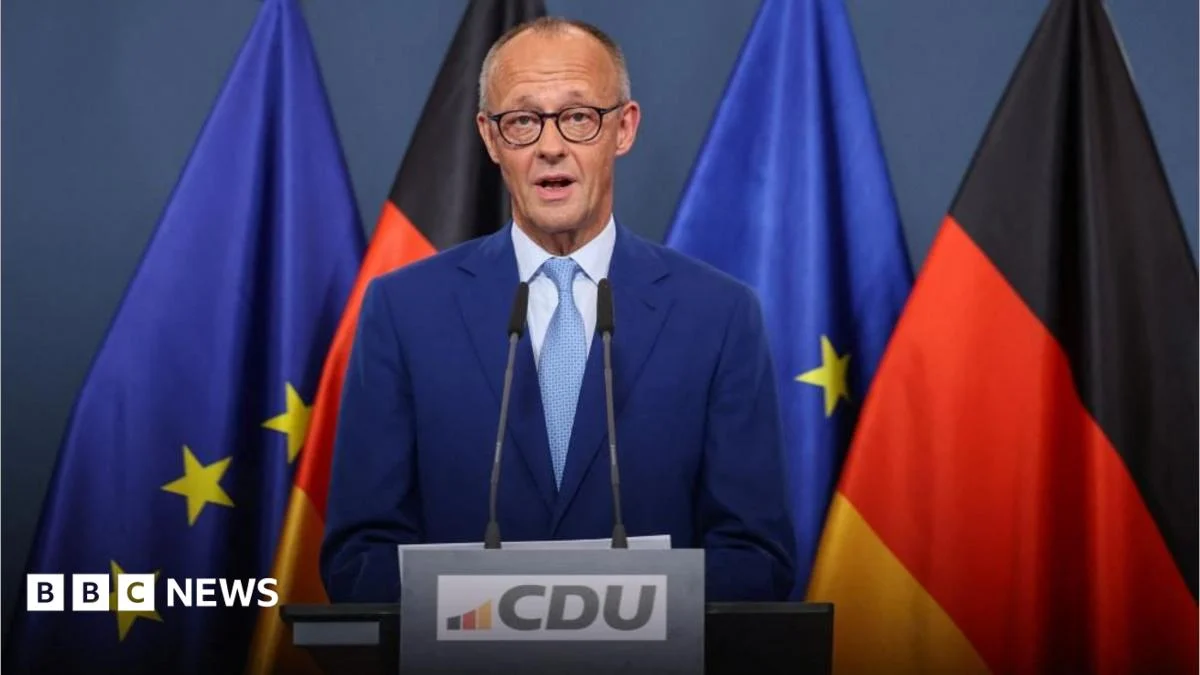
In a defiant stand against mounting political pressure, German Chancellor Friedrich Merz has firmly declared his intention to continue leading the nation, even as exit polls from two crucial local elections on Sunday painted a grim picture of significant defeats for his centre-right Christian Democratic Union (CDU) party. The results from the states of Mecklenburg-Vorpommern and Berlin have sent shockwaves through the political establishment, amplifying concerns about Merz’s leadership and the CDU’s dwindling electoral appeal.
In the northeastern state of Mecklenburg-Vorpommern, the CDU was projected to barely secure a seat in the state parliament, a stark indicator of its weakened standing. Compounding this distress, the far-right Alternative for Germany (AfD) was on track to emerge as the largest party, a development Merz himself unequivocally labelled "a disaster" for his party. This outcome in Mecklenburg-Vorpommern, a region that has seen a steady rise in AfD support in recent years, underscores a broader national trend where the far-right is increasingly capturing the disaffected electorate. The AfD’s success is often attributed to its populist appeal, tapping into public anxieties surrounding immigration, economic uncertainty, and a perceived disconnect between the political elite and ordinary citizens.
The electoral woes for the CDU did not end there. In the capital city of Berlin, the ruling CDU was also expected to be outpolled by Die Linke (The Left), another significant blow to Merz’s authority. This defeat in Berlin, a traditionally more liberal bastion, suggests that the CDU’s attempts to broaden its appeal may be faltering, potentially alienating its core base while failing to attract new voters. The performance of Die Linke, often seen as a more radical left-wing party, indicates a segment of the electorate seeking alternatives that are critical of the current government’s policies.
The cumulative impact of these electoral setbacks places Chancellor Merz under intense and escalating pressure. His approval ratings have been languishing, and the whispers of a potential "chancellor swap" – a mid-term replacement – have begun to circulate with alarming regularity. Such speculation, even if unsubstantiated at this juncture, signals a deep-seated unease within the CDU and among its coalition partners about the party’s direction and its ability to secure future electoral victories. The mere suggestion of a leadership change highlights the precariousness of Merz’s position and the urgent need for him to demonstrate a clear path forward.
These regional contests occurred just a fortnight after the CDU suffered another substantial electoral humiliation. In the state of Saxony-Anhalt, the party witnessed its vote share halved, a consequence of a major victory for the AfD. This prior defeat already served as a stark warning, indicating that the challenges facing the CDU were not isolated incidents but rather part of a more profound and systemic crisis of confidence. The repeated electoral failures suggest a disconnect between the CDU’s current platform and the evolving concerns of the German populace.
In the face of this mounting adversity, Chancellor Merz adopted an unyielding stance. Echoing his pronouncements after the Saxony-Anhalt defeat, he asserted on Sunday evening that he would press ahead with his coalition government’s ambitious agenda of economic, tax, and welfare reforms. "The reforms have to come," he insisted, his voice firm. "I am taking on this responsibility, because I want to move our country forward." Merz framed these reforms not merely as policy initiatives but as a crucial bulwark against what he described as "the authoritarian poison that, with the fascination of authoritarianism, is penetrating ever deeper into our society." This rhetoric suggests a deep-seated concern about the rise of populist and potentially anti-democratic forces in Germany and a belief that bold policy action is the most effective antidote.
The atmosphere at the CDU’s election night gathering in Berlin was palpably subdued, devoid of the usual cheers and celebrations. As the projected results flickered across screens, a palpable sense of unease permeated the room. This was not a moment of triumph, but rather a stark acknowledgment of a party grappling with significant internal and external challenges. The lack of jubilation underscored the gravity of the situation and the recognition that the CDU is indeed in trouble.
Friedrich Merz’s immediate declaration that he is "going nowhere" signals a determination to fight for his position. Having long aspired to the chancellorship, a role he assumed only 16 months ago, it is unlikely that he will relinquish it easily, especially without a protracted struggle. His political career has been marked by ambition and a strategic ascent within the CDU hierarchy, and he is evidently prepared to weather this storm.
The polls for both states closed at 18:00 local time (17:00 BST), with final results expected to be announced in the ensuing hours. Early projections provided by public broadcaster ZDF offered a detailed breakdown of the electoral landscape. In Mecklenburg-Vorpommern, the AfD was projected to secure a commanding 38% of the vote share, followed closely by the centre-left Social Democratic Party (SPD) at 36%. The CDU’s projected share in this state was significantly lower, barely managing to secure a parliamentary presence.
However, the AfD’s potential victory in Mecklenburg-Vorpommern is unlikely to translate into governing power. The established democratic parties have consistently maintained a united front against forming coalitions with the AfD, citing its extremist tendencies and its challenge to democratic norms. This refusal to engage in coalition talks effectively marginalizes the AfD from the levers of power, even when it achieves significant electoral success. This dynamic creates a peculiar situation where the AfD can gain popular support but struggles to translate that into tangible political influence at the state level.
In Berlin, the projections painted a similarly discouraging picture for the CDU. According to ZDF, the party was estimated to have garnered 20% of the vote share, falling behind Die Linke, which was projected to achieve nearly 26%. This suggests that in the capital, the left-leaning parties collectively hold a stronger position, further diminishing the CDU’s prospects of leading the government.
The intense speculation about Merz’s potential replacement had been a recurring theme in German political discourse in the weeks leading up to Sunday’s elections. The expectation was that an improved electoral performance would bolster his position. The opposite has now occurred, intensifying the pressure for a change in leadership. Earlier in the week, a significant show of support for Merz came from the leaders of eight German states, who publicly backed him. This gesture, while intended to shore up his authority, also implicitly acknowledged the vulnerability of his position.
The argument often put forward by Merz’s supporters is that many of the nation’s current challenges are inherited from previous administrations, a common tactic to deflect blame. However, Merz himself has become a deeply unpopular figure, a factor that cannot be easily dismissed. His perceived policy shifts, particularly his tack to the right on issues such as immigration, have been a subject of considerable debate. While this strategy may have been intended to win back voters who have gravitated towards the AfD, it appears to have alienated potential supporters further to the left without significantly eroding the AfD’s core base. This balancing act, attempting to appeal to different segments of the electorate, has proven to be a difficult and ultimately unsuccessful endeavor.
The former corporate lawyer, known for his pragmatic and often combative style, now faces the daunting task of navigating a political landscape that appears increasingly hostile to his leadership. The coming days and weeks will undoubtedly be critical in determining whether Merz can weather this storm and regain the confidence of his party and the electorate, or whether the pressure will ultimately force a change at the helm of the German government. His vow to continue with his reform agenda, however, signals a determination to leave his mark on German policy, regardless of the immediate political fallout. The effectiveness and reception of these reforms will be crucial in shaping the future political trajectory of both the CDU and Germany itself. The deep societal divisions and the rising appeal of populist alternatives present a formidable challenge, and the success of Merz’s proposed solutions remains to be seen in the complex and ever-shifting German political arena.
